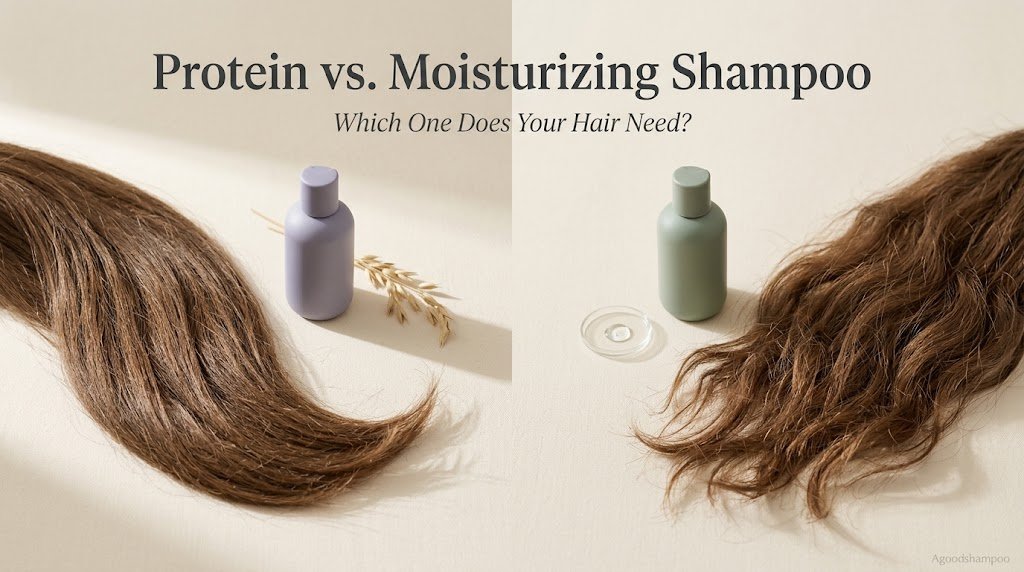
 A shampoo promising stronger hair and another promising softer, more moisturized hair can look equally appealing when your ends feel rough and break easily. But the two formulas may address different aspects of the problem.
Protein shampoo is generally designed to provide strengthening-related conditioning benefits, while moisturizing shampoo focuses on softness, lubrication, and manageability. Neither category is automatically better, and some shampoos contain both protein-derived ingredients and moisturizing or conditioning agents.
If your hair is heavily bleached, chemically treated, or prone to breakage, a protein-containing formula may be worth considering. If it mainly feels rough, tangled, or difficult to comb, a conditioning-focused moisturizing shampoo may be the more useful starting point.
The important thing is to understand what each formula can realistically do, rather than assume your hair has a measurable protein or moisture deficiency.
Protein vs. Moisturizing Shampoo at a Glance
Although the names suggest two distinct treatments, there is considerable overlap between these shampoo categories.
| Feature | Protein Shampoo | Moisturizing Shampoo |
|---|---|---|
| Primary focus | Strengthening-related conditioning and hair-fiber protection | Softness, lubrication, and easier manageability |
| Common ingredients | Hydrolyzed keratin, hydrolyzed wheat or soy protein, peptides | Glycerin, panthenol, silicones, conditioning polymers, oils |
| Often marketed for | Damaged, bleached, chemically treated hair | Dry, rough, frizzy, tangled hair |
| Can improve hair feel? | Yes, depending on formulation | Yes, depending on formulation |
| Can reduce grooming friction? | Some formulas can | Some formulas can |
| Permanently repairs damaged hair? | No | No |
| Suitable for frequent use? | Depends on the complete product and hair response | Depends on the complete product and hair response |
A protein shampoo may contain glycerin, silicones, and oils. A moisturizing shampoo may contain hydrolyzed proteins.
That overlap matters because the name on the bottle tells you less about performance than the formulation itself.
What Protein Shampoo Actually Does
Hair is primarily made of keratin, a structural protein that helps give each strand its physical characteristics.
Bleaching, chemical straightening, repeated coloring, heat, and mechanical stress can alter hair-fiber properties. Damaged strands may become rougher, weaker, more porous, or more vulnerable to breakage during brushing and styling.
Protein-focused shampoos attempt to improve some of these characteristics through cosmetic conditioning.
How Hydrolyzed Proteins Work
Many protein shampoos use hydrolyzed proteins. These are proteins broken into smaller fragments, including peptides of different sizes.
Common ingredient names include:
- Hydrolyzed Keratin
- Hydrolyzed Wheat Protein
- Hydrolyzed Soy Protein
- Hydrolyzed Silk
Depending on molecular characteristics and the surrounding formulation, some protein-derived ingredients may deposit on the hair surface, interact with damaged areas, or penetrate portions of the hair fiber.
Research published in the International Journal of Cosmetic Science in 2024 examined a silicone-free shampoo formulated with combinations of hydrolyzed proteins. The researchers observed improvements in certain measured conditioning properties, including reduced friction, compared with a tested reference formulation.
That is useful evidence that some protein-containing shampoos can affect hair properties. It does not establish that every protein shampoo performs equally well.
Can Protein Shampoo Repair Damaged Hair?
Protein-based cosmetic formulations can sometimes improve measurable hair properties and reduce friction-related damage. However, this should not be confused with completely rebuilding a severely damaged strand.
Hair outside the scalp is not living tissue capable of biological self-repair.
A protein-containing product may temporarily improve the way damaged hair feels and behaves. It cannot reverse every chemical change caused by bleaching or restore broken hair to its original condition.
For very fragile hair, reducing harsh handling and using appropriate conditioning products may be just as important as including protein in the routine.
What Moisturizing Shampoo Actually Does
Moisturizing shampoo is generally designed to cleanse while helping dry-feeling hair become softer, smoother, and easier to handle.
But the word moisturizing deserves some clarification.
Hair contains water, yet a shampoo’s ability to improve softness is not necessarily the same as increasing the amount of water retained within the strand.
Many moisturizing formulas improve the sensory feel of hair through lubrication, surface conditioning, and reduced friction.
Ingredients That Improve Softness and Manageability
Common moisturizing-shampoo ingredients include:
Glycerin: A humectant that interacts with water. Its effect depends on the formulation and surrounding environment.
Panthenol: A conditioning ingredient used in products intended to improve hair feel and manageability.
Dimethicone and other silicones: Can improve lubrication, reduce friction, and make hair feel smoother.
Argan oil and other oils: May contribute to lubrication and conditioning, depending on their concentration and formulation.
Conditioning polymers: Can reduce static, improve combing, and help hair feel less rough.
None of these ingredients automatically makes a shampoo suitable for every hair type.
A rich formula may feel comfortable on coarse, damaged lengths but leave fine hair appearing flat or weighed down.
Why Moisturizing Shampoo May Not Be Enough
A moisturizing shampoo can improve how dry-feeling hair behaves without solving the underlying reason for the dryness.
For example, severely bleached hair may have structural damage that ordinary conditioning cannot reverse.
Similarly, roughness caused by mechanical wear, excessive heat, or an unsuitable washing routine may require changes beyond replacing one shampoo.
For persistent tangling or dryness, a separate conditioner or leave-in product may provide more useful lubrication than expecting a rinse-off shampoo to do everything.
Which One Makes More Sense for Your Hair?
Instead of relying on a single home test, consider your hair’s chemical history, current texture, and response to products.
Bleached or Chemically Treated Hair
Bleaching and other chemical processes can make strands more susceptible to physical damage.
A well-formulated protein-containing shampoo may be a reasonable option, particularly when the hair feels fragile or breaks during grooming.
However, bleached hair commonly needs conditioning as well. A product marketed around protein but lacking adequate softness and slip may not provide the complete care routine your hair needs.
Consider a strengthening-focused cleanser together with a suitable conditioner that reduces tangling and friction.
Rough, Tangled, or Dry-Feeling Hair
When the main problem is roughness or difficulty combing, a moisturizing or conditioning-focused shampoo is often the more logical first choice.
Look for a formula that cleans adequately without making the lengths feel excessively stripped.
A conditioner applied after shampooing may provide the most noticeable improvement in slip.
If your hair feels soft while wet but rough again after drying, evaluate the complete conditioning and styling routine rather than assume it needs more protein.
Fine Hair That Becomes Flat Easily
Fine hair can benefit from conditioning, but overly rich products may leave it looking heavy.
A lightweight shampoo with appropriate cleansing and modest conditioning may suit this situation better than either an intensely moisturizing or heavily marketed strengthening product.
Protein ingredients alone do not guarantee additional volume, and oils do not necessarily make a formula too heavy. Concentration and formulation matter.
Curly or Coily Hair
Curly and coily hair may be more vulnerable to tangling and friction during handling, particularly when it is dry or damaged.
Conditioning, careful detangling, and reducing mechanical stress are important.
A moisturizing shampoo can be useful when softness is the main concern. A protein-containing option may also be appropriate for chemically treated or fragile hair.
There is no universal rule requiring curly hair to alternate protein and moisture on a fixed schedule.
Hair That Feels Stiff After Using Protein Products
Some people notice stiffness, roughness, or an undesirable coated feeling after using certain protein-focused products.
This is sometimes called protein overload, but the term is not a standardized clinical diagnosis.
An uncomfortable result could involve the total formula, product deposits, inadequate conditioning, or other factors. It does not prove that the hair contains too much protein.
If a product consistently leaves your hair unpleasantly stiff, reduce or stop its use and reassess your routine.
Why Ingredient Labels Matter More Than Product Names
Two shampoos marketed for different purposes can share several important ingredients.
Consider Redken Extreme Shampoo and Redken All Soft Shampoo as formulation examples.
Redken Extreme is marketed for damaged hair and uses strengthening-related ingredients, including protein-derived components.
Redken All Soft is marketed for dry, brittle hair and emphasizes conditioning and softness. However, manufacturer ingredient information also identifies soy protein and other conditioning components within the All Soft formulation.
This illustrates why a moisturizing shampoo should not automatically be described as protein-free.
Likewise, both types may contain sulfate surfactants, silicones, and other common shampoo ingredients.
What to Look for on the Bottle
When comparing formulas, examine the following:
- Cleansing agents: Does the product appear intended for your scalp type and washing needs?
- Protein ingredients: Are hydrolyzed proteins or peptides included?
- Conditioning agents: Does the formula contain silicones, conditioning polymers, oils, or other slip-enhancing ingredients?
- Usage instructions: Is the shampoo intended for ordinary washing or part of a specific treatment system?
- Actual hair response: Does your hair become easier to detangle and style without feeling coated or rough?
Ingredient order provides limited information about relative amounts, but it does not reveal exact concentrations or prove the final product’s performance.
Commercial formulations can also vary by country and change over time. Always check the ingredient list on the bottle available in your market.
When evaluating value, compare the price per unit, product quantity, amount needed per wash, and actual performance rather than paying more solely for a protein or moisture claim.
Can You Use Both Types of Shampoo?
Yes. There is generally no need to choose one category permanently.
You might use a conditioning-focused shampoo for ordinary washes and occasionally use a different protein-containing formula if it provides a noticeable benefit.
Alternatively, one balanced shampoo may already contain enough of both ingredient groups for your needs.
There is no scientifically established universal schedule requiring everyone to alternate protein and moisturizing shampoo every few washes.
The more useful question is whether a change improves softness, tangling, manageability, and breakage during routine handling.
Avoid switching several products simultaneously if you are trying to identify what makes a difference.
Remember that rinse-off shampoos have limited contact with hair compared with many conditioners and treatment products. A well-chosen conditioner or leave-in product may have a greater influence on everyday manageability.
What Shampoo Cannot Repair
Neither protein nor moisturizing shampoo can permanently restore every form of hair damage.
A visibly split end cannot be permanently fused back into an undamaged hair fiber by ordinary shampooing. Conditioning ingredients may temporarily improve its appearance, but trimming remains the dependable way to remove an existing split.
Likewise, shampoo cannot reverse major breakage caused by excessive chemical processing.
It is also important to distinguish hair breakage from hair shedding.
Breakage occurs when hair fibers snap along their length. Shedding involves whole hairs leaving the follicle, often with a small club-shaped root at one end.
Protein shampoos are not established treatments for medical hair loss, and persistent excessive shedding warrants a different assessment.
Choose a Formula for the Problem You Actually Have
If your hair is rough, tangled, and difficult to manage, start with a shampoo and conditioner combination that emphasizes comfortable cleansing and effective conditioning.
If it is chemically damaged and prone to breaking, a well-formulated protein-containing product may offer useful cosmetic benefits, but it should not replace adequate lubrication and gentle handling.
For hair with both problems, you may not need two shampoos at all. A balanced formula containing protein-derived and conditioning ingredients could be suitable.
Choose based on the complete formula, your hair’s history, and its response after washing—not the assumption that protein and moisture must compete.

Carolina Herrera writes about color-treated, damaged, and chemically processed hair. She focuses on understanding breakage, choosing suitable shampoos, and making sense of repair claims. Her goal is to help readers care for their hair with realistic expectations and informed product choices.