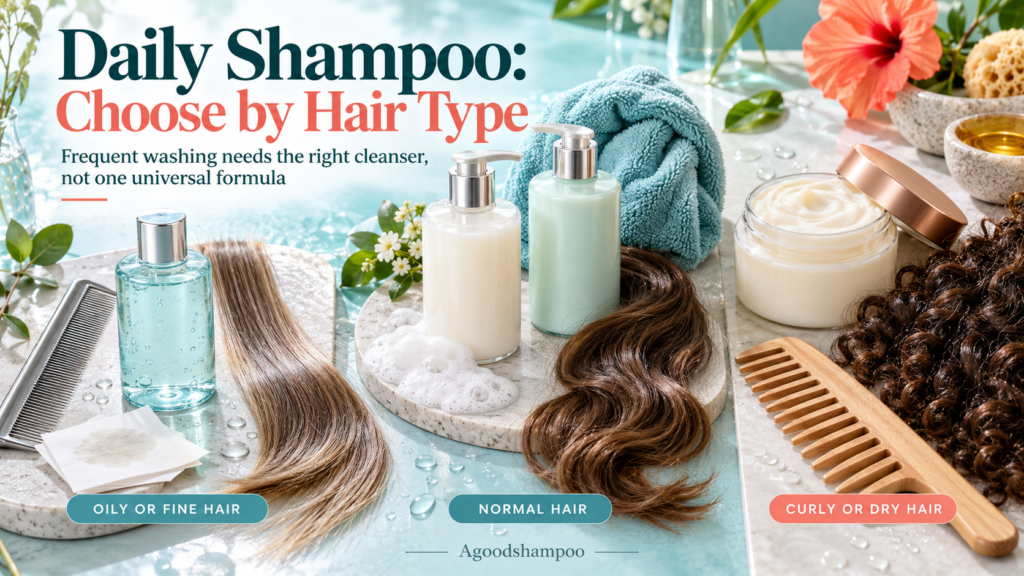
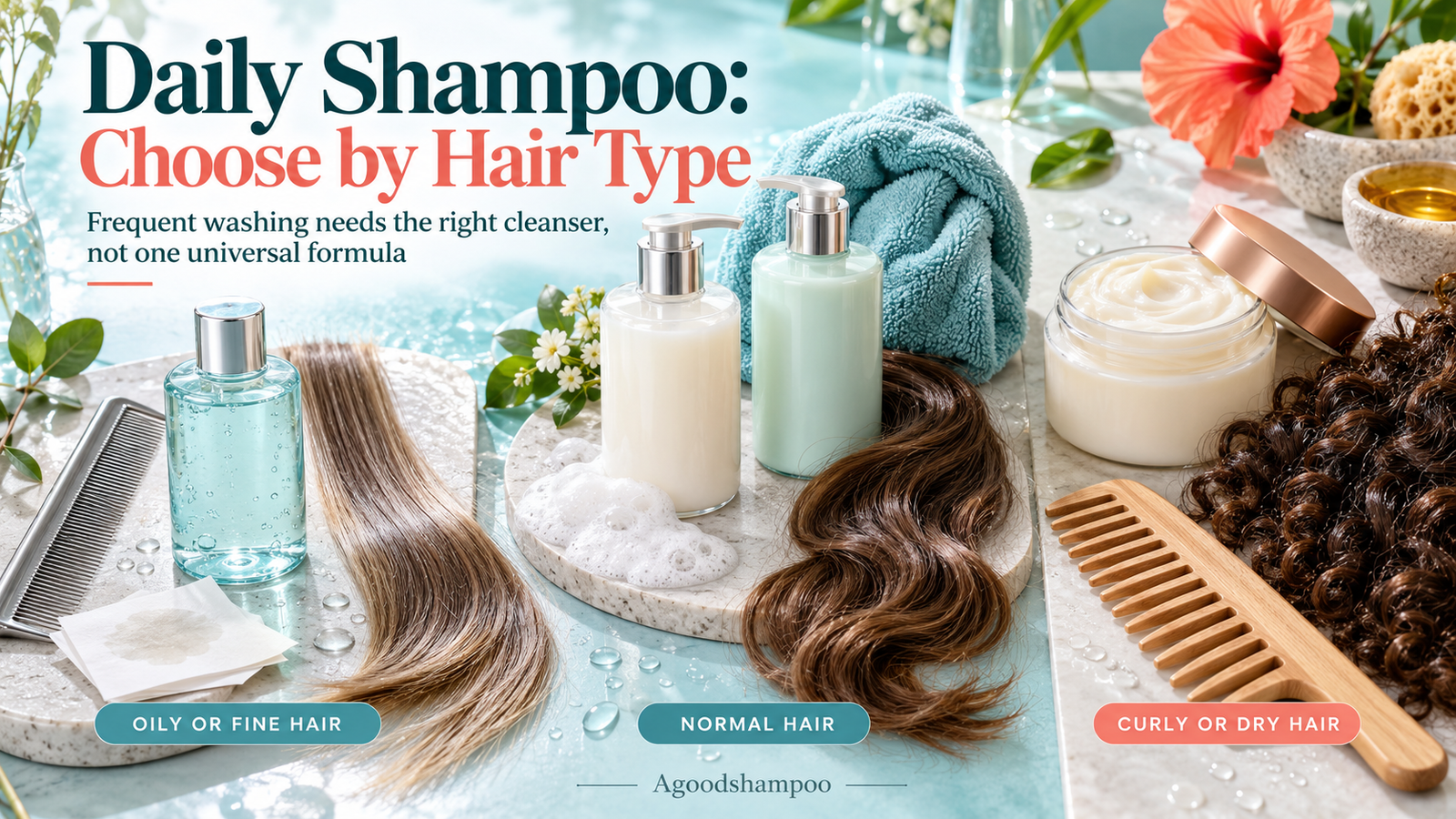
 If you wash your hair every day, the best shampoo is usually one that cleans your scalp effectively without repeatedly leaving your hair rough, tangled, tight-feeling or overly dry. But there isn’t one universal daily shampoo that works equally well for everyone.
Someone with fine hair and an oily scalp may comfortably shampoo every day. A person with dry, tightly curled, bleached or chemically processed hair may find that the same routine makes the lengths increasingly brittle.
That means the better question isn’t simply, which shampoo is good for daily hair wash? It is: how much cleansing does your scalp need, and how much can your hair comfortably tolerate at that frequency?
A mild or hydrating shampoo is often a sensible starting point for frequent washing. Still, words such as gentle, sulfate-free and daily use on a label don’t tell you everything. The whole formula, your scalp oiliness, hair texture, chemical treatments, styling habits and use of conditioner all matter.
Do You Actually Need to Shampoo Every Day?
Daily shampooing isn’t automatically bad for your hair.
It also isn’t necessary for everyone.
Cleveland Clinic dermatologist Dr. Shilpi Khetarpal advises that washing frequency should depend on hair texture and scalp oiliness. Fine hair may need cleansing every one or two days, while coarse or thick hair can usually go longer. People bothered by a greasy scalp may choose to wash daily.
That distinction matters because scalp and hair don’t always want exactly the same thing. Your scalp may become oily quickly while your ends remain dry. If you respond by aggressively shampooing the entire hair length every morning, the roots may feel clean while the ends become progressively rougher.
The more useful approach is to cleanse according to the scalp while protecting the lengths.
If you want a deeper look at the frequency question, AGoodShampoo’s guide to shampooing and conditioning hair every day explains how daily care can differ according to hair type.
Daily washing may suit oily or fine hair
Fine, straight hair often shows scalp oil sooner because sebum can move along straighter strands relatively easily. Hair can therefore look flat or greasy even when the scalp is healthy.
If that describes your hair, daily or near-daily washing can be reasonable when the shampoo leaves your scalp comfortable and the hair manageable.
Exercise, hot weather, helmets, occupational dust and frequent styling-product use can also increase how often you feel the need to cleanse.
One study published in Skin Appendage Disorders in 2021 compared different shampoo frequencies in Asian populations without specific scalp disease. In its observational portion, participants reported the greatest overall satisfaction around five to six washes per week. In a controlled part of the research, daily washing performed better than washing once weekly on the measured scalp and hair endpoints.
That finding doesn’t prove everybody should wash daily. Two authors were Procter & Gamble employees, and Procter & Gamble paid the full study cost. The population studied also limits how confidently the results can be applied to every hair texture.
A 2026 cross-sectional study involving 4,796 participants in Saudi Arabia also reported an association between more frequent shampooing and better reported hair and scalp condition. Because it was observational, it shows an association rather than proving that increasing shampoo frequency causes healthier hair.
The useful lesson is simpler: frequent washing itself should not automatically be treated as harmful.
Dry, curly, coily or processed hair usually needs more caution
Curly and coily hair often becomes dry more easily because natural scalp oil doesn’t move down bends and coils as readily as it does along straighter hair.
Bleaching, permanent coloring, relaxing, heat damage and other chemical processing can also make hair more vulnerable to roughness and breakage.
In those situations, the question isn’t only whether a shampoo says daily use. Repeated exposure to cleansing, water, friction, drying and styling can make an already fragile hair shaft harder to manage.
You may therefore need one or more of these adjustments:
- Shampoo less often.
- Concentrate shampoo mainly around the scalp.
- Choose a more conditioning formula.
- Use conditioner consistently on the lengths.
- Reduce heat and mechanical friction.
- Use a stronger cleansing shampoo only when buildup actually requires it.
This is why a product that’s excellent for someone’s oily roots may feel completely wrong on dry curls.
What Makes a Good Shampoo for Daily Use?
A good daily shampoo needs to remove enough oil, sweat and product residue without creating more problems than it solves.
You don’t need to memorize an ingredient dictionary. A few formulation principles are enough to make a better decision.
Cleansing strength matters more than the word daily
Shampoo cleans primarily through surfactants. These ingredients help water lift oil and other material away from the scalp and hair.
Some cleansing systems are stronger than others, but judging a shampoo by one ingredient alone is unreliable.
A shampoo containing sulfates isn’t automatically harsh.
A sulfate-free shampoo isn’t automatically gentle.
Formulators can combine several surfactants, conditioning ingredients, polymers, silicones, humectants and other components to change the way the finished shampoo behaves.
What matters for a daily user is the result after repeated washes.
Your shampoo may be too cleansing for you if your hair consistently feels:
- Rough or straw-like
- Difficult to detangle
- More frizzy after every wash
- Dry through the mid-lengths and ends
- Uncomfortably squeaky
- Tight or irritated at the scalp
On the other hand, a formula may be too rich or insufficiently cleansing if your roots quickly feel coated, limp or greasy even after proper rinsing.
A good mild shampoo shouldn’t leave the scalp uncomfortable
People searching for a good mild shampoo for daily use are often looking for something that feels less stripping.
That’s reasonable, especially if frequent washing is necessary because of oil, work, exercise or climate.
But mild doesn’t mean a shampoo should leave obvious buildup behind. You still need enough cleansing to remove the material accumulating on your scalp.
One current example is CeraVe Gentle Hydrating Shampoo. CeraVe describes it as suitable for daily use and says it is intended for all hair types and curl patterns, including color-treated hair. Its current ingredient list includes several cleansing agents as well as conditioning ingredients such as amodimethicone and polyquaternium-10. The brand also states that the shampoo is sulfate-free and fragrance-free.
That’s a useful example of formulation balance, not proof that CeraVe is automatically the best shampoo for every reader.
Your scalp’s response matters more than the marketing category.
Match Your Daily Shampoo to Your Hair and Scalp
Instead of searching for one best daily shampoo, start with your scalp and hair combination.
| Hair or scalp situation | What usually makes sense | What to watch for |
|---|---|---|
| Fine hair + oily scalp | Lightweight shampoo with effective cleansing | Heavy conditioning that flattens roots |
| Normal hair + comfortable scalp | Balanced shampoo based on how often you wash | Unnecessary over-cleansing |
| Dry hair | Gentler cleansing plus regular conditioner | Roughness, tangling and dry ends |
| Curly or coily hair | Moisture-supportive shampoo used according to need | Daily washing simply out of habit |
| Bleached or color-treated hair | Gentler cleansing and strong conditioning support | Repeated dryness and increased breakage |
| Sensitive scalp | Simple formula that your scalp tolerates | Fragrance or other personal triggers |
| Heavy product buildup | Normal shampoo most washes; deeper cleansing when needed | Using clarifying shampoo every day |
| Very oily scalp | More frequent cleansing may be appropriate | Overcompensating with heavy oils afterward |
This also explains why changing shampoos isn’t necessarily a problem. If your needs change, your shampoo can change too.
You don’t need to rotate products merely because you’ve used the same bottle for months. AGoodShampoo’s guide to whether you need to switch shampoos explains why hair doesn’t biologically become immune to shampoo and when changing products actually makes sense.
Good Daily Shampoo Options for Different Needs
Product recommendations become more useful when they’re tied to a specific reason for choosing them.
For frequent washing when you want a hydrating formula
CeraVe Gentle Hydrating Shampoo is one current option worth considering for someone looking for a gentle shampoo for frequent use.
CeraVe specifically describes the formula as safe for daily use and suitable for all hair types, curl patterns and color-treated hair. The current US formula is fragrance-free and includes niacinamide, ceramides, sodium hyaluronate and several conditioning agents alongside its cleansing system.
The important limitation is that these features don’t guarantee that every dry, oily, sensitive or curly scalp will prefer it. Personal tolerance still matters.
For oily roots that need reliable cleansing
If your scalp becomes visibly oily by the end of each day, you may not need the richest shampoo available.
A lighter cleansing formula may make more sense, particularly on fine hair.
Look at how your hair behaves several hours after washing rather than judging only the slippery feeling in the shower. If a supposedly moisturizing shampoo leaves your roots flat and oily quickly, the formula may simply be too conditioning for your needs.
Conversely, if a stronger shampoo keeps the roots fresh but makes the lengths rough, apply most of the shampoo to the scalp and rely on conditioner for the lengths rather than repeatedly scrubbing shampoo into the ends.
For dry or curly hair
People with dry, curly or coily hair should be especially careful with the assumption that a product marketed for daily use should actually be used every day.
The right shampoo may still be gentle. Your frequency, however, may need to be lower.
Cleveland Clinic notes that curly and coarse hair generally requires less frequent washing than fine hair because these textures tend to be drier.
For these hair types, conditioning is often as important as the shampoo choice itself.
For color-treated or chemically processed hair
Frequent cleansing can be more noticeable on hair already affected by bleaching, coloring or smoothing treatments.
If you wash every day, watch for changes in:
- Elasticity
- Detangling
- End dryness
- Frizz
- Breakage
- Color fading
A shampoo that felt fine before bleaching may feel too strong afterward.
People specifically searching for shampoo after Brazilian smoothing treatments have another issue to consider: treatment instructions and maintenance requirements may differ from ordinary daily hair care. AGoodShampoo has a separate guide to choosing shampoo for Brazilian-treated hair because that question shouldn’t be reduced to the same advice used for untreated hair.
Is Suave Shampoo Good for Daily Use?
Some Suave shampoos are specifically positioned for frequent use, but the answer depends on the exact product.
For example, Suave currently states that Suave Men Citrus Rush 3-in-1 Shampoo, Conditioner & Body Wash is designed for daily use. Its present ingredient list includes sodium C12-13 pareth sulfate and/or sodium laureth sulfate as cleansing agents, cocamidopropyl betaine, dimethiconol, glycerin, fragrance and several conditioning or formulation ingredients.
That makes it a convenient option for someone who wants one product for hair and body.
But convenience and optimal hair conditioning aren’t always the same thing.
Someone with short, relatively resilient hair may be perfectly satisfied with a 3-in-1. Someone with long, bleached, dry, curly or tangle-prone hair may prefer a separate shampoo and conditioner because that allows much more control over cleansing and conditioning.
If you’re considering the men’s line specifically, AGoodShampoo also has a closer look at Suave men’s shampoo.
Is a Men’s Shampoo and Body Wash Good for Daily Use?
A combined men’s shampoo and body wash can be practical, particularly for short hair, gym bags, travel or simple routines.
Suave’s current men’s range includes several 3-in-1 options, including Citrus Rush and a Hydrating Hair + Body + Face Wash. The brand’s instructions for those products allow them to be used as multi-purpose cleansers, and Citrus Rush is specifically described as suitable for daily use.
Still, the category has a tradeoff.
Skin and hair don’t necessarily need exactly the same cleansing and conditioning balance. A multi-purpose product is designed around convenience. A dedicated shampoo and separate conditioner give you more ability to adapt the routine to dry ends, curls, chemical damage or heavy conditioning needs.
So the best men’s shampoo and body wash isn’t automatically the best choice for a man with longer, bleached or very dry hair.
Gender matters less here than hair length, scalp oiliness, texture, chemical processing and styling habits.
Do You Need a Daily Shampoo and Conditioner?
For many people who wash daily, using conditioner regularly makes sense.
Shampoo removes oil and residue. Conditioner helps reduce friction, improve detangling and make the hair shaft feel smoother and easier to handle.
The need becomes more noticeable as hair gets longer.
Scalp oil begins at the roots. The oldest part of long hair is at the ends, where natural lubrication is harder to maintain and accumulated physical or chemical damage is often greatest.
That means someone can have an oily scalp and still benefit from conditioner on the mid-lengths and ends.
If conditioner makes fine hair flat, you don’t necessarily need to stop using it. Try:
- Applying less
- Keeping it away from the roots
- Concentrating it on the ends
- Choosing a lighter conditioner
- Rinsing thoroughly
If you wash every day because your scalp is oily, coating the scalp with a heavy conditioner after every shampoo may defeat the purpose of choosing a lightweight cleansing routine.
How to Tell If Your Daily Shampoo Is Working
You don’t need a laboratory test to tell whether an everyday routine suits you.
Look for consistency.
A daily shampoo is probably doing its job if your scalp becomes clean without routinely feeling tight or irritated and your hair remains manageable after repeated washing.
The signs that you may need to adjust the routine are usually practical.
Your shampoo may be too strong if:
- Hair becomes rougher with repeated washes.
- The ends tangle badly.
- Your scalp feels tight or uncomfortable.
- Curly hair becomes noticeably harder to manage.
- Processed hair seems increasingly brittle.
It may not cleanse enough if:
- Roots remain greasy immediately after washing.
- Heavy styling products continue to build up.
- Hair feels coated despite proper rinsing.
- You need repeated shampoo applications every wash.
Your wash frequency may be the real issue if:
- A shampoo feels good when used three times weekly but drying when used every day.
- Your scalp becomes greasy before the hair itself needs another full wash.
- Your hair is dry while your scalp is oily.
This is where routine matters more than the bottle.
Which Shampoo Makes the Most Sense for Your Daily Routine?
If you’re trying to decide which shampoo is good for daily hair wash, don’t start with the most expensive bottle or the longest ingredient list.
Start with what your scalp and hair are telling you.
For fine or oily hair, frequent washing with a well-tolerated cleanser can be perfectly reasonable. For dry, coarse, curly, bleached or chemically treated hair, the better answer may be a gentler shampoo, stronger conditioning support, fewer wash days, or a combination of all three.
A product such as CeraVe Gentle Hydrating Shampoo is one verifiable example specifically marketed for daily use. Suave also sells products such as Citrus Rush 3-in-1 that the manufacturer says can be used every day. Neither becomes the universal best choice just because the label permits daily washing.
The strongest daily shampoo routine is the one that gets your scalp clean while leaving your hair comfortable enough to repeat the process at the frequency you actually need.
If a shampoo consistently achieves that, there’s little reason to replace it just because another bottle says gentle, natural, sulfate-free or daily use.

Marlena Stell makes everyday hair care easier to understand. From choosing a shampoo to managing common hair concerns, she breaks down confusing product claims and practical routines into straightforward advice that helps readers find what works for their needs.