 An eight-year-old girl doesn’t usually need an adult shampoo promising intensive repair, keratin treatments, or extra shine. She needs a cleanser that removes dirt and scalp oil without leaving her hair dry, tangled, or uncomfortable. The American Academy of Dermatology (AAD) recommends shampooing once or twice a week for many children aged 8–11, although oily hair, swimming, sports, and dry curls call for different routines.
For most eight-year-old girls with a healthy scalp, a gentle children’s shampoo is a sensible first choice. Johnson’s Baby Shampoo is one option for straightforward cleansing, while Johnson’s Kids Shiny & Soft and Kids Curl Defining target different hair textures. The best choice depends more on her scalp and hair than on the name printed on the bottle.
Which Shampoo Is Good for an 8-Year-Old Girl?
A shampoo designed for children can make hair washing easier, especially when a child is still learning to rinse thoroughly and avoid getting shampoo in her eyes.
But children’s hair isn’t all the same. A girl with fine, straight hair may need little conditioning, while another with long, curly hair may struggle with knots and dryness after every wash.
That distinction matters more than buying the most expensive product.
For a child with a healthy scalp, look for a shampoo that:
Cleans effectively without leaving the scalp tight or uncomfortable.
Rinses easily and is suitable for her age.
Doesn’t make her hair unusually rough or difficult to comb.
Contains fewer potential fragrance triggers if she has a history of sensitivity.
Works with a conditioner when her hair is dry, curly, or easily tangled.
The word gentle is useful, but it isn’t a guarantee. Even shampoos marketed for babies or sensitive skin can contain fragrances or other ingredients that bother some children.
Gentle Shampoos Worth Considering for Children
Several established children’s shampoo ranges offer reasonable starting points. Their differences are mainly about cleansing, conditioning, and hair manageability, rather than medical benefits.
| Shampoo | Suitable starting point | What to consider |
|---|---|---|
| Johnson’s Baby Shampoo | Normal hair, simple cleansing | May not provide enough detangling for long or dry hair |
| Johnson’s Kids Shiny & Soft | Hair that tangles easily | Contains fragrance; softness claims are manufacturer claims |
| Johnson’s Kids Curl Defining | Curly or wavy hair | Contains shea butter and conditioning ingredients |
| Johnson’s Active Kids Soft & Smooth (India) | Long hair needing easier combing | Market-specific formula; check the local packaging |
These are product examples, not a ranking based on independent head-to-head testing.
Johnson’s Baby Shampoo for Simple Cleansing
Johnson’s Baby Shampoo
Johnson’s describes its original Baby Shampoo as a gentle cleanser developed for babies’ hair and scalp. It is designed to lather and rinse easily.
For an eight-year-old with normal hair and no troublesome tangles, this may be sufficient. A separate conditioner can be added when needed rather than choosing a heavier shampoo automatically.
A baby shampoo is not necessarily superior to every children’s or adult shampoo. The final choice should depend on how the exact formula performs on the child’s hair and scalp.
Johnson’s Kids Shiny & Soft for Tangled Hair
Johnson’s Kids Shiny & Soft Shampoo
The brand describes this shampoo as a smoothing formula containing argan oil and silk proteins. Its official US product page lists a tear-minimizing formulation and says it contains no added sulfates, parabens, or dyes.
It may be worth considering for straight or wavy hair that becomes difficult to manage after washing. However, the presence of argan oil and proteins does not independently prove that the finished shampoo prevents breakage.
Johnson’s Kids Curl Defining for Curly Hair
Johnson’s Kids Curl Defining Shampoo
This shampoo uses a cleansing system that includes cocamidopropyl betaine, decyl glucoside, and sodium cocoyl isethionate. Its published US ingredient list also includes glycerin, conditioning polymers, shea butter, and fragrance.
Those ingredients help explain why it is positioned for cleansing and managing curly hair. It is not evidence that the shampoo changes natural curl structure or repairs damaged hair permanently.
Girls with dry curls may still need a conditioner or detangling product after shampooing.
Children’s Shampoo Options Available in India
Parents buying shampoo in India should pay attention to local formulations instead of assuming a US product with a similar name contains the same ingredients.
Johnson’s India lists two relevant examples:
Johnson’s Active Kids Shiny Drops Shampoo contains aloe and green tea extracts according to its Indian product page. The manufacturer positions it for cleansing and shinier-looking hair.
Johnson’s Active Kids Soft & Smooth Shampoo is marketed for smoother, more manageable hair. The Indian ingredient information identifies cleansing agents including sodium methyl cocoyl taurate, sodium cocoyl isethionate, cocamidopropyl betaine, and decyl glucoside.
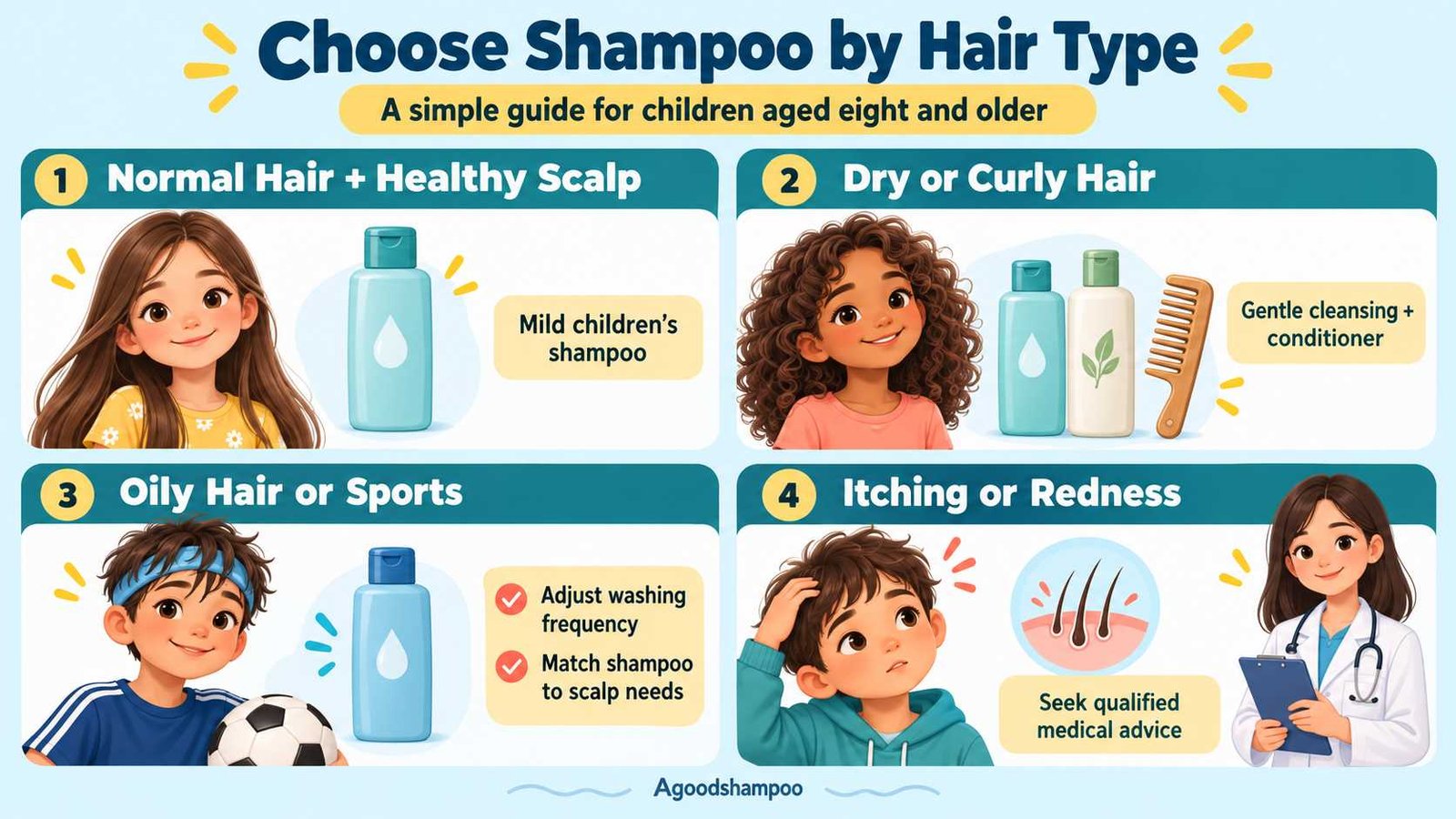
How to Choose a Shampoo for Her Hair and Scalp
The simplest way to narrow down the choices is to check how your daughter’s hair behaves between washes.
Choosing by hair type
Normal or straight hair
Start with a mild, easy-rinsing children’s shampoo.
Dry or curly hair
Choose gentle cleansing and use an appropriate conditioner.
Fine or oily hair
Prioritize effective rinsing and adjust washing frequency.
Sensitive scalp
Consider fragrance-free options and avoid known triggers.
Does Sulfate-Free Mean Safer for Children?
Not necessarily.
Sulfates such as sodium laureth sulfate are cleansing agents. Whether a shampoo feels harsh depends on its concentration, combination with other ingredients, and the complete formulation.
Similarly, sulfate-free shampoos can still contain cleansing agents that irritate some people.
For an eight-year-old, the practical question is whether the product cleans her scalp comfortably at an appropriate washing frequency.
Are Natural and Ayurvedic Shampoos Better?
A natural or Ayurvedic label does not automatically make a shampoo gentler.
Botanical extracts, essential oils, and fragrances can cause sensitivity in some children. Their natural origin does not establish safety for every scalp.
If a child has eczema, known allergies, or persistent scalp irritation, a simpler fragrance-free product may be preferable to a heavily scented herbal formula. Seek individualized medical advice when a scalp condition is present.
Can an 8-Year-Old Use Dove, Sunsilk, or Ayurvedic Shampoo?
An eight-year-old does not automatically need to avoid every adult shampoo. However, adult products may be designed around concerns such as color protection, intensive conditioning, strong cleansing, or cosmetic repair rather than straightforward childhood hair care.
Dove: Some Dove shampoos focus on smoothing, moisturizing, or treating the appearance of damaged hair. These benefits may be unnecessary for a child with healthy hair. The exact formula matters more than the brand. The site’s guide to choosing a Dove shampoo explains differences between adult product types.
Sunsilk: Many Sunsilk products are marketed for smoothness, shine, or specific adult hair concerns. A familiar brand name does not establish that a particular formula is the best starting choice for an eight-year-old.
Ayurvedic shampoo: Check the ingredient list, fragrance, essential oils, and any age recommendations instead of relying on herbal marketing.
For a child with no special scalp concerns, a suitable children’s shampoo is usually the simpler place to start. By age ten, the same reasoning applies, although hair and scalp oiliness may begin to change as puberty approaches.
How Often Should an 8-Year-Old Girl Wash Her Hair?
A child does not need daily shampooing simply because she attends school every day.
The AAD provides different washing schedules for children aged 8–12 according to their age, hair type, oiliness, and activities.
| Hair or activity pattern | Suggested starting frequency |
|---|---|
| Typical hair, ages 8–11 | 1–2 times weekly |
| Dry, curly hair | About every 7–10 days |
| Oily, straight hair | Every other day or daily if needed |
| Frequent sports or swimming | More frequent cleansing or appropriate rinsing, adjusted for hair type |
These are starting guidelines, not fixed rules. If her scalp becomes oily between washes, she may need to shampoo more frequently. If her hair is becoming dry or brittle, review the shampoo and washing schedule.
A Washing Routine That Reduces Tangling
The AAD recommends washing the scalp gently, rinsing thoroughly, and avoiding rough towel drying.
Wet her hair and scalp with comfortably warm water.
Put a small amount of shampoo in the palm and massage it gently over the scalp.
Rinse thoroughly until the shampoo is removed.
Apply conditioner when needed, especially to dry or curly lengths, following the product instructions.
Press out water with a soft towel rather than rubbing vigorously.
Detangle carefully with a wide-tooth comb, starting near the ends and working upward.
For children who are beginning to wash their own hair, supervision helps ensure they rinse properly and keep shampoo away from their eyes.
When Scalp Problems Need More Than a Gentle Shampoo
Persistent scalp itching, pain, redness, thick scaling, sores, or noticeable patches of hair loss should not be treated simply by switching between cosmetic shampoo brands.
These symptoms can have different causes, and some require specific treatment. A pediatrician or dermatologist can examine the scalp and recommend age-appropriate care.
Avoid using adult medicated dandruff shampoos, antifungal preparations, or hair-growth products on a child without checking whether they are suitable for her age and condition.
A regular shampoo can remove oil and dirt. It should not be expected to treat a scalp infection or a medical hair-loss condition.
Which Shampoo Should You Actually Buy for Your Daughter?
If your eight-year-old daughter has normal hair and a healthy scalp, Johnson’s Baby Shampoo is a reasonable first product to consider. It keeps the routine uncomplicated, and you can add conditioner if her hair needs more softness.
For long hair that tangles easily, Johnson’s Kids Shiny & Soft or a suitable local children’s smoothing shampoo may be more practical. For dry curls, choose a mild cleansing formula alongside a conditioner designed for curly hair.
There is no need to buy a premium repair shampoo or a heavily advertised herbal formula just because it promises stronger, faster-growing, or shinier hair.
Start with her hair type, check the exact product label, and observe how her scalp and hair respond over several washes. If the shampoo cleans comfortably and leaves her hair manageable, that matters more than finding a universally best brand.
Marlena Stell makes everyday hair care easier to understand. From choosing a shampoo to managing common hair concerns, she breaks down confusing product claims and practical routines into straightforward advice that helps readers find what works for their needs.