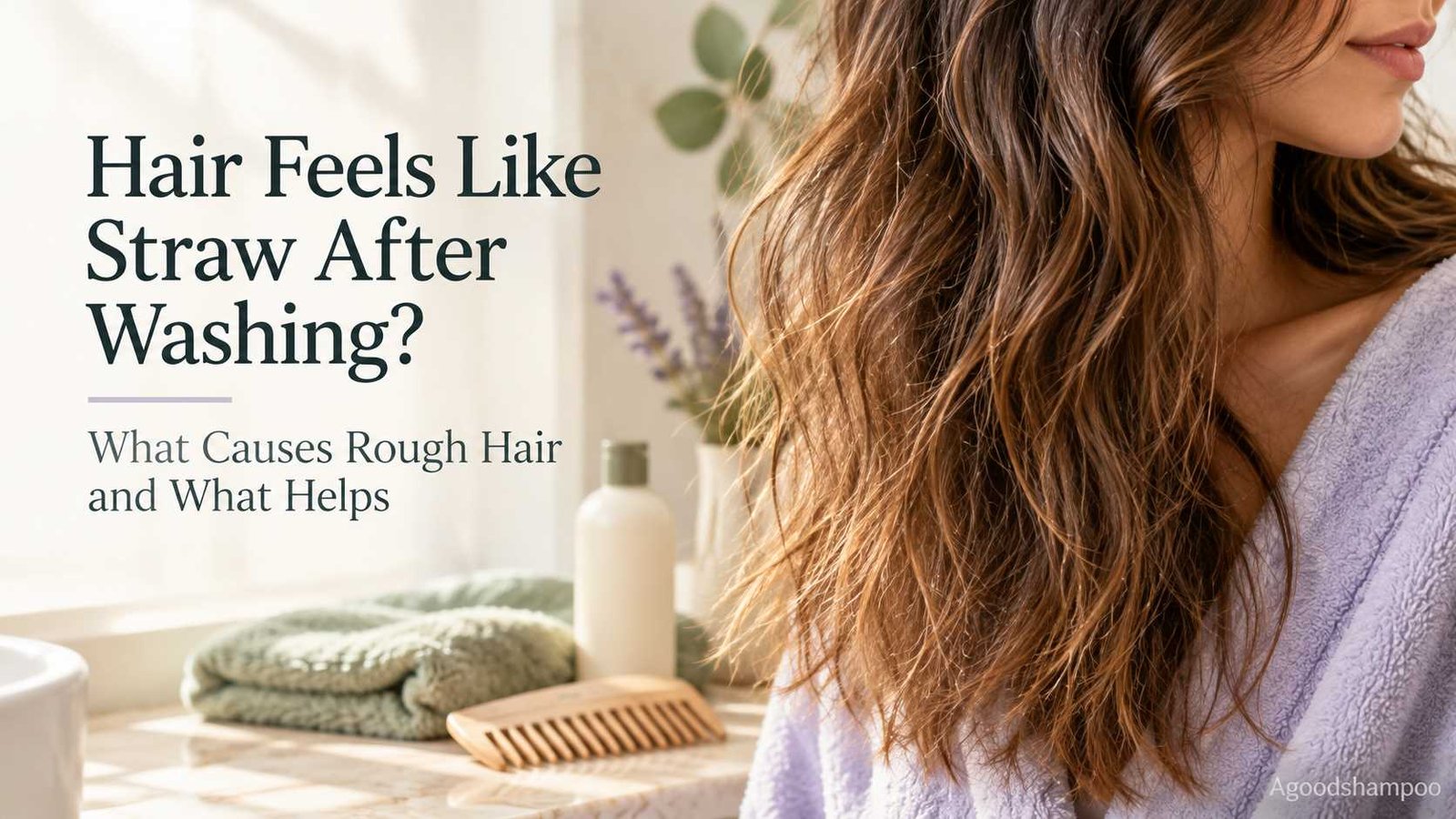
 You finish washing your hair, rinse out the conditioner, and expect your strands to feel clean and manageable. Instead, they feel stiff, coarse, or almost like dry straw. Sometimes the roughness starts while your hair is wet. Other times, it becomes obvious only after drying.
Hair can feel like straw after washing because cleansing has removed too much surface oil, conditioning is insufficient, or the hair already has damage from heat, coloring, or friction. Product residue and water quality may also contribute, but the rough feeling alone cannot identify the cause.
The useful question is not simply whether your hair is dry. It is when the roughness begins and which parts of your hair feel affected. Those details can help you choose a better next step.
Why Hair Can Feel Like Straw After Shampooing
Your shampoo may be cleansing more than your hair needs
Shampoo contains surfactants, the cleansing ingredients that help water remove oils, dirt, and product residue.
These ingredients are necessary for effective cleansing. However, a shampoo that removes more surface oil than your hair needs can leave the lengths feeling rough, particularly if your hair is naturally dry, curly, bleached, or already fragile.
Washing too frequently for your hair’s needs, shampooing the full lengths aggressively, or repeatedly using a strong clarifying formula can make the problem more noticeable.
This does not mean every sulfate-containing shampoo is harsh or every sulfate-free shampoo is gentle. The complete formula, how often you wash, and your hair’s condition matter more than a single ingredient name.
Your conditioner may not provide enough slip
Conditioner does more than make hair feel soft for a few minutes. Conditioning ingredients deposit on the hair surface, help reduce friction between strands, and make detangling easier.
If the conditioner is too light for your hair, applied unevenly, or rinsed out before it has been used according to its instructions, your lengths may remain difficult to comb.
You might notice that your roots feel comfortable while your middle lengths and ends catch against one another.
Fine hair often benefits from lighter conditioning, while thick, curly, or chemically treated hair may need richer products. The goal is smoother, more manageable hair without making it unnecessarily heavy.
Heat or chemical processing may have damaged the hair
Sometimes shampoo reveals roughness that was already present.
Bleaching, permanent coloring, chemical straightening, frequent hot tools, and repeated friction can affect the hair’s protective outer cuticle. As the surface becomes more worn, strands may tangle easily, lose smoothness, and break under tension.
Older ends are especially vulnerable because they have experienced more washing, styling, sunlight, and physical handling.
Conditioners can temporarily improve the feel of damaged hair, but they cannot completely restore severely damaged fibers to their original condition.
Residue or water conditions may contribute
Not every stiff or unpleasant hair texture is caused by over-cleansing.
Styling products, conditioning materials, and other deposits can sometimes leave hair feeling coated, heavy, or difficult to manage.
Water hardness is another possibility. Hard water contains dissolved minerals, mainly calcium and magnesium. Water chemistry can affect cleansing performance and deposits, although a rough hair texture is not proof of mineral buildup.
If your hair feels unusually coated rather than simply dry, review recent product use and any changes in water supply before reaching for another strong shampoo.
Our guide to what clarifying shampoo is good for explains when additional cleansing may be useful and why it should not be the automatic solution for every hair problem.
What the Timing and Location of Roughness Tell You
Pay attention to your hair at three points: while shampooing, after rinsing out conditioner, and once it has dried.
These observations are clues, not diagnoses.
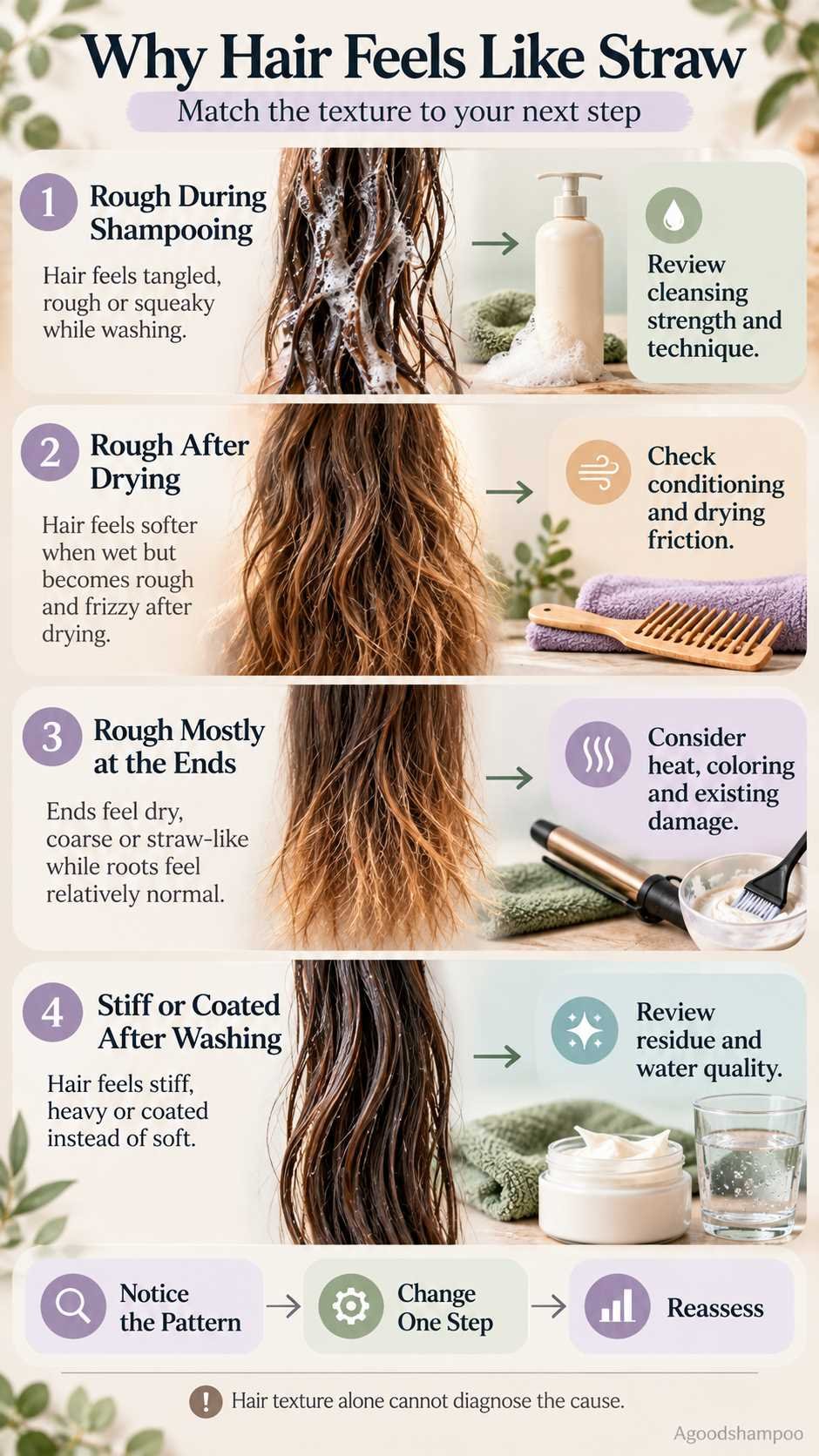
| What you notice | What to investigate first |
|---|---|
| Hair feels squeaky and tangled immediately after shampooing | Cleansing strength, washing frequency, and how shampoo is applied |
| Hair feels better with conditioner but rough again when dry | Conditioning performance, drying friction, and existing damage |
| Ends feel straw-like while roots feel normal | Older, weathered hair, heat exposure, or chemical processing |
| Hair feels stiff, coated, or heavy | Product residue, cleansing habits, and possibly water quality |
| Hair breaks easily and stays rough between washes | Accumulated hair-shaft damage rather than washing alone |
One especially useful distinction is roughness versus breakage.
Rough hair may feel coarse but remain relatively manageable after conditioning. Damaged hair may also show snapping strands, persistent tangles, visibly split ends, or sections that remain fragile even when handled gently.
Neither observation gives a complete diagnosis, but repeated breakage deserves more attention than a temporary rough feeling after one wash.
What to Change During Your Next Hair Wash
You do not need to replace your entire routine immediately. Make the most relevant adjustment first and observe whether the same problem returns.
1. Cleanse your scalp without scrubbing the lengths
Wet your hair thoroughly and apply an appropriate amount of shampoo mainly to your scalp.
Massage gently with your fingertips. When you rinse, allow the shampoo and water to travel down the hair lengths rather than rubbing them together.
The American Academy of Dermatology recommends concentrating shampoo on the scalp to cleanse without unnecessarily drying the rest of the hair.
If you regularly wash dry or curly hair, consider whether your current washing frequency matches how quickly your scalp actually becomes oily or dirty.
2. Give your lengths the conditioning they need
After shampooing, apply conditioner wherever your hair needs softness and detangling.
For fine or straight hair, this may mean concentrating on the ends. For curly, coarse, or particularly dry hair, more of the length may benefit.
Spread the conditioner evenly and follow the product’s directions before rinsing.
If your hair becomes soft only while wet, a small amount of leave-in conditioner designed for your hair type may help maintain manageability as it dries.
Choose a product intended to stay in the hair. Do not simply leave ordinary rinse-out conditioner in place unless its instructions specifically permit that use.
For broader product selection guidance, see how to choose a shampoo and conditioner for your hair.
3. Reduce friction while detangling and drying
Freshly washed hair can be vulnerable to mechanical damage, particularly when pulled or brushed aggressively.
Use your fingers or a wide-tooth comb to work gently through tangles, starting near the ends and moving upward.
For thick, curly, or tightly textured hair, detangling while conditioner is present can make the process easier. Straight hair may be better allowed to dry slightly before combing.
Instead of rubbing your hair with a towel, gently squeeze out excess water and wrap it in a soft towel or T-shirt.
Avoid repeatedly handling the hair as it dries.
4. Reduce unnecessary heat
If your hair already feels rough, high heat may make the problem more difficult to manage.
Allow some air-drying when practical. If you need a blow dryer, use a lower heat setting, keep it moving, and avoid concentrating heat on the same section.
Use an appropriate heat-protectant product when heat styling.
For hair that has recently been bleached, relaxed, or otherwise chemically treated, reducing additional heat exposure is especially sensible.
5. Reconsider clarifying only when there is a reason
If your hair feels dry, squeaky, and unusually tangled, another deep-cleansing wash may be the wrong first response.
Clarifying is more relevant when there is a credible reason to suspect accumulated product residue, such as frequent use of styling products combined with a coated or weighed-down feeling.
If you are unsure what kind of routine your hair needs, our guide to moisturizing shampoo and conditioner discusses options for different hair characteristics.
When Rough Hair Needs More Than a Routine Change
Hair that feels rough after one wash may improve with gentler cleansing and better conditioning. Persistent brittleness or breakage is different.
If your hair has been heavily bleached, repeatedly straightened, or exposed to high heat, the existing damage may not be completely reversible through cosmetic products.
Conditioners and leave-in treatments can improve the surface feel and reduce friction, but severely compromised sections may continue breaking. Trimming damaged ends can sometimes be more useful than repeatedly layering treatments over them.
Seek advice from a qualified dermatologist if you notice persistent unexplained breakage, sudden hair loss, scalp pain, marked redness, inflammation, or continuing discomfort after using a product.
These signs should not automatically be attributed to ordinary dryness or the wrong shampoo.
Likewise, if careful conditioning and reduced friction do not improve persistent unmanageable hair, a dermatologist can help assess whether there is an underlying hair or scalp concern.
Start With the Change Your Hair Actually Needs
If your hair feels like straw immediately after shampooing, start by reviewing the cleanser and how you wash. If it becomes rough only after drying, look more closely at conditioning and friction. If the ends remain brittle and break easily, existing damage may be the bigger concern.
Try the most relevant change across your next few washes rather than switching several products at once.
The goal is not to make your hair feel artificially slippery at any cost. It is to clean your scalp adequately while keeping the hair lengths comfortable, manageable, and protected from unnecessary damage.

Marlena Stell makes everyday hair care easier to understand. From choosing a shampoo to managing common hair concerns, she breaks down confusing product claims and practical routines into straightforward advice that helps readers find what works for their needs.