You wash your hair in the morning, wrap it in a towel, and get on with your day. Hours later, the ends feel almost dry, but the hair underneath is still damp. Perhaps the roots are wet even though everything else looks ready to style.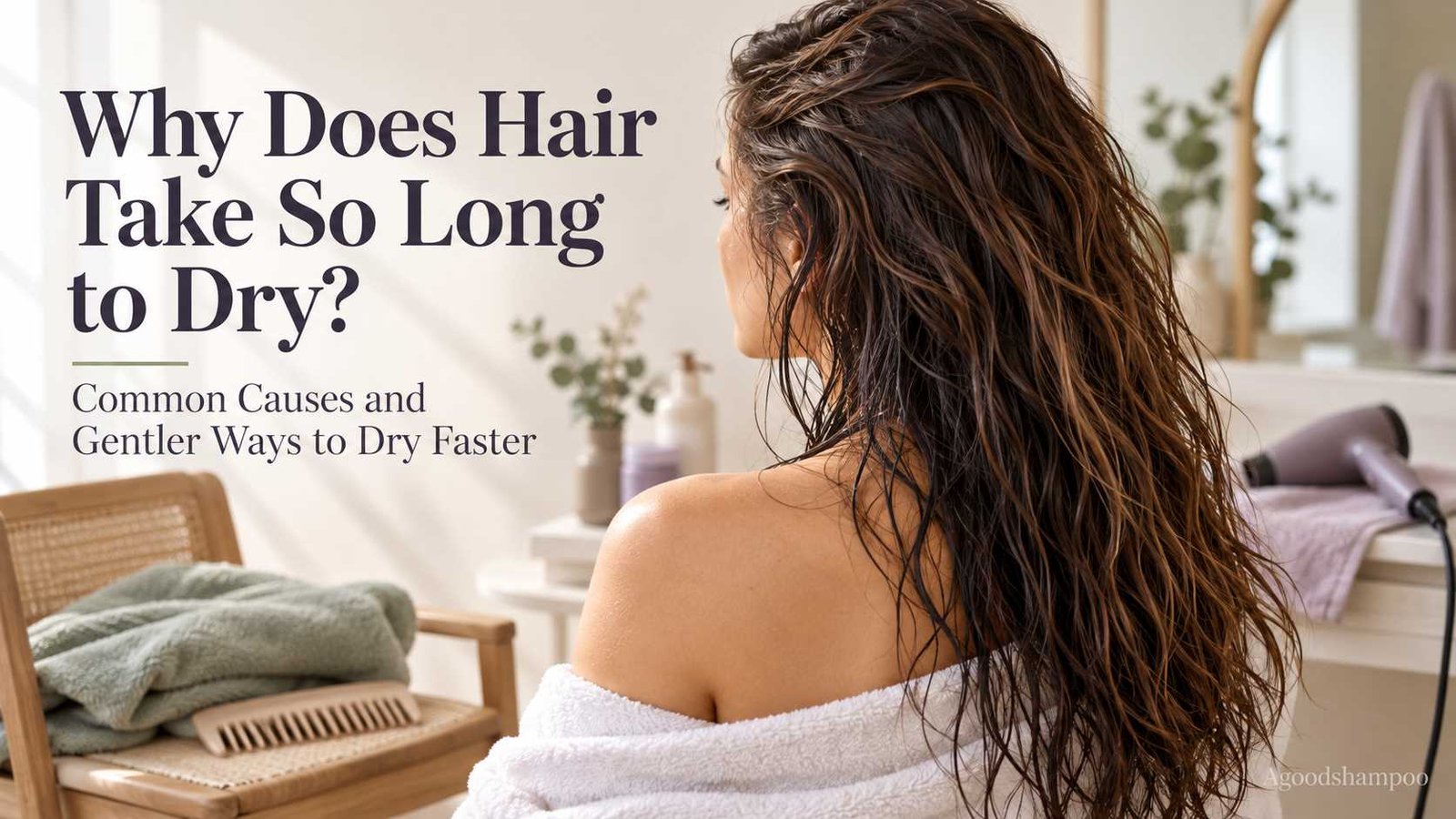
Hair can take a long time to dry because of its density, length, structure, the amount of water remaining after washing, and the surrounding humidity and airflow. Your styling products and drying technique can also make a difference.
Slow drying does not automatically mean your hair is damaged or unhealthy. The useful question is whether your hair has always dried this way or whether something has recently changed.
What Actually Makes Hair Take Longer to Dry?
Hair drying involves two processes: removing water sitting between strands and allowing moisture associated with the hair fibers to evaporate.
After washing, water remains on the hair surface, between closely packed strands, and within the fibers themselves. Some can be removed immediately with a towel. The rest must evaporate or be carried away by moving air.
Three factors particularly influence this process:
- Amount of hair: Longer or denser hair can hold more water overall.
- Air exposure: Closely packed strands may prevent air from reaching damp inner sections.
- Surrounding conditions: Humid air and limited ventilation can make evaporation slower.
Hair-fiber characteristics also influence how water enters and leaves individual strands. However, total drying time is not a reliable way to measure hair porosity or assess hair health.
Six Reasons Your Hair May Stay Wet for Hours
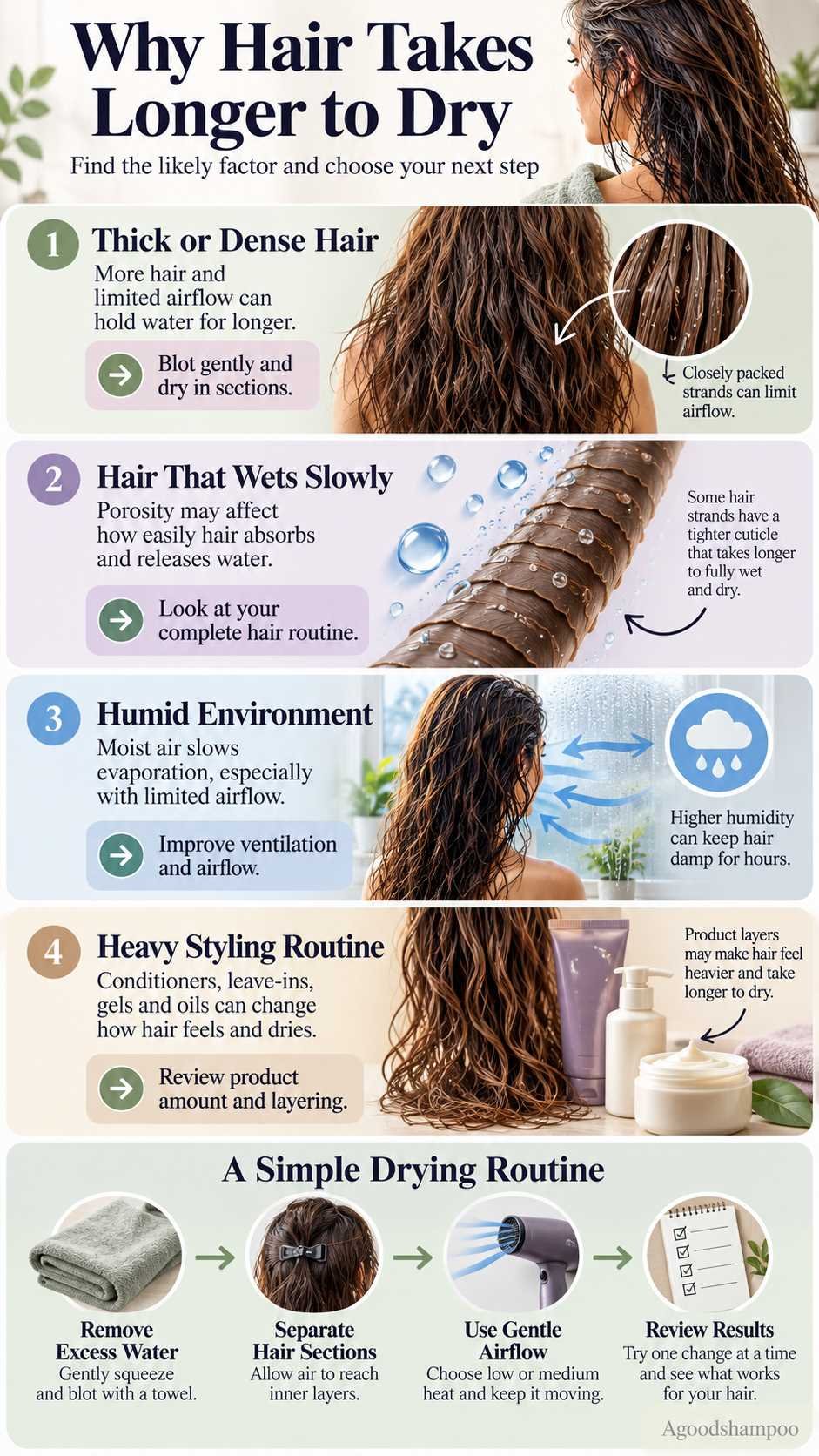
1. Your Hair Is Dense or Long
If you have a lot of hair, there is simply more material to dry.
Hair density refers to how many strands grow in a particular area of the scalp. Strand thickness describes the diameter of each individual hair. They are different characteristics.
Someone with very dense, fine hair may experience lengthy drying times because the closely packed strands restrict airflow. Long, thick hair can present a similar problem because of its greater overall mass.
You may notice that the top layers dry first while the roots and underneath sections stay damp.
What to try: Divide your hair into manageable sections after gently removing excess water. Allow air to reach the inner layers rather than leaving everything pressed together.
2. Your Hair Strands Hold Water Differently
Hair porosity describes how readily a hair fiber takes up and releases water under particular conditions. It is influenced by the fiber’s cuticle, internal structure, and treatment history.
Low-porosity hair is often associated with relatively resistant wetting, although real hair behavior is more complex than the popular high-versus-low porosity categories suggest.
If your hair takes time to become thoroughly wet in the shower and also takes hours to dry, porosity may be one factor worth considering. But that observation cannot confirm your porosity level.
Likewise, chemically damaged or more porous hair may absorb water differently without following one predictable drying pattern.
Our guide to shampoo for low-porosity hair provides related product-selection context, but no shampoo can be chosen correctly from drying time alone.
What to try: Consider how your hair responds to washing, conditioning, and styling together. Avoid using the floating-hair test as proof of porosity.
3. Curls and Closely Packed Hair Limit Airflow
Wavy, curly, and coily hair can form sections or clumps that keep neighboring strands close together.
This is not necessarily a problem. Clumping helps create curl definition, and disturbing it too aggressively can increase frizz.
However, tightly grouped sections may remain damp inside after their outer surfaces have started drying.
If you regularly apply styling gel and allow your curls to dry in defined clumps, the outer layer may feel set while the interior is still wet.
What to try: Gently remove excess water before applying styling products. If appropriate for your hairstyle, lift individual sections at the roots to improve airflow without pulling the curls apart.
4. Humidity Slows Evaporation
Have you noticed that your hair dries reasonably quickly in an air-conditioned room but stays damp for hours during humid weather?
Moist air generally reduces the rate at which additional water evaporates, particularly when there is little airflow.
A closed bathroom after a hot shower can also remain humid. Even hair that normally dries quickly may need more time under those conditions.
What to try: Move to a better-ventilated room after washing. Gentle airflow from a fan or hair dryer can help carry moisture away.
You do not need to expose your hair to intense heat simply because the weather is humid.
5. Styling Products Change How Hair Feels and Dries
Conditioners, leave-in creams, gels, oils, and other styling products can change strand separation, surface feel, and the way hair forms clumps.
A heavy styling routine may leave hair feeling wet, coated, or slow to set. However, that does not mean every silicone, oil, or conditioning ingredient prevents water from evaporating.
The actual effect depends on the complete formula, how much you apply, and how you style your hair.
If slow drying began after introducing a new leave-in or styling cream, the timing provides a useful clue.
What to try: On your next wash day, use a smaller amount of one styling product while keeping the rest of your routine unchanged.
If your hair also feels persistently waxy or coated, our guide to what clarifying shampoos are good for explains when additional cleansing may be appropriate.
Do not start frequent clarifying washes based on long drying time alone.
6. Your Drying Method Leaves Too Much Water Behind
Sometimes the main issue is not your hair type. It is how much water remains after washing.
Wrapping dripping-wet hair immediately or leaving thick sections tightly bundled can delay evaporation. Rough towel rubbing is not the solution, either, because wet hair is especially vulnerable to mechanical damage.
The American Academy of Dermatology recommends gently wrapping hair in a towel or T-shirt to absorb moisture instead of rubbing it vigorously.
What to try: Gently squeeze water from your lengths, then blot with an absorbent towel. Replace a saturated towel with a drier section when necessary, and avoid leaving wet hair compressed for an extended period.
How to Tell What’s Slowing Your Hair Down
The most useful clue is often whether your drying pattern is longstanding, newly changed, or concentrated in one area.
| What you notice | What to investigate first |
|---|---|
| Your hair has always taken hours to dry | Length, density, texture, and normal variation |
| Inner sections stay damp after the surface dries | Limited airflow between closely packed strands |
| Drying became slower after adding a new cream or gel | Product quantity, clumping, and application technique |
| Hair dries slowly mainly during humid weather | Room humidity and ventilation |
| Hair is difficult to wet and slow to dry | Hair-fiber characteristics, including possible porosity-related behavior |
| Roots remain damp while ends dry normally | Water trapped near the scalp and root-level airflow |
These clues are starting points, not diagnoses.
For example, damp roots may reflect dense hair packed close to the scalp rather than a scalp condition. Similarly, a new conditioner may change the way your hair feels without measurably changing how much water it contains.
If you suspect your shampoo and conditioner are poorly matched to your needs, see our guide to finding a shampoo and conditioner that works for your hair.
How to Dry Your Hair Faster Without Excessive Heat
You do not have to choose between leaving your hair wet for hours and blasting it with the hottest dryer setting.
A few adjustments can make the process more manageable.
- Remove excess water before stepping away from the shower. Gently squeeze the lengths rather than twisting or wringing them tightly.
- Blot instead of rubbing. Use a soft towel or cotton T-shirt to absorb surface water, working carefully through the sections that remain wettest.
- Separate dense sections. If your hairstyle allows, divide your hair so airflow can reach damp areas near the roots and underneath layers.
- Choose a ventilated space. Avoid leaving wet hair bundled in a humid bathroom for an extended period.
- Use a hair dryer thoughtfully. Choose a low or medium temperature, keep the dryer moving, and avoid concentrating hot air on one spot. A suitable heat-protectant product may be useful when heat styling.
- Review how much styling product you apply. If you use several creams or gels, reduce one product at a time and observe whether your routine becomes easier.
A laboratory study published in Annals of Dermatology in 2011 examined hair subjected to 30 drying treatments under different conditions. Higher dryer temperatures produced greater hair-surface damage. The results also suggested that a continuously moving dryer at a moderate distance could be preferable to prolonged natural drying for some measured structural changes.
This does not mean blow-drying is always healthier than air-drying. It means temperature, distance, movement, and exposure all matter.
Is Taking Several Hours to Dry a Problem?
Hair taking three or four hours to air-dry is not automatically abnormal. There is no single drying-time limit that applies to every hair type, length, hairstyle, or climate.
If your hair has always behaved this way, feels manageable, and your scalp is comfortable, you may not need to change anything.
Taking longer to dry also does not prove that your hair is better moisturized. Hair that still contains wash water is not necessarily better conditioned or healthier.
Pay more attention when your drying pattern changes substantially alongside other symptoms.
Persistent scalp itching, redness, scaling, unusual shedding, or significant breakage deserves attention independently of drying time. A dermatologist can help assess ongoing scalp or hair problems.
For most people, the question is one of comfort and convenience rather than a medical concern.
Choose the First Change That Fits Your Hair
If you have dense hair with damp underneath sections, begin with better sectioning and airflow. If humid weather is the main obstacle, change where you dry your hair. If drying became noticeably slower after adding styling products, review how much you use before replacing your shampoo.
Try one adjustment over a few comparable wash days, keeping the room conditions and other products as consistent as practical.
Your hair does not need to meet somebody else’s drying schedule. The goal is a routine that leaves it comfortably dry, manageable, and protected from unnecessary friction or excessive heat.

Marlena Stell makes everyday hair care easier to understand. From choosing a shampoo to managing common hair concerns, she breaks down confusing product claims and practical routines into straightforward advice that helps readers find what works for their needs.