 You wash your hair, rinse out the conditioner, and expect it to look fresh and full. Instead, your roots sit close to your scalp, your hairstyle lacks movement, and your hair looks flatter than it did before washing.
The frustrating part? Your hair might be perfectly clean.
Hair often looks flat after shampooing because of naturally fine strands, excess conditioning near the roots, residual oil or styling products, or the way it dries. A shampoo can remove dirt and oil without creating noticeable volume. Cleanliness and root lift are two different things.
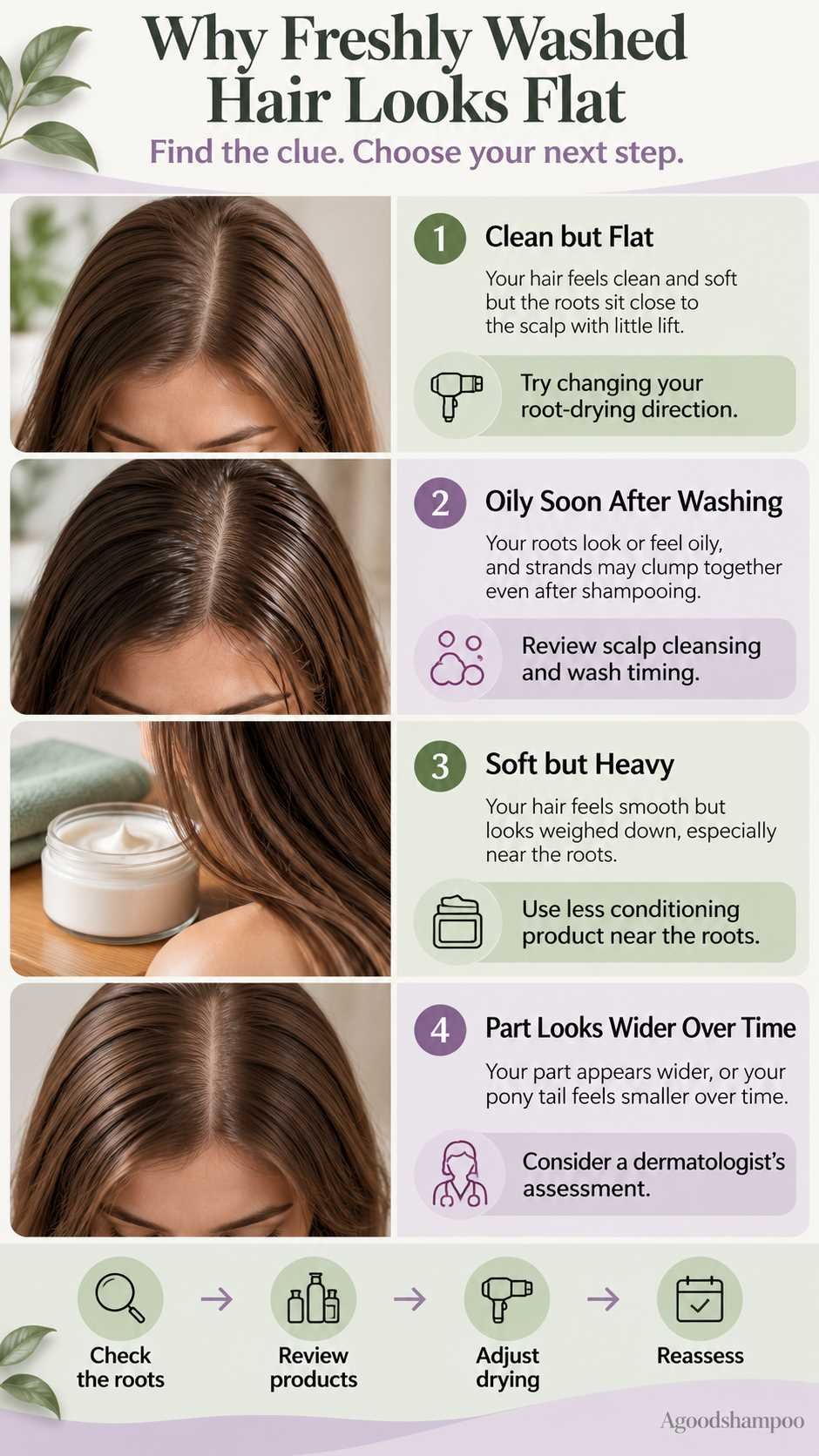
The solution depends on what your hair feels like after washing. If it is clean and soft but lies flat, changing your drying technique may help. If your roots feel oily, reviewing your cleansing routine makes more sense. And if your hair feels unusually heavy, the amount and placement of conditioner deserve attention.
Why Clean Hair Can Still Look Flat
Shampoo’s primary job is to remove excess oil, dirt, and unwanted residue. It does not automatically make individual strands thicker or force hair to stand away from the scalp.
Hair volume depends on several characteristics, including strand diameter, hair density, length, natural growth direction, and styling.
Fine hair, for example, has a smaller individual strand diameter than coarse hair. It may bend and lie closer to the head, even when it is freshly washed.
This is also why fine hair and thin hair are not interchangeable. Fine refers to the size of individual strands, while thinning generally refers to a reduction in hair density.
Someone can have plenty of fine strands and still struggle to create visible root volume.
Hair that naturally grows downward or is pulled down by its length may also appear flat without having a cleansing problem.
Six Reasons Your Hair Loses Volume After Shampooing
1. Your Hair Is Naturally Fine
Fine strands often have less resistance to bending than thicker strands. This can make them easier to smooth down and more challenging to style with lasting lift.
You might notice that your hair looks reasonably full while damp but settles close to your scalp as it dries.
If the roots feel clean and comfortable, your shampoo may not be the problem.
A lightweight styling mousse or carefully directed blow-drying may improve the appearance of volume. A volumizing shampoo can also be worth trying, although results depend on the complete formulation and your hair characteristics.
For product-selection guidance, see our article on choosing shampoo for fine hair.
2. Your Conditioner Is Weighing Down the Roots
Conditioner helps reduce friction, improve manageability, and make strands feel smoother.
However, a rich conditioner applied generously near the scalp can leave some fine hair looking limp.
The American Academy of Dermatology recommends applying conditioner to the ends of fine or straight hair. Dry, curly, or textured hair may benefit from conditioning more of its length.
Try using a smaller amount of conditioner and concentrating it on the areas that actually need softness and detangling.
Do not stop conditioning altogether simply because your hair looks flat. Unconditioned lengths may become tangled, rough, or harder to manage.
3. Your Scalp Is Not Being Cleansed Thoroughly
If your roots feel oily or clumped shortly after shampooing, they may still have excess sebum or styling residue.
Sebum is the natural oil produced by glands in the skin. It helps lubricate hair and skin, but excess oil can make strands group together and appear less full.
This can happen when shampoo is spread mainly over the hair lengths instead of being worked gently across the scalp.
Make sure the shampoo reaches the roots, especially around the crown and back of the head. Massage with your fingertips, then rinse thoroughly.
People with fine, oily hair may also need a different washing frequency from those with dry or tightly curled hair.
Our guide to shampoo for fine, oily hair explores how cleansing needs and hair texture affect product selection.
4. Styling Products Are Making the Hair Feel Heavy
Leave-in conditioners, creams, oils, waxes, and styling serums can improve hair’s appearance and manageability. But layering several products may reduce movement, particularly in fine hair.
A common mistake is applying a smoothing cream, followed by an oil, followed by another leave-in product without considering how much conditioning the hair needs.
The problem is not necessarily a specific ingredient.
Silicones, for example, are used in many cosmetic formulations to improve smoothness, lubrication, and manageability. Their effects depend on the silicone type, product formulation, application amount, and cleansing routine.
If your hair feels coated or unusually heavy, simplify your routine before assuming that an ingredient must be avoided.
Occasional clarifying may help with removable styling residue, but stronger cleansing is not automatically necessary after every wash.
You can learn more in our guide to clarifying shampoo and buildup.
5. Your Drying Technique Is Flattening Your Roots
Hair can dry in a shape that provides very little lift.
For example, repeatedly brushing damp hair downward and allowing the roots to dry against the scalp may produce a smooth result with limited volume.
If your scalp feels clean and your hair does not seem heavy, test a different drying method.
Allow the hair to dry partially, then gently direct the roots upward or opposite their usual growth direction while using a blow-dryer on low or medium heat.
A lightweight root-lifting product may provide additional temporary support.
Avoid excessive brushing, high heat, or strong tension. These can damage hair, especially when it is already fragile.
6. Your Hair Length or Parting Makes It Look Flatter
Sometimes the hairstyle itself contributes to the appearance of flatness.
Longer hair may pull downward under its own weight. A defined part can also make the hair around the crown look flatter because strands consistently lie in the same direction.
Try shifting your part slightly or styling the crown in a different direction.
A haircut with an appropriate shape may also create the appearance of more fullness, depending on your hair density, texture, and preferred style.
These changes affect appearance, not the biological thickness or number of hair strands.
What Your Flat Hair Is Telling You
You do not need to replace every hair product at once. Start by noticing what your roots look and feel like.
| What you notice | What it may suggest | What to try first |
|---|---|---|
| Clean, soft hair with flat roots | Natural strand characteristics or drying direction | Change how the roots dry |
| Oily roots shortly after washing | Excess oil or insufficient cleansing | Review scalp washing |
| Very smooth but heavy hair | Too much conditioning product | Apply less near the roots |
| Clumped strands and a coated feeling | Possible styling-product residue | Simplify products and assess cleansing |
| Good volume initially, then flatness | Product weight, oil, or insufficient styling hold | Adjust the styling routine |
| A progressively wider part | Possible change in hair density | Arrange a dermatology assessment |
These observations are clues rather than reliable diagnostic tests.
The timing also matters. Hair that looks flat immediately after drying may benefit more from styling changes. Hair that becomes oily and limp later may require a different cleansing schedule.
How to Wash and Dry Hair for Better Root Lift
A few controlled adjustments can help you identify what makes the biggest difference.
Step 1: Choose shampoo for your scalp and hair needs.
If your scalp becomes oily quickly, choose a shampoo that removes oil effectively without leaving your hair uncomfortably dry. If your scalp is dry or sensitive, prioritize a suitable gentle formula.
Volumizing shampoos may improve cosmetic fullness, but the label alone cannot guarantee results.
Step 2: Cleanse the scalp rather than scrubbing the entire hair length.
Gently massage shampoo through the roots with your fingertips. Let the lather rinse through the lengths without aggressively rubbing them together.
Step 3: Rinse thoroughly.
Ensure that shampoo and loose residue are washed away, particularly around the crown and underneath thicker sections of hair.
Step 4: Condition according to your hair type.
For fine, straight hair, start with conditioner on the ends. If your hair is dry, curly, or damaged, use the conditioning coverage needed to keep it manageable.
Step 5: Remove excess water gently.
Use a soft towel or T-shirt to absorb moisture instead of rubbing vigorously. Detangle carefully using a method suitable for your hair texture.
Step 6: Create lift while drying.
When appropriate for your hair type, allow partial air-drying before gently lifting the roots with a brush or your fingers while using low or medium blow-dryer heat.
Use heat protection when recommended for the styling tool and product.
Step 7: Keep styling products light at the roots.
Start with a small amount of mousse or another lightweight styling product, then adjust based on the results.
If your hair is also dry, preserve sufficient conditioning on the lengths rather than sacrificing hair comfort for volume.
For more product guidance, our fine-hair shampoo and conditioner guide covers options intended for hair that becomes weighed down easily.
When Flat Hair May Be More Than a Styling Problem
Naturally flat hair is not the same as hair loss.
However, if your hair has become noticeably flatter over time because your part is widening, your ponytail feels smaller, or you are experiencing unusual shedding, a change in hair density may be involved.
Hair thinning can have several causes, including inherited patterns, hormonal changes, nutritional problems, certain medications, and medical conditions.
Shampoo may improve cosmetic fullness, but it cannot reliably correct these underlying causes.
Consider consulting a dermatologist if you notice progressive thinning, sudden significant shedding, patchy hair loss, or scalp redness, pain, or persistent irritation.
Start With the Change Your Hair Actually Needs
If your hair feels clean but looks flat, begin with drying direction and lightweight styling. If the roots feel oily, assess how thoroughly and how often you wash. If the hair feels unusually heavy, reduce product layering or change where you apply conditioner.
Try changing one part of your routine at a time over several wash days.
The goal is not to make your hair feel as stripped-clean as possible. It is to find the balance between a comfortable scalp, manageable lengths, and the amount of volume your hair can realistically maintain.

Marlena Stell makes everyday hair care easier to understand. From choosing a shampoo to managing common hair concerns, she breaks down confusing product claims and practical routines into straightforward advice that helps readers find what works for their needs.