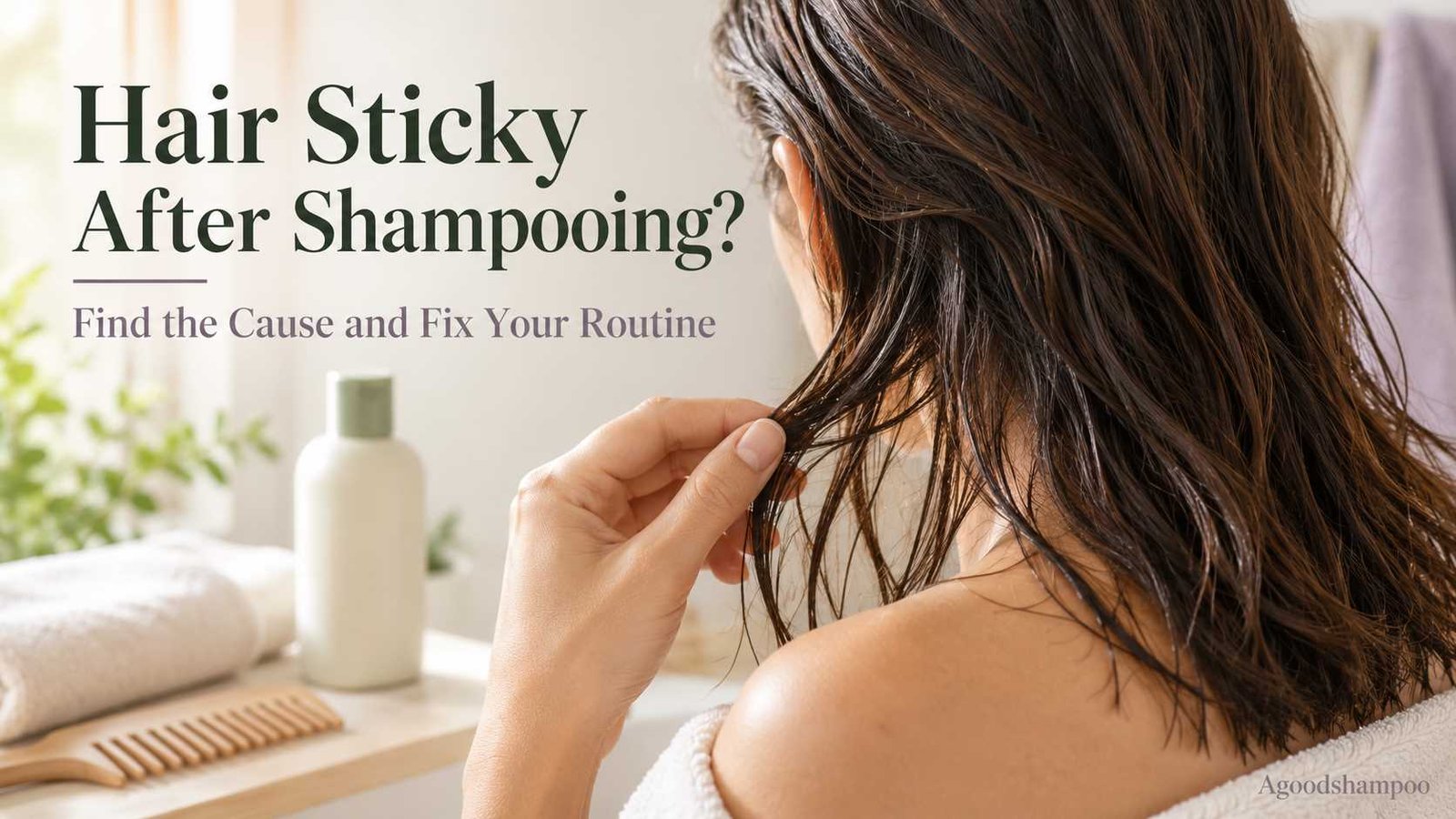
 Freshly shampooed hair is supposed to feel clean, but sometimes it feels sticky, tacky, or strangely coated instead. You may notice strands sticking together while wet, a slightly adhesive feeling near your roots, or hair that becomes difficult to separate after drying.
Hair usually feels sticky after shampooing because some oil, styling product, or cleansing product has not been adequately removed. Conditioner and leave-in products can also contribute, while certain shampoo formulas deposit conditioning ingredients that change how your hair feels.
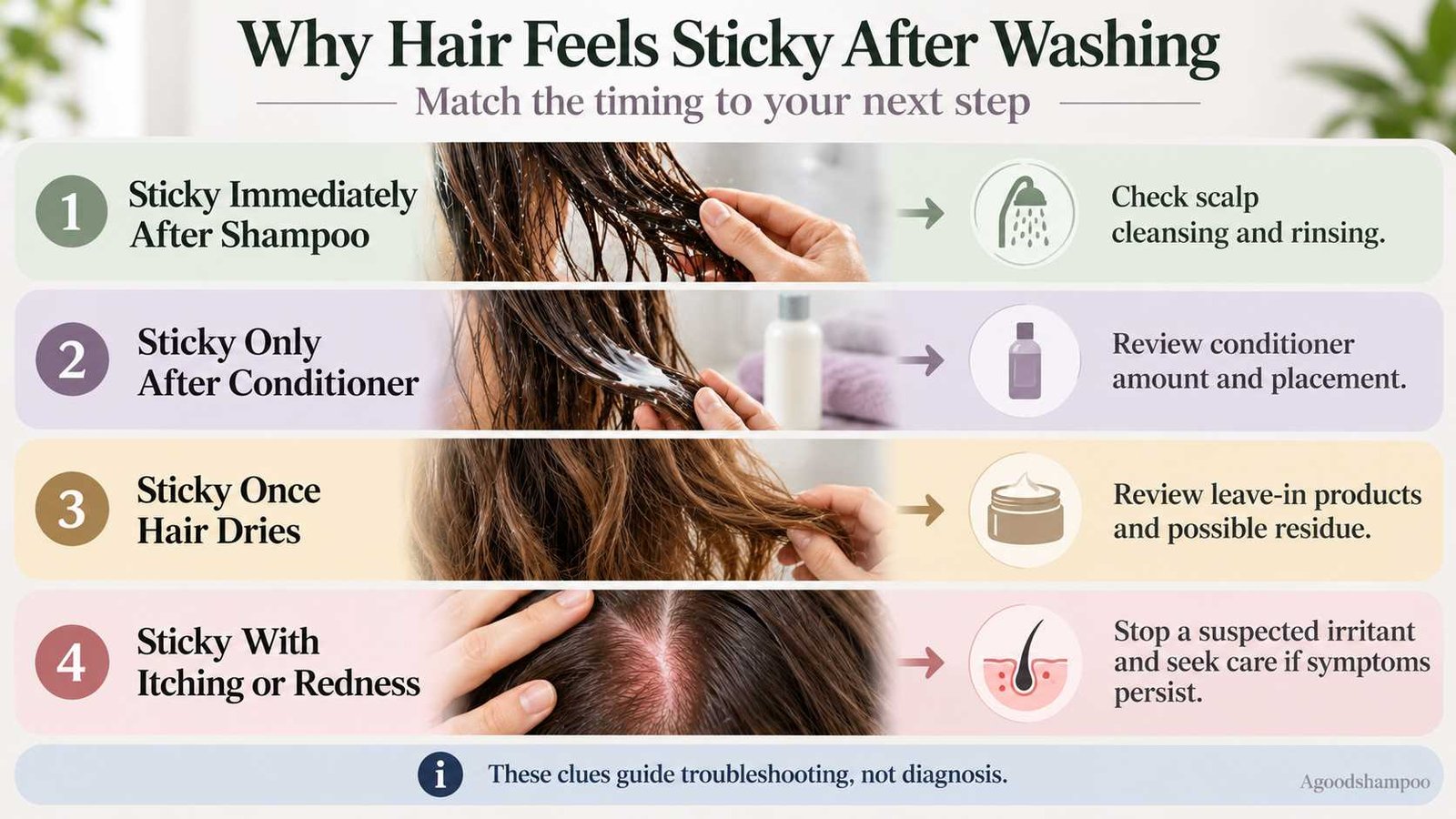
The important clue is when the stickiness appears. Hair that feels tacky immediately after shampooing may need a different adjustment from hair that only becomes sticky after conditioner or styling products.
Why Hair Feels Sticky After Shampooing
1. Your hair may not have been rinsed thoroughly
Incomplete rinsing is one of the first possibilities worth checking.
Thick hair, dense curls, and areas close to the nape can make it difficult for water to reach every section. If shampoo remains concentrated in one area, the hair may feel slippery, coated, or tacky.
This does not mean every sticky sensation is leftover shampoo. However, if the problem appears immediately after rinsing, incomplete removal is a reasonable place to start.
2. Oil and styling products may remain on the hair
Shampoo contains cleansing agents called surfactants. These help lift and disperse oils and other materials so they can be rinsed away.
Heavy styling creams, waxes, gels, dry shampoo, and hair oils can sometimes be difficult to remove during a single wash, especially when several products have been layered together.
The result may be hair that looks clean but still feels coated in certain areas.
3. Your shampoo may deposit conditioning ingredients
Not everything that remains on hair after shampooing is accidental residue.
Some shampoos contain positively charged conditioning polymers, including ingredients from the polyquaternium family and modified guar derivatives. These ingredients can attach to the hair surface and help reduce friction and improve combability.
Silicones may also be used for conditioning.
Research on shampoo formulations confirms that ingredient deposition depends on the combination of surfactants, polymers, and other components.
This conditioning effect is intentional. But if the finished formula leaves more coating than your hair needs, the result may feel heavy or unpleasantly tacky.
A conditioning ingredient is not automatically harmful, and finding a silicone or polymer on an ingredient label does not prove that it caused the problem.
4. Conditioner or leave-in products may be responsible
Sometimes shampoo is blamed for stickiness that actually develops later.
Using too much conditioner, applying a rich treatment where it is not needed, or layering leave-in products can leave hair feeling coated.
Fine hair may become weighed down by products that work comfortably on thick, coarse, or highly textured hair.
If your hair feels normal after shampooing but sticky after conditioning, review that step before replacing your shampoo.
5. Your hair’s condition may affect how products feel
Porosity, damage, previous chemical treatments, and hair texture can influence conditioning needs and product performance.
Bleached or chemically treated hair may experience roughness, tangling, or unusual wet texture that is mistaken for ordinary residue.
Hard water may also complicate hair care because dissolved minerals can interact with cleansing systems and contribute to deposits under certain conditions. However, sticky hair alone is not evidence of hard water.
What the Timing and Location Tell You
Instead of guessing from the appearance of your hair, pay attention to the precise point when the problem begins.
| What you notice | What to investigate first |
|---|---|
| Sticky immediately after rinsing shampoo | Rinsing thoroughness and cleansing performance |
| Normal after shampoo, sticky after conditioner | Conditioner amount, placement, and formula |
| Sticky only after drying or styling | Leave-in products, oils, gels, or styling creams |
| Sticky roots but comfortable ends | Scalp oil, product placement, and root cleansing |
| Sticky mid-lengths or ends | Styling-product accumulation and conditioning layers |
| Sticky feeling with itching or redness | Possible irritation or a separate scalp condition |
These patterns provide clues, not definite diagnoses. More than one factor can contribute to the same sensation.
An especially useful test is to observe your hair after shampooing and rinsing, before you apply conditioner. If the stickiness is already present, concentrate on cleansing and rinsing. If it develops afterward, investigate the later products.
How to Remove the Sticky Feeling Without Overwashing
You usually do not need an aggressive treatment to begin troubleshooting. A controlled adjustment to your next wash is more informative.
Start by thoroughly wetting your scalp
Allow water to penetrate the hair before adding shampoo. With thick or dense hair, gently separate sections so water reaches the roots and nape.
Apply an appropriate amount of shampoo according to the product instructions and your hair’s needs.
Cleanse the scalp rather than scrubbing the lengths
The American Academy of Dermatology recommends concentrating shampoo on the scalp instead of rubbing it aggressively through the entire hair length.
Massage gently with your fingertips to loosen oil and accumulated products. Avoid scraping with your nails.
When rinsing, allow the shampoo and water to move through the lengths. If you have substantial styling-product residue on the lengths, those areas may need gentle attention too.
Rinse methodically
Spend time rinsing around the hairline, behind the ears, at the crown, and near the nape.
Separate dense sections so water can reach the scalp. Continue until you no longer notice concentrated shampoo or obvious suds.
There is no universal rinsing time that guarantees removal for every hair type, shower, and product.
Adjust conditioner rather than abandoning it
Conditioner reduces friction and helps improve manageability, particularly for dry or damaged hair.
For fine or easily weighed-down hair, begin by applying it mainly to the lengths and ends. Dry, curly, or textured hair may benefit from broader coverage.
Use the amount appropriate for your hair and rinse according to the label. If you suspect conditioner is causing the tacky feeling, test a smaller amount before eliminating it entirely.
Consider clarifying only when appropriate
If the problem persists and you regularly use heavy styling products, an occasional clarifying shampoo may help remove accumulated cosmetic residue.
Choose a product suitable for your hair and follow its instructions. Avoid repeatedly washing with stronger cleansers in an attempt to make the hair feel squeaky.
Overcleansing may leave hair rough, tangled, or excessively dry without resolving the original problem.
When the Shampoo Formula May Be the Problem
A shampoo’s cleansing performance cannot be judged from one ingredient alone.
For example, a sulfate-free shampoo is not automatically too gentle to clean effectively. Sulfate-containing shampoos are not automatically too harsh. The complete formula, how it is used, and the condition of the hair all matter.
Similarly, silicones and conditioning polymers are not inherently undesirable. They may improve slip, reduce friction, and make hair easier to manage.
If stickiness consistently appears after using one shampoo, despite thorough rinsing and unchanged styling products, try a different formula appropriate for your scalp and hair type.
For hair that is easily weighed down, a lighter-conditioning shampoo may be worth testing. For dry or damaged hair, changing to a very strong cleanser may create more problems than it solves.
Change one product at a time so you can better understand the result.
When Sticky Hair Needs a Different Approach
Sticky-feeling hair is usually a cosmetic troubleshooting issue, but certain accompanying symptoms deserve more attention.
If your scalp becomes red, painful, swollen, or persistently itchy, stop using a suspected irritating product and consult a healthcare professional or dermatologist. Seek prompt care for severe reactions.
A different concern is hair that becomes abnormally stretchy, mushy, or gummy when wet, especially after bleaching or chemical processing. That sensation may reflect compromised hair fibers rather than removable residue.
Avoid pulling or repeatedly testing weakened strands. Reduce further chemical and heat stress and seek individualized advice if breakage is significant.
Persistent stickiness despite careful rinsing, simplified products, and an appropriate shampoo change may also justify professional assessment.
What to Change at Your Next Wash
Begin with the simplest test: thoroughly wet your hair, cleanse the scalp gently, and rinse every section carefully. Check how your hair feels before applying conditioner.
If it already feels sticky, focus on cleansing performance and rinsing. If the sensation appears afterward, reduce or change the conditioning and styling products one at a time.
The goal is not to strip away every trace of conditioning. It is to find a routine that leaves your hair clean, manageable, and comfortable without an unwanted tacky feeling.

Michael Chen focuses on the science behind shampoos and hair-care ingredients. He explains how cleansing agents, silicones, proteins, and other formula components work, separating useful evidence from marketing claims to help readers better understand the products they use.