 Shampooing twice in one shower can be useful if your scalp has accumulated substantial oil, dry shampoo, or styling-product residue. But when one thorough wash leaves your scalp clean and comfortable, a second application is usually unnecessary.
The answer depends on what you’re trying to remove, the shampoo you’re using, and how your hair responds to cleansing.
Someone who applies hair oil before washing may benefit from an additional shampoo application. Someone with dry, bleached, or fragile hair may find that washing twice simply leaves the lengths rougher.
The most sensible approach is to shampoo once, rinse thoroughly, and repeat only when there is a practical reason.
What Happens When You Shampoo Twice?
Shampoo contains cleansing ingredients called surfactants. These help loosen scalp oil, dirt, and cosmetic-product residue so water can rinse them away.
During the first application, shampoo removes some of the material accumulated on the scalp and hair. If considerable oil or residue remains, a second application may remove more.
That doesn’t necessarily make double shampooing better. Once the scalp is adequately clean, additional cleansing may offer little benefit.
Why does shampoo lather more the second time?
Many people notice that the first shampoo application produces relatively little foam, while the second produces noticeably more.
This can happen because oils and certain product ingredients interfere with foam formation. After some of those materials are removed, the same shampoo may lather more easily.
However, lather depends on the formulation, water conditions, and quantity of shampoo. Some effective shampoos naturally produce less foam than others.
More foam is not reliable evidence that the second wash was necessary.
The useful question is whether your scalp and hair were adequately cleansed, not how much lather appeared.
When Is a Second Shampoo Worth It?
There are situations where two applications may provide a noticeable practical benefit.
After heavy styling-product use
Dry shampoo, hair wax, styling creams, hairspray, and some gels may leave residue, particularly when several products are layered between washes.
A single thorough application may remove this material. But if your roots still feel unusually coated after rinsing, a second gentle wash may help.
This is particularly relevant when you have used dry shampoo repeatedly without washing your scalp.
After applying hair oil
Pre-wash oiling is common in many hair-care routines. Coconut oil, castor oil, and oil blends can leave a noticeable coating, depending on how much is applied.
If your first wash leaves substantial oil behind, another application may make the hair feel lighter and easier to manage.
However, this doesn’t mean everyone who oils their hair needs to shampoo twice. The amount of oil, shampoo formulation, and hair condition all matter.
When your scalp has accumulated considerable sebum
Sebum is the natural oil produced by glands in the skin. It lubricates the scalp and hair.
If your scalp is naturally oily or you’ve gone longer than usual between washes, a second application might remove oil that remains after the first.
Use the following table as a practical guide.
| What you notice | What to do |
|---|---|
| Scalp feels clean after one wash | Stop after one application |
| Heavy product residue appears to remain | Consider a second gentle wash |
| Significant pre-wash oil remains | A second application may help |
| Hair feels dry or tangled after shampooing | Avoid unnecessary repetition |
| Scalp becomes itchy, tight, or uncomfortable | Reassess the product and routine |
| Hair becomes oily again the next day | Review washing frequency and products rather than automatically shampooing twice |
These observations are useful clues, not definitive tests.
If your hair feels waxy after washing, the cause may involve product residue, conditioner placement, oil, or water-related deposits. Repeating shampoo isn’t always the right solution.
When Is One Shampoo Enough?
For many people, one properly performed wash is sufficient.
If you wash regularly, don’t use heavy styling products, and find your scalp comfortable afterward, there’s little reason to make double shampooing a compulsory part of your routine.
Certain hair characteristics also deserve consideration.
Dry or curly hair: Natural scalp oil may not spread easily along the lengths of curly or tightly coiled hair. Additional shampooing can sometimes make those strands feel drier or more tangled.
Bleached or chemically treated hair: Hair that has undergone chemical processing may be more susceptible to roughness and breakage. Repeated cleansing should serve a clear purpose rather than become an automatic habit.
Color-treated hair: Additional shampooing exposes dyed hair to more washing, which may contribute to color fading depending on the dye, formulation, and routine.
Sensitive scalp: If your scalp stings, burns, itches, or feels unusually tight after washing, a second application may increase discomfort.
These considerations aren’t strict prohibitions. Someone with curly hair can have an oily scalp, and color-treated hair may occasionally need more cleansing after extensive product use.
The goal is to balance scalp cleanliness with the condition of the hair lengths.
How to Shampoo Twice Without Overwashing
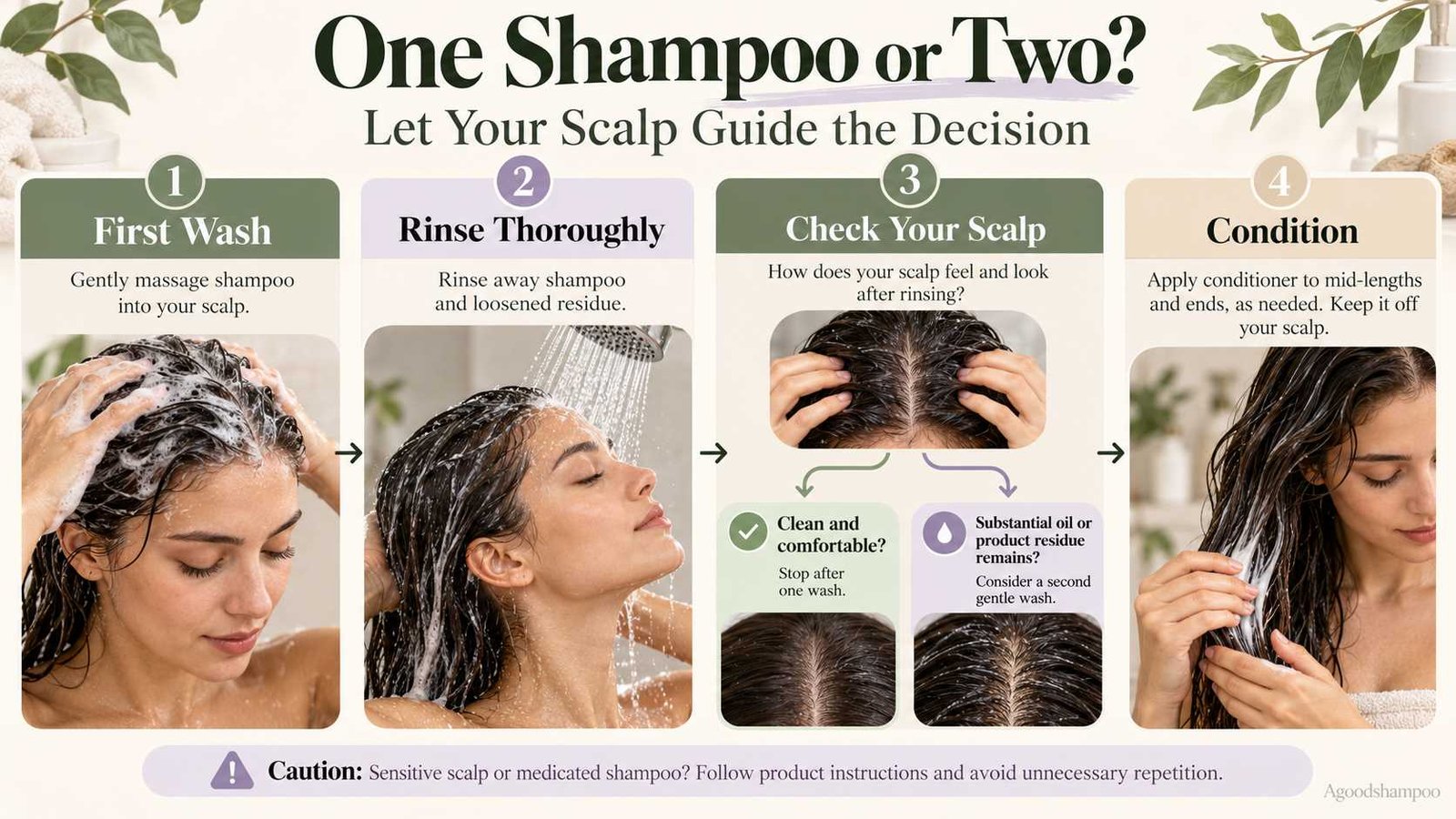
If you decide that two applications are appropriate, a gentle technique is more important than vigorous scrubbing.
- Wet your hair and scalp thoroughly. Allow water to reach the roots, particularly if your hair is dense or thick.
- Apply shampoo to the scalp. Distribute it around the hairline, crown, sides, and back of your head.
- Massage gently using your fingertips. Avoid scratching with your nails or rubbing the lengths into a tangled mass.
- Rinse thoroughly. Make sure the loosened residue and shampoo are washed away.
- Assess whether another application is necessary. If considerable oil or styling residue seems to remain, shampoo the scalp again with the same gentle technique.
- Rinse completely and condition your hair. Follow your conditioner’s directions, concentrating on the lengths and ends where appropriate.
You do not need to use a large quantity of shampoo simply because you’re washing twice. Choose an amount appropriate for the product and your hair.
There is also no requirement to use two different shampoos. Double shampooing describes repeating the cleansing step, not necessarily changing products.
The American Academy of Dermatology recommends concentrating shampoo on the scalp rather than aggressively rubbing it throughout the hair lengths. This helps remove scalp oil and product residue while limiting unnecessary drying of the hair.
If the first application does the job, skip the second.
Does Shampooing Twice Keep Hair Cleaner for Longer?
A second application may remove additional oil or residue present at the time of washing, particularly if the first application was insufficient.
But it doesn’t permanently change how much oil your scalp produces.
Sebaceous glands continue producing sebum after shampooing. How quickly your hair becomes visibly greasy depends on several factors, including your natural oil production, hair characteristics, washing routine, and styling products.
There’s no good reason to assume that two applications will automatically keep everyone’s hair clean for twice as long.
Likewise, double shampooing shouldn’t be promoted as a proven way to control scalp oil production, stimulate hair growth, or prevent hair loss.
If your hair consistently feels heavy or coated despite careful washing, it may be worth learning what clarifying shampoos are good for rather than increasing the number of applications indefinitely.
A clarifying shampoo is a different type of cleansing product, and its suitability depends on its formulation and the residue involved. Some residues, including certain mineral deposits, may require a specifically formulated product.
What About Dandruff or Medicated Shampoo?
Dandruff shampoos and other medicated scalp cleansers require additional care.
Some contain active ingredients designed to manage specific scalp conditions. Their instructions may specify how often to use them and how long they should remain on the scalp.
The American Academy of Dermatology notes that some dandruff shampoos require approximately five to ten minutes of contact time before rinsing. This varies by product.
Using medicated shampoo twice is not a substitute for following its directions.
Don’t automatically repeat the application because you normally double shampoo with a cosmetic product.
Follow the manufacturer’s instructions or advice from your healthcare professional. Depending on the treatment and hair needs, a separate regular shampoo or conditioner may be appropriate.
If you experience persistent redness, significant itching, sores, or severe flaking, additional washing is unlikely to address every possible cause. A dermatologist can help identify the underlying problem.
How to Decide at Your Next Wash
The next time you shampoo, consider how much oil and styling product has accumulated since your previous wash.
Start with one thorough application. Rinse completely and pay attention to whether your scalp feels comfortably clean.
If you’ve used substantial hair oil or styling products and significant residue appears to remain, consider repeating the wash gently.
If your scalp already feels clean, stop there and condition your hair appropriately.
Pay attention to how your hair feels after drying, too. Consistent roughness, increased tangling, or scalp discomfort may indicate that your routine needs adjusting.
Some wash days may call for two applications. Others may need only one.
A useful shampoo routine is the one that removes unwanted oil and residue without unnecessary dryness or scalp irritation.

Marlena Stell makes everyday hair care easier to understand. From choosing a shampoo to managing common hair concerns, she breaks down confusing product claims and practical routines into straightforward advice that helps readers find what works for their needs.