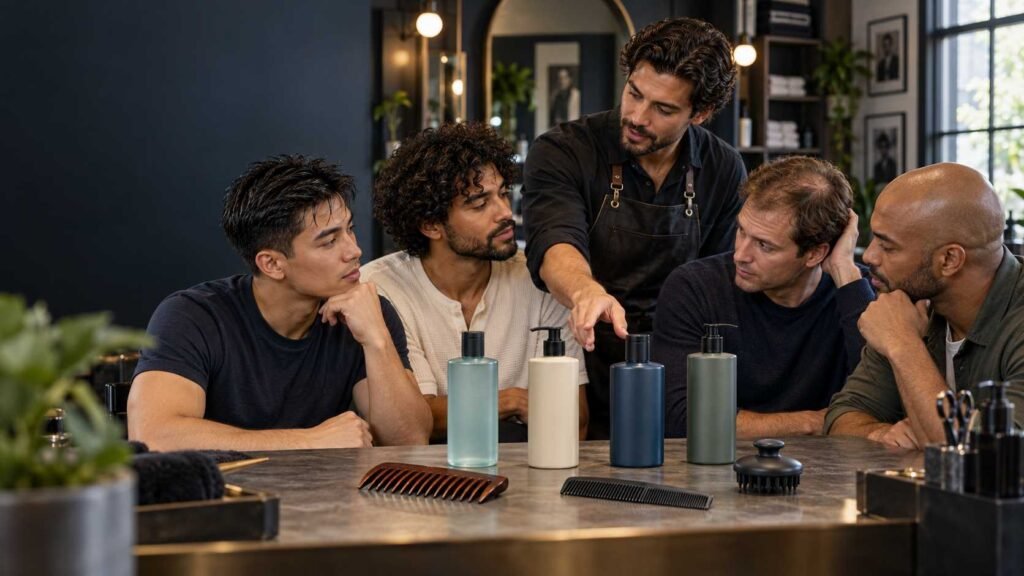
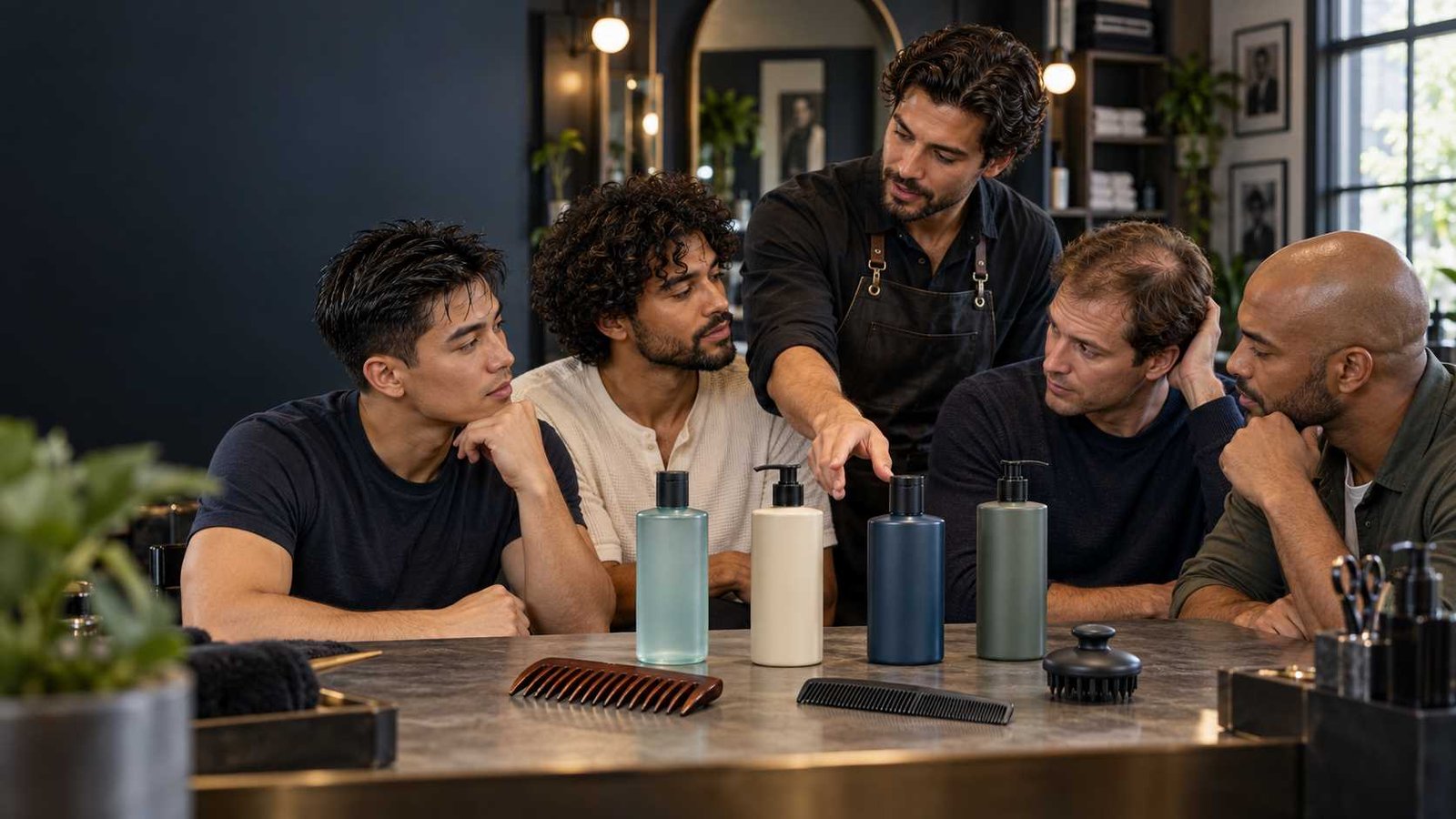
 If you’re wondering which shampoo is good for guys, don’t start with the word “men” on the bottle. Start with your scalp and hair.
A guy with short, oily hair may need a shampoo that removes sweat, sebum and styling residue efficiently. Someone with dry curls needs almost the opposite: enough cleansing to keep the scalp fresh without repeatedly leaving the lengths rough and dehydrated. Fine hair may need light conditioning so it doesn’t collapse, while thinning hair raises a different question entirely because making existing strands look fuller is not the same thing as treating hair loss.
That makes the best shampoo for guys less about gender and more about four things: scalp condition, hair texture, strand thickness and the problem you’re actually trying to solve.
Which Shampoo Is Actually Good for Guys?
For most men, a good shampoo is one that keeps the scalp clean and comfortable while leaving the hair manageable after washing. You don’t need a complicated routine, but you do need the right type of cleanser.
The American Academy of Dermatology recommends choosing hair products according to hair type and washing according to how quickly the hair becomes dirty or oily. It also recommends concentrating shampoo on the scalp rather than aggressively scrubbing the entire length of the hair.
That gives you a better starting point than labels such as “maximum strength,” “sport,” “ice,” or “for men.”
Here is the basic match:
| Your hair or scalp | A sensible shampoo direction | Main concern |
|---|---|---|
| Oily scalp | Effective, lightweight cleansing | Heavy residue |
| Normal short hair | Balanced everyday shampoo | Unnecessary rich conditioning |
| Dry or coarse hair | Moisturizing shampoo | Over-cleansing |
| Curly hair | Moisturizing cleanser made for curls | Dryness and breakage |
| Fine or flat hair | Lightweight or volumizing shampoo | Heavy oils and conditioners |
| Heavy styling-product use | Occasional clarifying shampoo | Buildup |
| Dandruff | Proper anti-dandruff shampoo | Treating persistent flakes as simple dryness |
| Thinning hair | Gentle cleansing plus cosmetic volume | Confusing fullness with regrowth |
| Bald or shaved scalp | Scalp-focused cleanser | Dryness, oil, irritation or dandruff |
The useful question isn’t “What shampoo do men use?” It is “What does my scalp need cleaned away, and what does my hair need left behind?”
That’s also why a basic men’s formula can work perfectly well for one person and feel wrong for another. If you’re considering an inexpensive everyday men’s product, our analysis of whether Suave Men’s shampoo is a good fit explains the same principle in a brand-specific context.
Match Your Shampoo to What Your Hair Is Doing
A shampoo cleans mainly through surfactants, ingredients that help water lift oil, sweat and residue from the scalp and hair. But shampoos aren’t identical. The cleansing system, conditioning agents, fragrance, anti-dandruff actives and overall formula change how a shampoo behaves.
You therefore don’t need to hunt for one magical ingredient. Look at the whole job the product is designed to do.
If your scalp becomes visibly oily by the end of the day, a shampoo that cleans effectively and rinses clean will usually make more sense than a heavy moisturizing formula. Some people with straight hair and an oily scalp may need to shampoo daily, according to the American Academy of Dermatology.
If your scalp stays comfortable for several days but the hair feels coarse, frizzy or rough after washing, stronger cleansing is unlikely to be the answer. A more moisturizing shampoo and regular conditioner may suit you better.
Fine hair creates another tradeoff. It can become greasy or flat quickly because small amounts of oil and conditioning material are noticeable on lightweight strands. That doesn’t mean fine hair should be “stripped.” It means you usually want enough cleansing to maintain lift without coating the hair with more conditioning material than it needs.
What Shampoo Is Good for Curly Hair for Guys?
For curly-haired guys, moisture retention matters more.
The American Academy of Dermatology notes that curly and coily hair is more prone to dryness and breakage. Its guidance recommends a moisturizing shampoo formulated for curly hair and warns that washing curly hair too often can leave it dry, frizzy and harder to manage.
That does not mean every sulfate-containing shampoo is automatically bad for curls. Cleansing strength depends on the full formula, not one ingredient name. It also does not mean curly hair should never be clarified.
If you regularly use pomade, curl cream, gel, oil or wax, buildup can become part of the problem. The AAD specifically notes that people using gels, oils, creams or pomades may benefit from a clarifying shampoo before their moisturizing shampoo.
A practical curly-hair routine is therefore:
- Use a moisturizing shampoo as your regular cleanser.
- Focus it on the scalp.
- Condition the full hair length.
- Use a clarifying shampoo occasionally if styling residue is accumulating.
- Adjust wash frequency according to oil, sweat, dandruff and how your curls behave.
If Dove is one of the brands you’re considering, see our guide to Dove shampoo and conditioner for curly hair for a more focused look at that brand.
Fine Hair and Dry Hair Aren’t Opposites
“Fine” describes the diameter of individual strands. “Dry” describes a condition.
You can have fine hair that is oily at the roots and dry at the ends. You can also have coarse hair with an oily scalp. This is why hair labels sometimes seem contradictory.
For fine, oily hair, a lighter shampoo followed by a small amount of conditioner mainly on the ends may work well. The AAD recommends applying conditioner mainly to the ends for fine or straight hair, whereas dry or curly hair generally benefits from conditioner through the full length.
If your hair is fine but dry from heat styling, bleaching or frequent washing, don’t automatically choose the strongest volumizing cleanser. You may need a balance between lightness and conditioning.
Shampoo for Guys With Thinning or Balding Hair Has a Different Job
This is where shampoo marketing needs the most careful reading.
A shampoo can clean the scalp, reduce residue, condition existing strands and sometimes make fine hair appear fuller. A thickening or volumizing formula may improve the appearance of density by changing how existing strands feel or sit.
That is a cosmetic effect on the hair you still have.
It is not the same as reversing male-pattern hair loss.
Male-pattern hair loss, also called androgenetic alopecia, involves the hair follicle. The American Academy of Dermatology identifies topical minoxidil and prescription finasteride as FDA-approved medications for male-pattern hair loss. Shampoo is not listed as an equivalent treatment.
The distinction matters because “thicker-looking hair” sounds similar to “growing thicker hair,” but those are very different claims.
The AAD reports that, by age 50, more than half of white men have a visible sign of male-pattern hair loss. That statistic is specifically about white men and should not be generalized to every population.
It also reports that finasteride slows further hair loss in about 80% to 90% of men taking it. Again, that figure relates to a prescription treatment, not a shampoo ingredient.
So if you are choosing a shampoo for guys with thinning hair, look for realistic benefits:
- gentle cleansing if the remaining hair feels fragile
- enough cleansing to prevent scalp buildup
- lightweight conditioning
- volume without excessive residue
- reduced breakage where possible
- compatibility with any scalp treatment you already use
The AAD advises people experiencing hair loss to use a gentle shampoo and moisturizing conditioner because thinning or shedding hair can be fragile and more easily damaged.
What you should not expect is a normal cosmetic shampoo to restore follicles lost to established male-pattern baldness.
If your hairline is steadily receding, the crown is becoming increasingly visible, or shedding has changed significantly, shampoo shopping should not be the only step. Earlier assessment can matter because the AAD notes that men with male-pattern hair loss generally see better treatment results when treatment begins earlier.
What About Shampoo for Bald Guys?
A bald scalp still needs cleansing.
Sweat, sebum, sunscreen, dead skin and styling or shaving products can accumulate even when there is little or no hair to wash. But at that point, the main concern is scalp skin, not hair-fiber repair.
A bald or closely shaved guy should therefore choose according to scalp behavior:
- oily scalp: a cleanser that removes oil without leaving heavy residue
- dry scalp: a milder, less drying formula
- dandruff: an appropriate anti-dandruff shampoo
- sensitive scalp: a formula that doesn’t repeatedly trigger burning, itching or redness
A “hair growth” label is not automatically useful simply because the scalp is bald.
Do Guys Need Conditioner Too?
Usually, yes, if the hair is long enough to feel dry, tangled, rough or difficult to style.
Shampoo and conditioner do different jobs. Shampoo primarily removes oil and residue. Conditioner deposits materials that reduce friction, improve manageability and help the hair feel smoother.
The American Academy of Dermatology recommends using conditioner after washing. For fine or straight hair, it suggests focusing conditioner on the ends. For dry or curly hair, it recommends applying conditioner through the hair’s length.
That means the best shampoo and conditioner for guys depends partly on length and texture.
A man with a very short buzz cut may need little separate conditioner because there isn’t much hair shaft to condition. Someone with medium-length curls, bleached hair, coarse hair or hair exposed to regular blow-drying may notice a much bigger difference.
Leave-in conditioner can also be useful for certain hair types. The AAD notes that people with curly, dry, fine, long, heat-styled or frizz-prone hair may benefit, but the amount should be adjusted because fine hair generally needs less product than thick hair.
Don’t assume a 2-in-1 is bad either. Convenience products can work well for short, uncomplicated hair. They simply may not provide enough conditioning for someone whose curls, dry ends or damaged lengths need more targeted care.
Where Dove and Beer Shampoos Fit
Some guys aren’t searching by hair type. They’re standing in a store comparing familiar names.
Two related searches come up often: which Dove shampoo is good, and which beer shampoo is good for hair.
Neither question has one universal answer.
Which Dove Shampoo Is Good for Guys?
Dove’s current U.S. Men+Care range includes products positioned for different concerns rather than one single “men’s shampoo.” The current lineup includes options for thin hair, cleansing, dandruff and hydration.
For example, Dove currently lists Men+Care Thick & Strong Fortifying 2-in-1 Shampoo for Thin Hair. The brand describes the product as making thinning hair look thicker and fuller. That wording is important: it is a manufacturer claim about the appearance and feel of existing hair, not evidence that the shampoo treats male-pattern hair loss.
The current U.S. Men+Care range also includes anti-dandruff products containing pyrithione zinc, including a Cooling Menthol 2-in-1 formula whose official ingredient listing identifies pyrithione zinc 1% as the anti-dandruff active.
For dry hair, Dove lists a Hydration Fuel 2-in-1 positioned as a hydrating shampoo and conditioner. Those are useful product categories, but the right bottle still depends on the actual problem you’re solving.
For a broader comparison beyond the men’s line, our guide to which Dove shampoo is good for different hair needs goes through the brand in more detail.
Is Beer Shampoo Better for Men’s Hair?
Beer shampoo isn’t automatically better for male hair, and “beer” is not a hair type.
Some formulas use beer, barley, hops, proteins or beer-related extracts as part of the product story. Those ingredients may contribute to how a shampoo is formulated or how hair feels, but you should still judge the complete shampoo by its cleansing system, conditioning ingredients, fragrance, intended use and how your hair responds.
The presence of beer does not prove that a shampoo grows hair, prevents male-pattern baldness or permanently strengthens follicles.
So if two shampoos are in front of you and one says “beer shampoo,” don’t choose it just because beer sounds strengthening. Ask the same questions you would ask of any other formula: Does it suit an oily or dry scalp? Is your hair fine, coarse or curly? Does it leave buildup? Is it intended for regular cleansing or occasional use?
Our detailed guides explain which beer shampoo may fit different hair needs and what beer shampoo can realistically do for hair.
A Simple Way to Choose Your Next Shampoo
If you’ve bought several shampoos and none seem quite right, use this order instead of starting with brand names.
1. Check your scalp first.
Does it become oily quickly, feel tight after washing, itch, flake or stay comfortable for several days? Shampoo mainly interacts with the scalp during cleansing, so this is the first clue.
2. Identify your hair texture.
Straight, wavy, curly and tightly coiled hair don’t distribute scalp oils in exactly the same way. Curly hair is particularly prone to dryness and generally needs more conditioning support.
3. Separate fine hair from actual hair loss.
Fine strands can look flat even when density is normal. Thinning density, a receding hairline or a growing bald spot may point to a follicle-level issue that shampoo alone cannot solve.
4. Consider what you put on your hair.
Wax, pomade, dry shampoo, gel, oil and heavy leave-ins can accumulate. If your ordinary shampoo no longer seems to rinse hair clean, occasional clarification may help.
5. Match conditioning to the strand.
Short, oily hair may need very little. Long, curly, bleached, heat-damaged or coarse hair usually needs more.
6. Judge the result over several washes.
A shampoo is doing its job if your scalp stays comfortable and your hair becomes clean without repeatedly feeling excessively greasy, coated, rough or stripped.
7. Don’t ignore persistent scalp or hair-loss problems.
Ongoing severe itching, inflammation, open sores, sudden shedding or progressive hair loss deserves professional assessment rather than repeated shampoo switching.
The Best Shampoo for a Guy Is the One That Matches His Hair
So, which shampoo is good for guys?
For a man with short, normal or oily hair, a straightforward lightweight cleanser may be all that’s needed. Curly or dry hair usually does better with more moisture and conditioning. Fine hair often benefits from lighter formulas that don’t weigh it down. Dandruff calls for an appropriate anti-dandruff shampoo rather than another ordinary cleanser.
Thinning hair needs the most realistic expectations. A shampoo can clean gently, reduce breakage and make existing hair look fuller, but that is not the same as treating male-pattern hair loss. If the change is progressive, the sensible next step is to evaluate the cause rather than keep searching for stronger “growth” shampoo.
And if you’re bald or closely shaved? You still need scalp care. Choose according to oiliness, dryness, dandruff and sensitivity rather than promises aimed at hair that is no longer present.
The useful rule is simple: don’t buy shampoo because it says it’s for guys. Buy it because its cleansing and conditioning job matches what your scalp and hair actually need.

Marlena Stell makes everyday hair care easier to understand. From choosing a shampoo to managing common hair concerns, she breaks down confusing product claims and practical routines into straightforward advice that helps readers find what works for their needs.