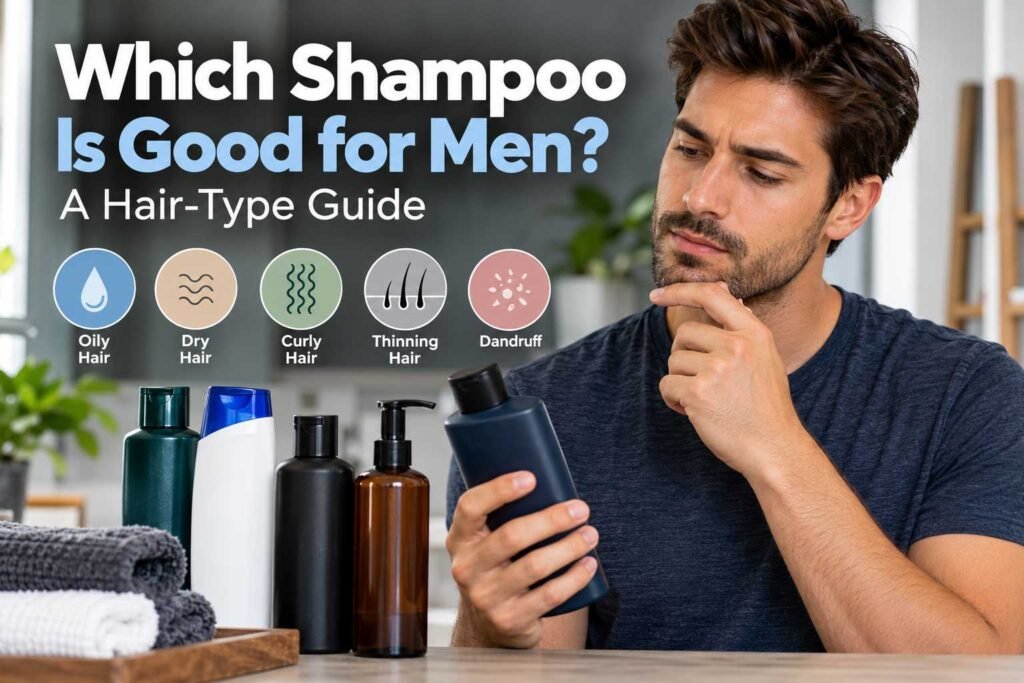
 Which shampoo is good for men? The best choice usually isn’t determined by the word “men” on the bottle. It depends more on how oily your scalp gets, whether your hair is fine, thick, straight or curly, how often you wash it, and whether you’re dealing with dryness, dandruff, styling-product buildup or noticeable thinning.
A man with short, fine hair and an oily scalp may need a more effective cleanser than someone with thick curls that become dry easily. A man with dandruff needs something different again: an appropriate dandruff shampoo rather than simply a strongly scented men’s formula.
That makes choosing shampoo much easier. Start with your scalp, then look at your hair texture and the problem you actually want the shampoo to solve.
Which Shampoo Is Good for Men? Start With Your Scalp
Your scalp is the first place to look because shampoo’s primary job is cleansing. The American Academy of Dermatology recommends applying shampoo mainly to the scalp rather than rubbing it aggressively through the full length of the hair. This removes excess oil, dead skin and product buildup while reducing unnecessary drying of the lengths.
There isn’t one ideal washing schedule for every man either. If your hair is straight and your scalp becomes oily quickly, frequent washing can be reasonable. The AAD notes that some people with an oily scalp and straight hair may want to shampoo daily. Dry, thick, curly or textured hair generally needs washing less frequently.
A useful starting point looks like this:
| Your main concern | What to look for |
|---|---|
| Oily scalp | Effective cleansing without leaving the scalp persistently tight or irritated |
| Dry or rough hair | Gentler cleansing with conditioning support |
| Curly or coily hair | Cleansing that doesn’t leave curls excessively dry or tangled |
| Fine hair | Lightweight shampoo that cleans without heavy residue |
| Product buildup | A stronger or occasional clarifying wash when genuinely needed |
| Dandruff | A shampoo with an appropriate anti-dandruff active ingredient |
| Thinning-looking hair | Lightweight volume and less breakage, with realistic expectations about regrowth |
| Sensitive scalp | A formula you tolerate well, especially regarding fragrance and stronger cleansing systems |
The important point is that “men’s shampoo” is a marketing category, not a diagnosis of what your scalp needs.
Match the Shampoo to What Your Hair Actually Needs
Oily or Frequently Sweaty Scalp
If your roots look greasy soon after washing, you probably need adequate cleansing more than you need an ultra-rich moisturizing shampoo.
This is especially relevant if you exercise regularly, wear helmets or caps for long periods, or use wax, clay, pomade or styling paste. Those products can add oils, waxes, polymers and other materials that eventually need to be washed away.
A shampoo that leaves the scalp clean without persistent itching, burning or tightness is usually a more sensible goal than automatically avoiding a particular surfactant.
Sulfates are a good example of where hair-care advice often becomes too simplistic. The presence of a sulfate doesn’t automatically make a shampoo bad, just as “sulfate-free” doesn’t automatically make one gentle enough for every scalp. Cleansing strength depends on the complete surfactant system, concentration, conditioning ingredients and how frequently you use the product.
If your roots get oily but your ends remain dry, the answer may not be an extremely gentle shampoo everywhere. Clean the scalp properly, then protect the lengths with conditioner. Our guide to [shampoo for an oily scalp and dry hair] can help with that specific combination.
Dry, Rough or Longer Hair
Short hair can sometimes tolerate a simple wash-and-go routine because damaged ends are trimmed away frequently. As hair gets longer, however, the older sections of each strand have experienced more washing, friction, combing, heat and environmental exposure.
If your hair feels rough after every shampoo, stronger cleansing may be more than you need.
Look for a shampoo that leaves the scalp clean but doesn’t make the lengths feel unusually squeaky, tangled or stiff. Conditioner also becomes more valuable as hair gets longer or drier.
The AAD recommends conditioner after washing because it can moisturize and detangle hair. For fine or straight hair, concentrating conditioner toward the ends may be enough. For dry or curly hair, applying conditioner throughout more of the length may make sense.
Men wondering whether they should use a separate conditioner can also see our guide to [choosing shampoo and conditioner for men].
Curly or Coily Hair
Curly and coily hair deserves a different approach because aggressive cleansing can leave the lengths dry even when the scalp itself needs cleaning.
The AAD advises people with coarse, naturally curly or coily hair to shampoo according to need rather than assuming daily washing is necessary. Conditioner also becomes particularly useful for detangling and maintaining manageability.
That doesn’t mean every curly-haired man automatically needs a sulfate-free shampoo. It means the finished formula and how your hair responds matter more than a single label claim.
If curls lose softness immediately after washing, feel unusually tangled, or require large amounts of conditioner just to feel normal again, consider a gentler cleansing formula or less frequent washing.
For a deeper look at curl-specific cleansing, see our guide to [choosing shampoo for curly hair].
Fine or Thinning-Looking Hair
Fine hair can become flat when a formula leaves too much conditioning material behind. In that case, a lighter shampoo may create better movement and apparent volume.
“Thickening,” “volumizing” and “hair-loss” shampoos need more careful interpretation.
A shampoo can make hair look fuller by reducing oiliness, improving lift or helping strands retain moisture. Some products may also reduce breakage. Those cosmetic improvements can make the scalp less visible.
They are not the same as producing new follicles or reversing male-pattern hair loss.
The American Academy of Dermatology explains that hair-loss shampoos may help hair retain moisture or reduce breakage, making hair look fuller, but they cannot regrow lost hair or stop hereditary hair loss from progressing.
If you’re noticing a progressively receding hairline, widening thinning area or bald spot at the crown, shampoo selection shouldn’t be your only strategy. Male-pattern hair loss has established medical treatment options, and earlier assessment can matter.
Dandruff and Hair Loss Need Different Shampoo Decisions
Dandruff and thinning hair are often grouped together in men’s grooming products, but they’re different problems.
A dandruff shampoo is chosen primarily for the scalp. The AAD lists ingredients used in dandruff shampoos including ketoconazole, selenium sulfide, salicylic acid, zinc pyrithione, sulfur and coal tar. Which options are available depends on your country and the exact product.
How you use the shampoo also matters. Some dandruff products need to remain on the scalp for several minutes before rinsing, while others have different label instructions. Follow the directions on the particular bottle rather than applying one internet routine to every formula.
Curly and coily hair needs an additional consideration. The AAD notes that dandruff-treatment ingredients can dry the hair, so concentrating the medicated shampoo on the scalp can help protect the lengths.
For a more detailed look at active ingredients and product choice, see our guide to [shampoo for dandruff in men].
Hair loss is different. Shampoo can clean the scalp and help hair look better, but a cosmetic shampoo shouldn’t be presented as a substitute for evidence-based treatment of androgenetic alopecia.
The AAD identifies topical minoxidil and prescription finasteride among established treatments for male-pattern hair loss. A shampoo marketed for thinning hair should therefore be judged mainly on cleansing, conditioning, breakage and cosmetic volume unless the finished product has credible evidence supporting a stronger claim.
Is Dove Shampoo Good for Men?
Dove can be a reasonable shampoo choice for some men, but “Dove shampoo” isn’t one formula.
Dove Men+Care currently sells several products with substantially different cleansing systems, conditioning ingredients and marketing purposes. That means it’s better to judge the exact Dove product than to label the entire brand good or bad.
For example, the current US Dove Men+Care Strengthening with Vitamin & Mineral Complex 2-in-1 lists cocamidopropyl betaine, sodium lauroyl isethionate and sodium methyl lauroyl taurate among its cleansing ingredients. It also contains avocado oil, tea tree leaf oil, zinc PCA, conditioning polymer Polyquaternium-10 and fragrance.
A Dove Men+Care Refreshing Clean Shampoo currently listed in the Philippines is quite different. Its ingredient list includes sodium laureth sulfate and cocamidopropyl betaine, along with dimethiconol, menthol, caffeine, peppermint extract and fragrance. Dove positions that product toward deeper cleansing and a cooling sensation.
There is even another current US Dove Men+Care Strengthening 2-in-1 listing that uses sodium C12-13 pareth sulfate with cocamidopropyl betaine, glycerin and dimethiconol.
This is why copying an ingredient analysis from an old review or another country can give you the wrong answer.
Dove Men+Care may make sense if the exact formula matches your scalp, hair texture and washing routine. A fragrance-sensitive scalp, very dry curls or a need for medicated dandruff treatment may point you toward something different.
You can compare the wider range in our guide to [choosing a Dove shampoo].
Do Men Actually Need a “Men’s” Shampoo?
Not necessarily.
Men and women can have differences in grooming habits, hair length, styling products and the types of fragrances they prefer. Brands also create men’s lines around those preferences.
But your hair doesn’t read the front label.
A shampoo marketed toward women can still cleanse a man’s scalp effectively. A men’s shampoo can still be too drying, too conditioning or simply unnecessary for another man.
The useful questions are much more practical:
- How quickly does your scalp become oily?
- Is your hair fine, coarse, straight, curly or coily?
- Is it short or long?
- Do you use waxes, pastes, oils or pomades?
- Does your hair feel dry after washing?
- Do you have persistent dandruff?
- Are you actually experiencing hair loss rather than temporary breakage?
- Does fragrance bother your scalp?
That also explains why a 2-in-1 isn’t automatically bad.
For someone with short, relatively undamaged hair who wants a quick routine, a well-formulated shampoo-and-conditioner combination may be perfectly practical. Someone with long, bleached, curly or very dry hair may prefer the control of separate shampoo and conditioner.
The right answer isn’t the product with the most masculine bottle. It’s the routine that leaves your scalp clean and your hair manageable without creating another problem.
Plantur 39 Is Not the Obvious Men’s Choice
The search query “Is Plantur 39 Shampoo good?” often appears near searches about men’s shampoo, but Plantur 39 needs some context.
Plantur describes Plantur 39 as its caffeine hair-care line developed for women over 40 experiencing thinning hair. The company calls Alpecin its counterpart aimed at men’s hair care.
That doesn’t mean a man physically cannot wash his hair with Plantur 39. It means it isn’t the obvious place to begin when you’re simply asking for a good shampoo for men.
More importantly, caffeine-shampoo marketing shouldn’t be confused with established treatment for male-pattern hair loss. The Plantur 39 manufacturer makes its own claims about caffeine and its Phyto-Caffeine Complex, but manufacturer claims about a cosmetic shampoo are not equivalent to independent evidence that the product treats androgenetic alopecia.
If thinning is the real concern, identify why the hair is thinning first rather than choosing shampoo solely because it contains caffeine.
How to Tell Whether Your Current Shampoo Is Working
You don’t need an elaborate test to judge an everyday shampoo.
After several washes, ask whether it is doing the basic jobs you bought it for.
Your scalp should feel adequately clean for a reasonable period after washing. Your hair shouldn’t consistently emerge so dry, tangled or coated that you immediately have to compensate with several other products.
Oiliness returning isn’t automatically evidence that a shampoo has failed. Sebum production continues after washing. A very oily scalp may simply require more frequent cleansing.
Likewise, that ultra-squeaky feeling isn’t proof that hair is healthier. It may simply mean you’ve removed a lot of surface oil and conditioning material.
Watch for patterns instead:
- Persistent tightness or burning after washing may mean the product isn’t a good match.
- Hair that becomes extremely tangled or rough may need gentler cleansing or better conditioning.
- Fine hair that collapses quickly may be getting more conditioning than it needs.
- Persistent flakes may require an actual dandruff treatment rather than repeated ordinary shampooing.
- Heavy pomades and waxes may require stronger periodic cleansing.
- A receding hairline or progressive crown thinning calls for a hair-loss evaluation, not repeated shampoo switching.
Give more weight to those practical results than to words such as “energizing,” “power,” “maximum strength,” “natural” or “men’s formula” printed prominently on a bottle.
The Best Shampoo for a Man Is the One That Matches His Scalp and Hair
So, which shampoo is good for men?
For an oily scalp, choose enough cleansing power to remove excess sebum and styling residue. For dry or longer hair, balance cleansing with conditioning. Curly and coily hair usually benefits from greater attention to moisture and less unnecessary cleansing of the lengths. Fine hair often does better with lighter formulas.
If dandruff is the problem, choose an appropriate dandruff shampoo and follow its specific directions. If progressive thinning is the concern, don’t expect a cosmetic shampoo to do the job of a proven hair-loss treatment.
Dove Men+Care can be a practical everyday option when the exact formula fits your needs, but Dove formulas vary between products and markets. Plantur 39, meanwhile, is primarily positioned for women over 40 rather than as a general men’s shampoo.
The simplest rule is also the most useful: ignore the gendered packaging for a moment and look at your scalp, hair texture and actual problem. Those three things will tell you far more about which shampoo you should buy.

Marlena Stell makes everyday hair care easier to understand. From choosing a shampoo to managing common hair concerns, she breaks down confusing product claims and practical routines into straightforward advice that helps readers find what works for their needs.