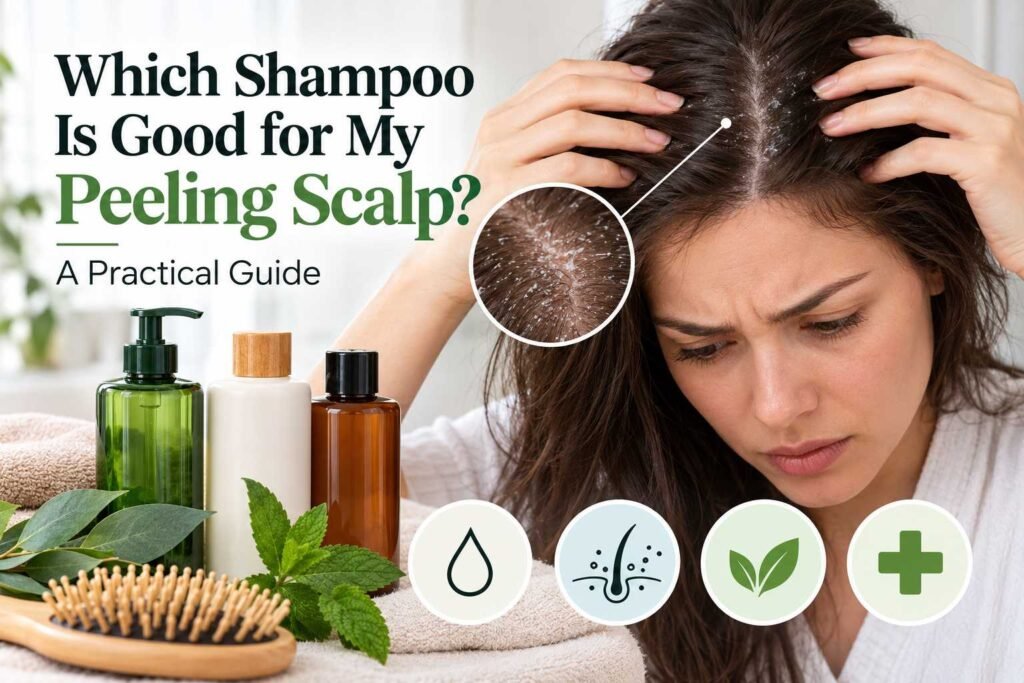
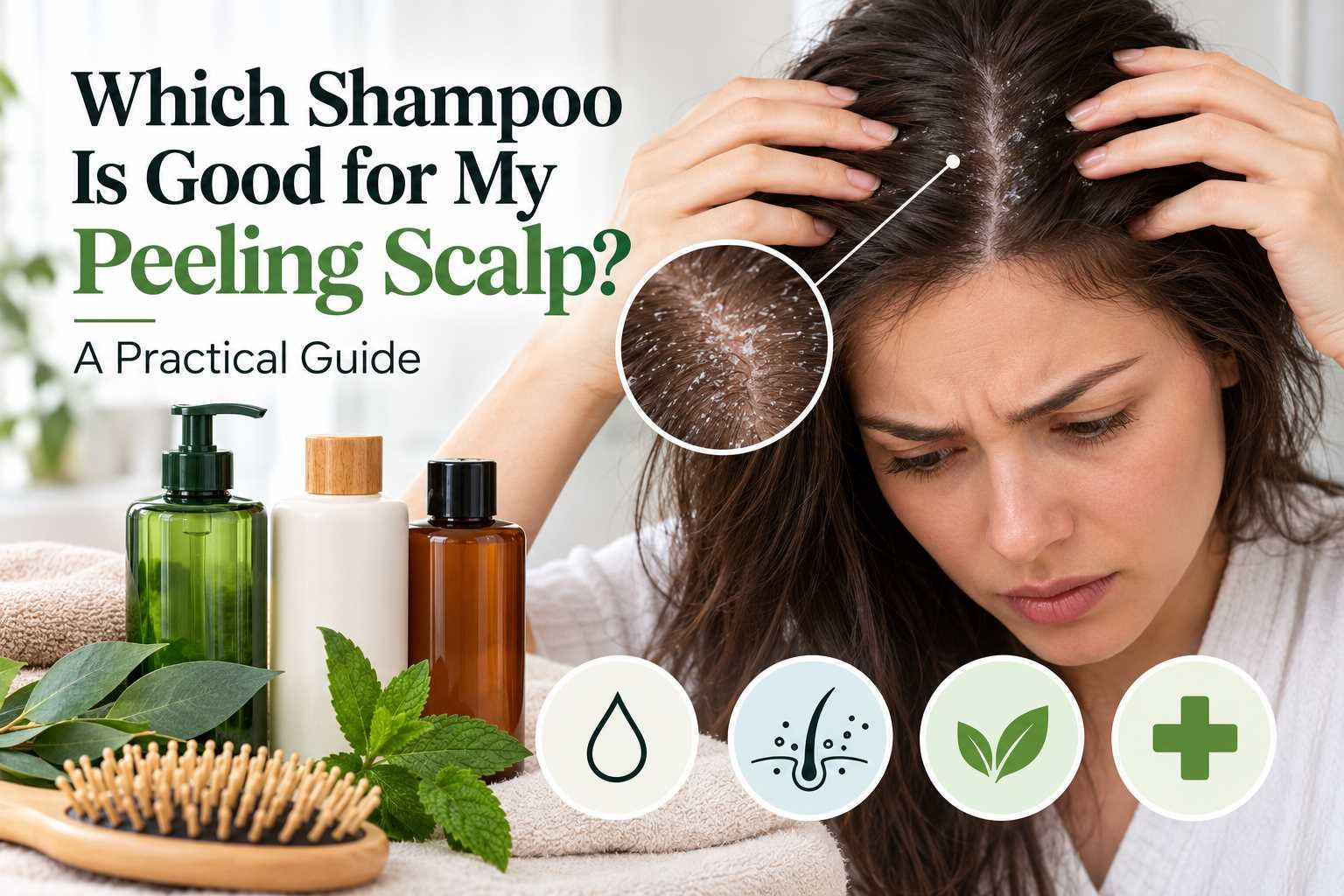
 If you’re asking which shampoo is good for my peeling scalp, the first thing to know is that peeling doesn’t always mean the same thing. A scalp that feels tight and sheds tiny dry flakes may need a gentle, moisturizing shampoo. An oily scalp with recurring white or yellowish flakes may respond better to an anti-dandruff shampoo. Thick, stubborn scale can require a different approach again.
That distinction matters because shampoo is only useful when it matches the problem reasonably well. The American Academy of Dermatology notes that dry scalp, dandruff, seborrheic dermatitis, psoriasis, and other scalp conditions can produce overlapping symptoms. A shampoo that helps one may do very little for another.
A useful starting point is this:
| What your scalp seems like | Shampoo direction to consider |
|---|---|
| Tight, dry, small loose flakes | Gentle non-medicated moisturizing shampoo |
| Oily with recurring flakes and itch | Anti-dandruff shampoo |
| Thick or stubborn scale | Shampoo with a scale-loosening ingredient such as salicylic acid |
| Burning after a new hair product | Stop the suspected product and simplify the routine |
| Thick plaques, bleeding, pain, severe redness or persistent symptoms | Get the scalp assessed rather than repeatedly changing shampoos |
This is not a diagnosis chart. It is a practical way to avoid treating every type of scalp peeling as ordinary dryness.
Dry Scalp and Dandruff Can Both Flake, but They Need Different Shampoo
Dry scalp and dandruff are easy to confuse because both can leave visible flakes in your hair.
With a genuinely dry scalp, the skin has lost moisture. The scalp may feel tight or uncomfortable, especially after washing. Flakes are often relatively small and dry. Hair-care products that remove too much oil or irritate the skin can contribute, as can cold or low-humidity conditions.
The American Academy of Dermatology says a dry scalp may improve when you switch to a gentle, non-medicated shampoo.
That makes a moisturizing or mild hair and scalp shampoo a reasonable first choice when dryness seems to be the main issue. Look for a formula that cleans effectively without leaving your scalp feeling noticeably tighter after every wash.
Our guide to when moisturizing shampoo makes sense for a dry scalp goes deeper into that type of routine.
Dandruff is different.
The American Academy of Dermatology describes dandruff as scalp flaking that may have several contributing factors, including oily skin and hair-care habits. It is also closely related to seborrheic dermatitis. Seborrheic dermatitis tends to affect oily areas and can produce white-to-yellowish scale that may be dry or greasy and itchy.
So if your scalp is both oily and flaky, adding heavier oils or repeatedly switching to richer moisturizing shampoos may not address the actual problem.
That is the point where an anti-dandruff shampoo becomes more relevant.
Shampoo Ingredients That Make Sense for Different Types of Scalp Flaking
There is no single ingredient that is best for every peeling scalp. The useful ingredient depends on what the shampoo is trying to accomplish.
For dandruff, the American Academy of Dermatology lists several active ingredients commonly found in dandruff shampoos, including ketoconazole, selenium sulfide, salicylic acid, zinc pyrithione, sulfur, and coal tar. Mayo Clinic also lists several of these ingredients for controlling scaling and flaking.
| Shampoo ingredient | Why it may be used | Main limitation |
|---|---|---|
| Ketoconazole | Antifungal ingredient used in dandruff treatment | Not necessary for simple dry scalp |
| Selenium sulfide | Helps control dandruff and seborrheic scaling | Follow product directions carefully |
| Zinc pyrithione | Used in some anti-dandruff shampoos | Availability and permitted formulas can differ by market |
| Salicylic acid | Helps loosen and remove scalp scale | Can feel drying for some people |
| Coal tar | Can reduce scaling in certain scalp conditions | Odor, staining and sun-sensitivity concerns can limit appeal |
| Gentle moisturizing ingredients | Can improve cleansing comfort on genuinely dry scalp | They do not treat dandruff simply because they moisturize |
Ketoconazole Is More Relevant to Dandruff Than Simple Dryness
Ketoconazole-containing shampoos are commonly used for dandruff and seborrheic dermatitis because of their antifungal action.
That doesn’t mean everyone with a few flakes should immediately use ketoconazole. If the scalp is simply dry from frequent washing, environmental conditions, or an irritating routine, a medicated antifungal shampoo may be unnecessary.
The more useful question is whether you have recurring dandruff-like scaling and itching rather than simply a dry scalp.
Selenium Sulfide Is Another Established Anti-Dandruff Option
Selenium sulfide is also used in dandruff shampoos. It can be particularly relevant when dandruff or seborrheic scaling is recurring.
As with any medicated scalp shampoo, more is not automatically better. Use it according to the product instructions rather than treating it like an ordinary everyday cleanser.
Salicylic Acid Helps When Scale Is Sticking to the Scalp
Salicylic acid works differently. Its main value in scalp shampoos is helping loosen scale and dead surface cells.
That can make it useful when the scalp feels covered with stubborn buildup or adherent scale.
But there is a tradeoff: a scale-removing shampoo can sometimes leave already-dry hair or scalp feeling drier. A person with dry lengths may therefore need to concentrate treatment on the scalp and use conditioner on the hair.
This distinction is one reason a product described broadly as a shampoo good for scalp health still may not be right for every type of scalp.
What If My Peeling Scalp Is Also Oily?
An oily scalp does not rule out dandruff. In fact, oily skin is one factor associated with dandruff, and seborrheic dermatitis commonly affects oily areas such as the scalp.
If your roots become greasy quickly but you also have persistent flakes and itching, think beyond oil control alone.
A regular oily-scalp shampoo may remove sebum and styling residue. An anti-dandruff shampoo contains active ingredients specifically intended to address dandruff or scaling. Those are two different jobs.
For more detail on routine cleansing, see our guide to choosing shampoo for an oily scalp.
Which Herbal Essences Shampoo Is Good for Oily Scalp?
Among the current Herbal Essences US range, Herbal Essences Scalp + Purify Eucalyptus Shampoo is the most directly positioned toward scalp oil and buildup.
Herbal Essences says the current sulfate-free formula is designed to remove oil and buildup and leave the scalp feeling refreshed. Its ingredient list includes sodium cocoyl isethionate, lauramidopropyl betaine, cocamidopropyl betaine, sodium lauroyl sarcosinate, camellia oil, aloe, eucalyptus extract, menthol, peppermint oils, fragrance, and other formulation ingredients.
That makes it a reasonable cosmetic cleansing option for oily scalp and buildup.
It should not, however, be confused with a medicated anti-dandruff shampoo merely because the scalp is peeling. Its current product page does not position it as a dandruff treatment.
There is another practical consideration if your scalp is already irritated: the current formula contains fragrance, menthol, eucalyptus extract and peppermint-derived oils. Those ingredients do not automatically make a shampoo bad, but an already-reactive scalp may be better served by a simpler formula.
Which Raw Sugar Shampoo Is Good for Oily Scalp?
Raw Sugar currently positions The Oil Remedy Shampoo Rosemary + Mint specifically for oily hair and buildup.
Its current formula includes sodium C14-16 olefin sulfonate, cocamidopropyl betaine, rosemary oil, peppermint oil, alfalfa-derived material, apple cider vinegar, jojoba oil, glycerin and fragrance, among other ingredients.
Raw Sugar reports that the Oil Remedy system removed up to 97.4% of excess oil in laboratory hair-tress testing compared with untreated controls. That is manufacturer-reported testing of oil removal, not evidence that the shampoo treats dandruff, seborrheic dermatitis or another scalp disorder.
So the practical distinction is straightforward: Raw Sugar Oil Remedy may make sense when excess oil and buildup are the main complaint. Persistent peeling, inflammation or dandruff-like scaling may call for a different shampoo category.
An Itchy Peeling Scalp Changes the Decision
If peeling comes with itching, first consider whether the scalp is simply dry or whether dandruff is involved.
Mild dry skin can itch. Dandruff can itch too. So can seborrheic dermatitis, psoriasis, contact reactions and some infections.
That means itch alone cannot tell you which shampoo to buy.
For mild itching with obvious dryness and no significant scale, starting with a gentle cleanser makes sense.
For recurring flakes plus itch, an anti-dandruff shampoo is more logical.
Our detailed guide to choosing shampoo for an itchy scalp covers that problem in more depth.
For readers dealing specifically with recurring flakes and itching, the guide to shampoos for itchy scalp and dandruff is the more focused next step.
One mistake to avoid is assuming that a product labeled natural, herbal, sulfate-free or scalp balancing must automatically be soothing. A shampoo’s entire formulation matters. Fragrance, essential oils and cooling ingredients can feel refreshing to one person and uncomfortable to another.
How to Use Scalp Shampoo Without Making the Peeling Worse
Choosing the right shampoo is only half the job. Using it correctly matters too.
1. Apply treatment shampoo to the scalp, not just the hair.
Dandruff shampoos need contact with the scalp to do their job. Running foam through the hair without working it into the scalp is less useful.
2. Follow the contact-time instructions.
The American Academy of Dermatology notes that some dandruff shampoos may need to remain on the scalp for 5 to 10 minutes before rinsing. The required time varies by product, so follow the directions on the bottle.
Mayo Clinic similarly advises that many dandruff shampoos need to remain on the scalp for several minutes.
3. Match washing frequency to your scalp and hair.
People with oily scalps or fine, straight hair may need to shampoo more frequently. AAD gives an example of daily shampooing with dandruff shampoo about twice weekly for some people in this group.
People with coarse, curly or coily hair may need less frequent washing and may tolerate a dandruff shampoo around once weekly, depending on the individual and the product.
These are starting points, not rigid schedules.
4. Keep medicated shampoo mostly on the scalp if your lengths are dry.
Some dandruff and scale-removing ingredients can dry the hair. If your ends are already fragile or curly, concentrate treatment where it is needed and condition the lengths afterward.
5. Rinse thoroughly.
Residual cleanser or styling product can add another source of irritation. Thorough rinsing is especially useful when the scalp is already reactive.
6. Do not scrape or pick off stubborn scale.
Picking may injure the skin. In scalp psoriasis specifically, the AAD warns that forcefully removing scale can aggravate the scalp and contribute to temporary hair loss.
If thick scale will not release with appropriate shampooing, repeatedly scratching it off is not the solution.
When a Peeling Scalp Needs More Than a Different Shampoo
Sometimes the answer to which shampoo is good for your peeling scalp is: shampoo alone may not be enough.
Scalp psoriasis, for example, may cause thick patches, silvery-white scale, itching, soreness or burning. Scratching can lead to bleeding, and temporary hair loss can occur when the scalp is heavily scratched or scale is forcibly removed.
Seborrheic dermatitis can also produce more than ordinary dandruff. According to the American Academy of Dermatology, it may cause inflammation and white-to-yellowish scale and can involve the ears, eyebrows, beard area, sides of the nose or chest as well as the scalp.
An allergic or irritant reaction to a new dye, shampoo, fragrance or styling product is another possibility when peeling begins soon after a product change.
A scalp infection can produce symptoms that should not be managed by endlessly trying shampoos.
Seek professional assessment if you notice:
- thick or worsening plaques
- significant redness or discoloration
- painful, burning or swollen scalp
- cracks, bleeding or open sores
- pus-filled bumps
- unusual or patchy hair loss
- very intense itching
- scaling spreading beyond the scalp
- symptoms that persist despite appropriate over-the-counter care
AAD specifically recommends professional evaluation when over-the-counter approaches fail because several scalp disorders can resemble dry scalp or ordinary dandruff.
Which Shampoo Choice Makes Sense for Your Scalp?
If you’re still wondering which shampoo is good for my peeling scalp, use the character of the scalp rather than the word peeling to guide the first step.
If your scalp feels dry and tight and the flakes are small and dry, begin with a mild, non-medicated moisturizing shampoo.
If your scalp is oily, itchy and repeatedly flaky, an anti-dandruff shampoo with an established active such as ketoconazole, selenium sulfide, zinc pyrithione where available, or another appropriate dandruff active is more logical.
If thick scale is the main issue, salicylic acid or another scale-removing approach may help loosen it, although dryness can be a tradeoff.
If excess oil is the problem without clear dandruff, products designed for oily scalp and buildup can make sense. Herbal Essences Scalp + Purify Eucalyptus and Raw Sugar Oil Remedy are examples of current cosmetic oil-control options, but neither should be treated as a universal answer for a peeling scalp.
And if peeling is painful, severe, persistent, spreading, bleeding or associated with significant hair loss, buying progressively stronger shampoo is not the best next move. The sensible step is to find out what is actually affecting the scalp.

Marlena Stell makes everyday hair care easier to understand. From choosing a shampoo to managing common hair concerns, she breaks down confusing product claims and practical routines into straightforward advice that helps readers find what works for their needs.