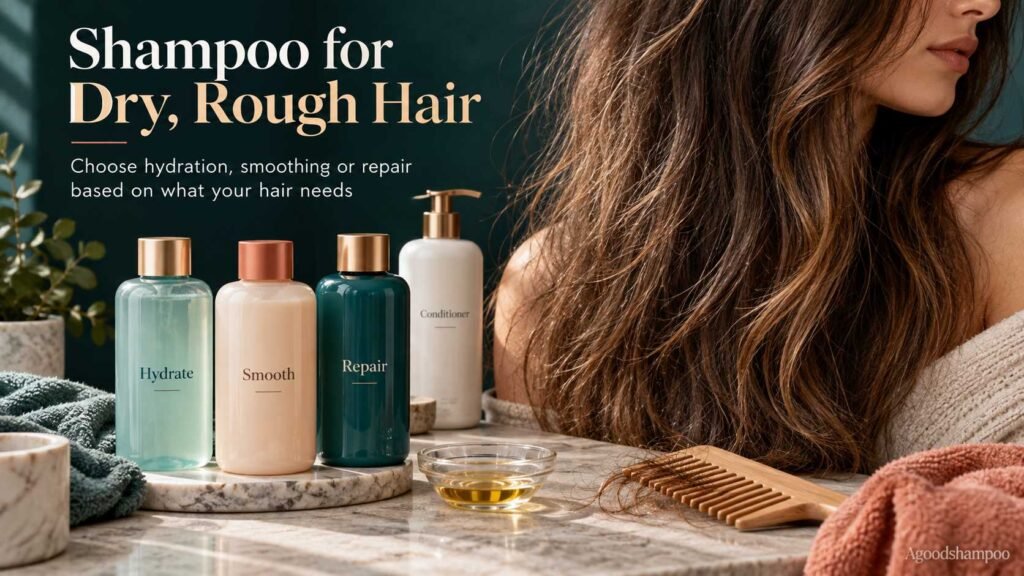
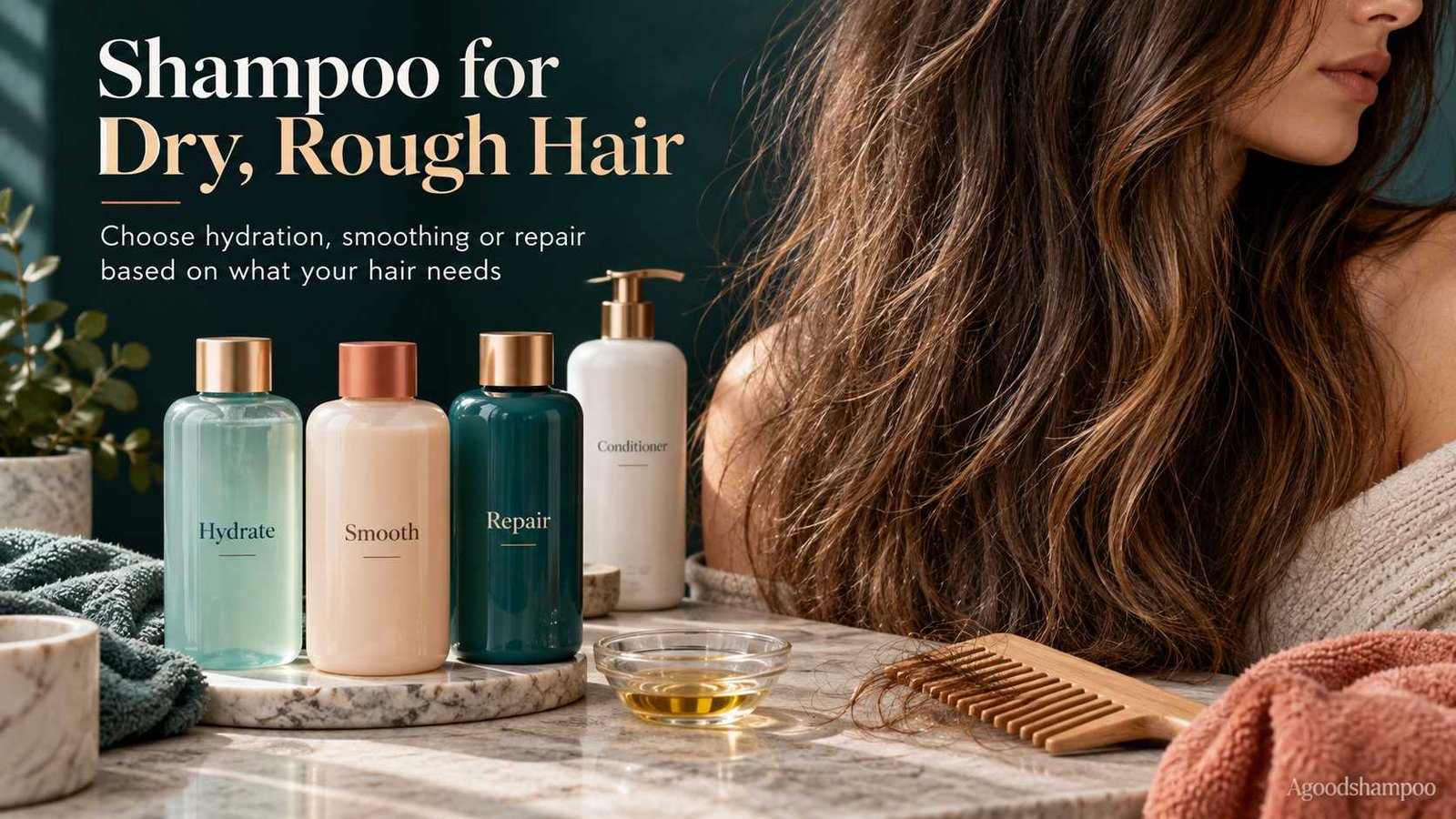
 If your hair feels dry, rough, dull, or difficult to comb, the best shampoo is usually a moisturizing or smoothing formula that cleans the scalp effectively without leaving the hair lengths feeling stripped.
But there isn’t one shampoo that’s best for everyone with dry hair. Hair that is naturally coarse and frizzy needs something different from fine hair damaged by bleach, and both need something different from oily roots with dry ends.
That distinction matters more than whether the bottle says moisturizing, repair, natural, herbal, or sulfate-free.
For uncomplicated dryness, start with a moisturizing shampoo and a good conditioner. If your hair is rough because of bleaching, coloring, frequent heat styling, or chemical processing, look for a formula designed for damaged hair and pay just as much attention to your conditioner and leave-in care.
Which Shampoo Is Good for Dry and Rough Hair?
For most people with dry and rough hair, the best starting point is a shampoo that combines effective but reasonably gentle cleansing with conditioning ingredients.
Think about your hair this way:
| Your hair feels like | Shampoo type to start with | Main priority |
|---|---|---|
| Dry, dull and slightly rough | Hydrating or moisturizing shampoo | Reduce the stripped, dry feel |
| Dry and frizzy | Smoothing or moisturizing shampoo | Improve slip and manageability |
| Bleached, colored or heat damaged | Repair-focused shampoo | Support damaged hair fibers and reduce friction |
| Fine and dry | Lightweight hydrating shampoo | Moisture without excessive weight |
| Thick, coarse or curly and dry | Rich moisturizing or smoothing shampoo | Lubrication and easier detangling |
| Oily at roots but dry at ends | Balancing shampoo | Clean scalp without repeatedly stripping lengths |
The shampoo itself isn’t expected to biologically heal a damaged strand. Hair outside the scalp consists of nonliving fiber. What good cosmetic products can do is improve lubrication, smoothness, manageability, surface condition and protection from additional friction.
A review of hair cosmetics explains that weathering from chemical treatments, heat, grooming and environmental exposure can progressively damage the hair shaft and increase tangling, frizz and breakage. Conditioning products can reduce friction and improve the way damaged hair behaves.
If dryness is your main problem, you may also find our guide to hydrating shampoo for dry hair useful.
First Work Out Why Your Hair Feels Dry and Rough
Roughness is a symptom, not a single hair type.
Before choosing another shampoo, look at what is happening to your hair.
Dry but otherwise healthy hair
Hair can naturally feel drier if it is thick, coarse, curly, very long, or washed frequently. Sebum produced by the scalp does not always travel easily along the full length of the hair, particularly through curls and textured hair.
You may notice:
- dullness
- mild frizz
- tangling
- rough ends
- less flexibility
- hair that feels much better immediately after conditioner
For this type of dryness, a moisturizing shampoo plus conditioner is usually a more logical starting point than an aggressive repair treatment.
Dry, damaged or chemically treated hair
Bleaching, permanent coloring, chemical straightening, relaxing, repeated high heat and rough handling can alter the outer hair structure.
Damaged hair may feel:
- unusually porous
- brittle
- rough even after conditioning
- difficult to detangle
- weak when wet
- prone to split ends or snapping
Scientific reviews of hair weathering describe bleaching, straightening and other chemical procedures as important sources of structural hair-fiber damage. Repeated heat and poor brushing practices can contribute as well.
For this situation, choose products designed for damaged or processed hair, but keep expectations realistic. Cosmetics can temporarily improve damaged hair’s surface properties; they cannot turn a severely weathered strand back into biologically new hair.
Oily scalp with dry lengths
This combination deserves different treatment.
If your scalp looks greasy after a day or two but your mid-lengths and ends remain rough, using the richest possible shampoo everywhere may leave your roots flat without solving the dry ends.
Instead, clean the scalp properly and let the lather run through the lengths rather than aggressively scrubbing the ends. Put most of your conditioning effort into the mid-lengths and ends.
Our dedicated guide to an oily scalp with dry ends goes deeper into that combination.
Dry hair should also not automatically be confused with a dry scalp. If the scalp itself is flaky, tight or itchy, see our guide to shampoo for a dry scalp.
What to Look for in a Shampoo for Dry Hair
The ingredient list can help, but judging a shampoo from one ingredient is unreliable.
A shampoo is a complete formulation. One scientific review notes that shampoos commonly combine cleansing agents, conditioning agents, additives and special-care ingredients, while the type and amount of surfactants affect how the shampoo cleans.
That means a product containing a sulfate isn’t automatically bad for dry hair, just as a sulfate-free shampoo isn’t automatically moisturizing.
Moisturizing and conditioning ingredients
Depending on the formula, dry-hair shampoos may use ingredients such as:
Glycerin and other humectants: These are commonly included in cosmetic formulations to help manage water and product feel.
Silicones such as dimethicone or amodimethicone: These can improve slip, reduce friction, smooth the hair surface and make rough hair easier to comb.
Conditioning polymers: Ingredients such as polyquaterniums can help improve manageability and reduce static.
Plant oils: Coconut, argan, almond, jojoba and other oils are frequently used in dry-hair products. Their usefulness depends on the finished formula rather than the presence of an oil name on the front label.
Proteins and amino-acid derivatives: These are often used in products aimed at weathered or damaged hair. Protein conditioning effects are cosmetic and temporary rather than permanent reconstruction of the strand.
A shampoo does not need every one of these ingredients.
More is not automatically better.
Very fine hair, for example, can feel flat or coated when a formula is too rich, while thick, coarse or highly processed hair may benefit from heavier conditioning.
Does sulfate-free automatically mean better for dry hair?
No.
Sulfate-free shampoos can be a good choice, especially when someone finds a particular conventional shampoo too cleansing or wants a formula designed around gentler cleansing and color care. But the words sulfate-free do not tell you everything about how mild, moisturizing or suitable the entire formulation will be.
Surfactants are the core cleansing system of shampoos, and modern formulas often use combinations of surfactants to balance cleansing, foam, mildness and ingredient deposition.
So don’t reject a shampoo simply because sodium laureth sulfate appears on the ingredient list. Likewise, don’t assume a sulfate-free shampoo will automatically fix dry hair.
If you’re comparing formulas, our sulfate-free shampoo guide explains the distinction in more detail.
Shampoo Choices for Different Types of Dry and Rough Hair
Instead of searching for one universal winner, match the shampoo to what your hair is doing.
For dry and dehydrated hair
Look first for a shampoo described as hydrating or moisturizing.
The goal is straightforward: clean the scalp while avoiding a finish that makes the hair feel squeaky, rigid or harder to detangle.
Follow with conditioner every time if your hair benefits from it. The American Academy of Dermatology specifically recommends using conditioner after shampoo as one way to help prevent hair damage.
If one moisturizing shampoo leaves your roots greasy, don’t assume moisturizing shampoo is wrong for you. Try a lighter formula.
For dry and frizzy hair
Frizz often involves more than lack of water.
Weathering, surface damage and increased friction between hair fibers can make strands tangle, repel each other and look less smooth. A review of hair cosmetics notes that inappropriate cleansing formulations can aggravate fiber friction, while suitable conditioning systems can help reduce frizz and improve disentangling.
For dry, frizzy hair, smoothing shampoos containing conditioning polymers, silicones or appropriately formulated oils can make sense.
Then use conditioner. Shampoo alone is rarely the strongest part of an anti-frizz routine.
For dry, damaged or heat-treated hair
A repair-focused shampoo makes more sense when roughness appeared after:
- bleaching
- frequent permanent coloring
- straightening or relaxing
- repeated curling-iron use
- frequent high-temperature blow drying
Choose a shampoo made for damaged or processed hair and pair it with a conditioner or treatment that provides adequate slip.
Don’t expect the shampoo to permanently fuse split ends. A severely split strand eventually needs trimming.
For fine dry hair
Fine hair creates a balancing problem: it needs conditioning but can easily become limp.
Start with a lightweight moisturizing shampoo rather than the richest oil-based formula you can find.
Use most conditioner from the mid-lengths downward.
If the roots become heavy shortly after washing, move toward a lighter cleansing system rather than abandoning conditioning altogether.
For thick, coarse or curly dry hair
Thicker, curlier and more textured hair often benefits from richer conditioning and careful handling.
Look for shampoos aimed at moisture, smoothing or curl care, then prioritize a conditioner with good slip.
The practical goal is not to make the hair unnaturally silky. It is to reduce excessive friction and make detangling easier.
For oily roots and dry ends
Clean where the oil is: the scalp.
You usually don’t need to repeatedly rub shampoo into already dry ends. Apply shampoo to the scalp, massage gently, then rinse through the rest of the hair.
Condition the lengths and ends according to need.
Which L’Oréal Shampoo Is Good for Dry Hair?
The answer depends partly on where you live because L’Oréal Paris ranges differ between markets.
L’Oréal options for dry hair in India
For India, two current L’Oréal Paris ranges are particularly relevant to this question.
L’Oréal Paris Extraordinary Oil Nourishing Shampoo is positioned by the brand for dry, dull and frizzy hair. Its current Indian ingredient list includes sodium laureth sulfate and coco-betaine as cleansing agents, plus dimethicone, amodimethicone, glycerin and several plant oils, including coconut, argan, camelina, jojoba and almond oils.
That formula illustrates why judging a shampoo from the word sulfate alone can be misleading. It combines its cleansing system with silicones, conditioning ingredients and oils.
The manufacturer describes it as a nourishing, smoothing option for rough and frizzy hair. Those performance statements are L’Oréal’s claims rather than independent clinical proof.
L’Oréal’s Hyaluron Moisture range is another option aimed at dehydrated hair in the Indian market.
If your hair is mainly dry and lightweight rather than coarse and frizzy, a hydration-focused formula may feel more appropriate. If it is thick, rough and difficult to control, a richer smoothing formula may make more sense.
L’Oréal options for dry hair in the USA
The current U.S. dry-hair range is different.
L’Oréal Paris EverPure Moisture Shampoo is a sulfate-free shampoo marketed for dry and color-treated hair. The current product page describes it as sulfate-free, silicone-free and intended to provide moisture while being gentle on color-treated hair.
L’Oréal says its moisture results are based on use of the shampoo and conditioner system compared with a non-conditioning shampoo. That is a manufacturer comparison, not evidence that every user will experience the same degree of improvement.
The U.S. dry-hair collection also currently includes Elvive Hyaluron + Plump Hydrating Shampoo, which L’Oréal markets for dry and dehydrated hair, as well as smoothing EverPure options for frizz.
So if you’re asking which L’Oréal shampoo is good for dry hair, don’t rely on a recommendation written for another country. Look at the current products sold in your market.
Which Shampoo Is Good for Dry Hair in India?
There is no single best shampoo for every person in India with dry hair.
Climate, water quality, washing frequency, hair texture, coloring, heat styling and budget all change the answer.
A useful way to narrow the choice is:
For straightforward dryness: Start with a moisturizing or hydrating formula.
For roughness plus frizz: Consider a richer smoothing shampoo such as L’Oréal Paris Extraordinary Oil Nourishing Shampoo if its formula suits you.
For chemically damaged hair: Choose a damage-focused or repair-focused range rather than relying only on a basic moisturizing label.
For fine dry hair: Avoid choosing the richest product simply because it is marketed for extreme dryness.
For oily roots and dry ends: Pick according to the scalp first, then use conditioner strategically on the lengths.
That approach is more reliable than choosing a shampoo because it is the most expensive, most natural-looking, or most heavily advertised.
For a broader selection framework, see our guide on how to choose the right shampoo.
Which Biotique shampoo is good for dry hair?
Biotique currently markets Soya Protein Intense Repair Shampoo & Conditioner for dry and damaged hair in India.
Its official product page lists soya protein, almond oil, amla oil and wild turmeric among the highlighted ingredients. Biotique describes the product as a gentle cleanser intended for dry and damaged hair and claims benefits including repair and healthy-looking shine.
The important distinction is that these repair statements come from the manufacturer.
The presence of soya protein or botanical oils does not independently prove that a shampoo can permanently repair structural hair damage. If your hair is chemically weathered, the product may improve feel and manageability, but no shampoo can make an old split end biologically regenerate.
Which herbal shampoo is good for dry hair in India?
Don’t select a herbal shampoo solely because it is herbal.
Natural extracts can be perfectly reasonable cosmetic ingredients, but plant-based branding does not automatically tell you:
- how strong the cleansing system is
- whether the formula is conditioning
- how much fragrance it contains
- whether it will suit sensitive skin
- whether it will weigh down fine hair
- whether the botanical ingredient is present at a meaningful level
For dry hair, the overall formula matters more than whether the bottle prominently displays amla, aloe, hibiscus, argan oil or another botanical.
A conventional shampoo with a well-designed conditioning system can suit dry hair better than a poorly formulated herbal shampoo.
Shampoo Alone Usually Won’t Fix Rough Hair
If your shampoo seems appropriate but your hair still feels rough, changing shampoo again may not be the solution.
Conditioner and handling make a major difference.
The American Academy of Dermatology recommends conditioner after shampoo and advises reducing damaging practices such as aggressive towel rubbing and inappropriate brushing of wet hair. For straight hair, it recommends allowing hair to dry somewhat before gently using a wide-tooth comb; textured or tightly curled hair can be combed while damp with a wide-tooth comb.
A simple dry-hair routine can look like this:
- Apply shampoo mainly to the scalp. Clean the area where oil, sweat and product buildup accumulate.
- Avoid aggressively scrubbing the lengths. The rinse water and lather generally clean them sufficiently for routine washing.
- Use conditioner after shampoo. Concentrate it where the hair feels driest.
- Detangle gently. A wide-tooth comb can reduce unnecessary pulling compared with forcing a brush through tangled hair.
- Reduce excessive heat. Very high temperatures can contribute to hair weathering.
- Trim severely split ends. No rinse-off shampoo can permanently reunite a physically split fiber.
If your hair suddenly becomes extremely dry, begins breaking heavily, or the scalp develops persistent redness, pain, sores, intense itching or unusual shedding, the issue may be more than a cosmetic shampoo-selection problem. A dermatologist or qualified healthcare professional can assess persistent or concerning symptoms.
The Best Choice Depends on What Made Your Hair Rough
So, which shampoo is good for dry and rough hair?
For ordinary dry hair, start with a moisturizing or hydrating shampoo and use conditioner consistently.
For dry and frizzy hair, choose a smoothing formula with enough conditioning to improve slip and reduce friction.
For bleached, colored, heat-damaged or chemically processed hair, use a repair-focused system while remembering that cosmetic repair is temporary support for damaged hair fibers, not biological regeneration.
For fine dry hair, prioritize lightweight moisture.
For thick, coarse or curly dry hair, a richer moisturizing or smoothing system may be more comfortable.
For oily roots with dry ends, choose shampoo according to the scalp and put most of your conditioning effort into the lengths.
The biggest mistake is searching for a universally best bottle. The better question is what is making your hair rough and how much cleansing versus conditioning your particular hair needs.
Once you answer that, choosing the right shampoo becomes much easier.

Marlena Stell makes everyday hair care easier to understand. From choosing a shampoo to managing common hair concerns, she breaks down confusing product claims and practical routines into straightforward advice that helps readers find what works for their needs.