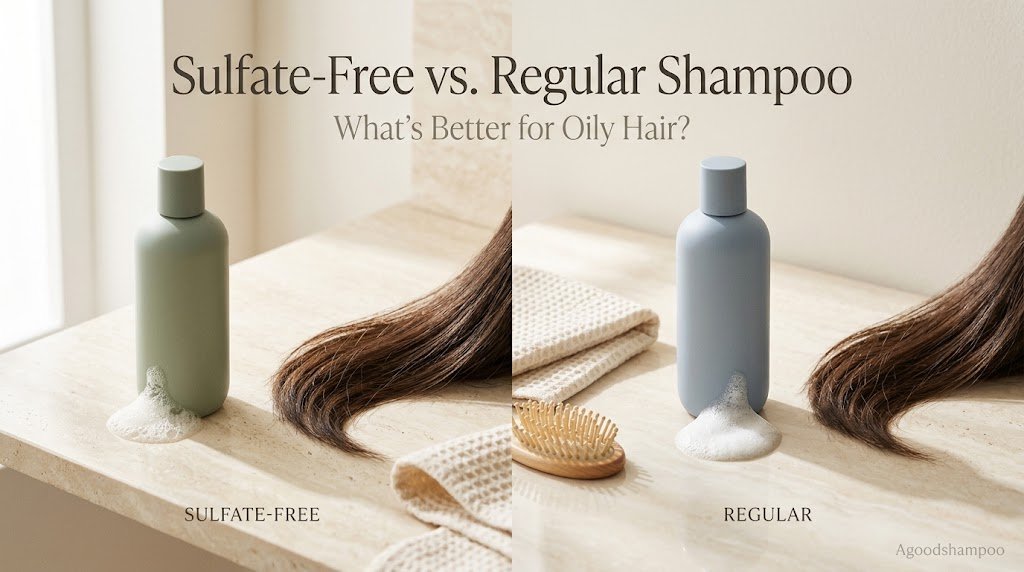
 An oily scalp needs a shampoo that removes excess sebum without leaving the skin uncomfortable or the hair unnecessarily dry. But does that mean choosing a regular sulfate shampoo or switching to sulfate-free?
Both sulfate-free and sulfate-containing shampoos can clean oily hair effectively. Some sulfate-containing formulas provide strong cleansing, which can be useful for greasy roots and accumulated styling products. However, a well-formulated sulfate-free shampoo can also remove considerable oil.
The difference comes down to the shampoo’s complete cleansing system, conditioning ingredients, and how your scalp and hair respond.
The label alone cannot tell you which product will leave your roots cleaner for longer. Understanding what the ingredients actually do is a better starting point.
Sulfate-Free vs. Regular Shampoo: The Key Differences
The term regular shampoo is often used for formulas containing sulfate-based cleansing agents, especially sodium lauryl sulfate (SLS) or sodium laureth sulfate (SLES). Sulfate-free shampoos use alternative surfactants to perform the same basic cleansing task.
Here is how the two categories compare.
| Feature | Sulfate-Free Shampoo | Sulfate-Containing Shampoo |
|---|---|---|
| Typical cleansers | Isethionates, glucosides, sarcosinates, and other non-sulfate surfactants | SLS, SLES, ammonium laureth sulfate, and others |
| Removes scalp oil | Yes | Yes |
| Removes styling residue | Depends on formulation | Depends on formulation |
| Lather | Can range from low to abundant | Often produces abundant foam |
| Scalp irritation potential | Still possible | Still possible |
| Suitable for oily hair | Yes, if cleansing is sufficient | Yes, if well tolerated |
| Suitable for frequent washing | Depends on formula and individual needs | Depends on formula and individual needs |
| Automatically gentler? | No | No |
| Automatically better value? | No | No |
A shampoo’s cleansing performance cannot be judged reliably from sulfate content alone. Surfactant combinations, ingredient concentrations, conditioning additives, and the product’s overall formulation all matter.
How Each Type Removes Oil From the Scalp
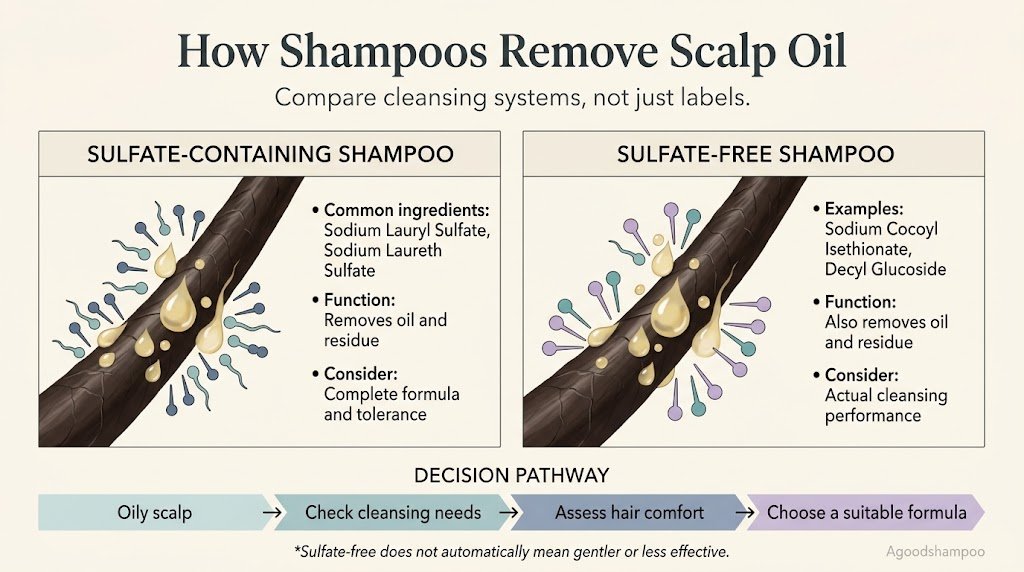
Your scalp produces sebum, a natural oily substance that helps lubricate the skin and hair. When sebum accumulates, roots may appear greasy, separate into clumps, or lose volume.
Water alone does not efficiently remove all oily material because oil and water do not mix readily.
Shampoos solve this problem using surfactants, ingredients with structures that interact with both water and oily substances. During washing, surfactants help disperse sebum and other residue so they can be rinsed away.
What Sulfates Do
Sodium lauryl sulfate and sodium laureth sulfate are common cleansing surfactants.
SLS is known for effective cleansing and foaming, but it can also cause irritation under certain exposure conditions. SLES has different properties and may be formulated into cleansing systems that are more comfortable for some users.
The Cosmetic Ingredient Review has evaluated the safety of these ingredients in cosmetic products. Its assessment of SLES emphasizes that irritation potential must be considered alongside how the finished product is formulated.
That distinction matters. The mere presence of a sulfate does not prove a shampoo is damaging or unsuitable for oily hair.
How Sulfate-Free Formulas Clean
Sulfate-free shampoos use other cleansing agents, such as sodium cocoyl isethionate, decyl glucoside, sodium lauroyl sarcosinate, or combinations of these and similar ingredients.
These surfactants also interact with oil and water, allowing them to clean the scalp.
Some sulfate-free products are designed for mild everyday cleansing. Others are formulated to handle considerable oil or product residue.
The phrase sulfate-free therefore describes an ingredient exclusion, not a fixed cleansing strength.
Is Sulfate-Free Shampoo Strong Enough for Oily Hair?
Yes, provided the formula contains an effective cleansing system suited to your scalp.
A sulfate-free shampoo may leave oily hair feeling clean and light, especially when applied thoroughly to the scalp and rinsed properly.
However, some products marketed for dryness or intensive nourishment contain substantial conditioning ingredients. These may leave certain fine or oily hair types feeling weighed down, even when the shampoo removes some sebum.
If your roots feel coated shortly after washing, the problem may involve insufficient cleansing, product residue, or the formula’s conditioning properties rather than the absence of sulfates itself.
There is also no reliable basis for promising that switching to sulfate-free shampoo will automatically reduce the scalp’s natural oil production.
Sebum production is influenced by several biological factors. Removing surface oil with shampoo does not establish that your sebaceous glands will compensate by producing more.
For additional product-selection considerations, see our guide to sulfate-free shampoo for greasy hair.
When Regular Shampoo May Work Better
A sulfate-containing shampoo may be a sensible choice when your scalp becomes oily quickly and you need dependable removal of excess sebum.
It may also be useful if you regularly use styling creams, waxes, dry shampoo, or other products that contribute to noticeable residue.
However, sulfate-containing does not automatically mean clarifying. Some sulfate shampoos contain substantial conditioning agents, while some sulfate-free shampoos are formulated specifically for stronger cleansing.
Consider a suitable regular shampoo when:
- Your roots remain greasy despite careful washing with your current product.
- Your scalp tolerates your existing sulfate-containing formula comfortably.
- You use products that leave persistent residue.
- You prefer the cleansing feel of a formula containing SLES or a similar ingredient.
If a shampoo consistently leaves your scalp clean and comfortable, there is no scientific requirement to replace it simply because its label lists sulfates.
When Sulfate-Free Shampoo May Be Preferable
A sulfate-free option may be worth trying if a particular sulfate-containing product leaves your scalp uncomfortable or your hair lengths excessively rough.
This does not mean every sulfate-free formula will be gentler. Non-sulfate surfactants can also irritate sensitive skin, and fragrance or other ingredients may contribute to reactions.
The most useful approach is to consider the entire product.
Oily Scalp With Dry Ends
Having oily roots and dry ends is common, especially when hair is long, colored, heat-styled, or chemically treated.
Your scalp needs cleansing, while the older hair lengths may need more conditioning and careful handling.
A compatible sulfate-free shampoo may work well, but so may a suitable sulfate-containing formula.
Apply shampoo primarily to the scalp, allow the rinse water to pass through the lengths, and use conditioner according to the hair’s needs.
For more specific advice, read our article on managing an oily scalp with dry hair lengths.
Fine Hair That Becomes Greasy Quickly
Fine hair can look oily sooner because even modest amounts of sebum may visibly separate or flatten the strands.
For this hair type, a shampoo that rinses clean without leaving excessive conditioning residue may be more useful than one marketed as intensely nourishing.
Both sulfate-free and regular shampoos can meet that requirement.
Our guide to choosing shampoo for fine, oily hair explores related considerations.
How to Read the Shampoo Ingredient List
Marketing descriptions such as gentle, detox, oil balancing, and deep clean do not provide standardized measurements of cleansing performance.
The ingredient list offers more meaningful clues, although it cannot reveal the exact concentration or behavior of every ingredient.
Identify the Cleansing Agents
Look for surfactants such as:
| Ingredient | General role |
|---|---|
| Sodium Lauryl Sulfate | Cleansing and foaming |
| Sodium Laureth Sulfate | Cleansing and foaming |
| Sodium Cocoyl Isethionate | Non-sulfate cleansing and foaming |
| Decyl Glucoside | Non-sulfate cleansing and foaming |
| Sodium Lauroyl Sarcosinate | Non-sulfate cleansing and foaming |
| Cocamidopropyl Betaine | Often used alongside other surfactants to support cleansing and foam |
A cleanser’s name identifies its ingredient family, but not the finished product’s actual cleaning power.
Consider the Rest of the Formula
Conditioning polymers, silicones, fatty ingredients, and other additives can affect how hair feels after washing.
They may improve softness and manageability, but some formulations can leave fine hair feeling heavier than desired.
Fragrance and botanical extracts also deserve consideration if you have experienced irritation. Natural origin does not guarantee better tolerance.
Finally, compare product value using the bottle size, actual price per unit, how much you need per wash, and whether the shampoo performs adequately. There is no reason to assume sulfate-free products offer better value merely because of the label.
How Often Should You Wash an Oily Scalp?
Washing frequency should reflect how quickly your scalp becomes oily, your hair texture, and how comfortable your hair feels afterward.
The American Academy of Dermatology advises washing according to how often hair becomes oily or dirty. People with straight hair and oily scalps may benefit from shampooing daily.
That does not mean everyone with oily hair must wash every day.
A simple routine is:
- Wet your hair and scalp thoroughly.
- Apply shampoo primarily to the scalp rather than aggressively rubbing it through the lengths.
- Massage gently with your fingertips, avoiding scratching with nails.
- Rinse thoroughly, paying attention to the roots and hairline.
- Apply conditioner where your hair needs it, usually the lengths and ends for fine or straight hair.
- Reassess whether your scalp feels clean and comfortable before deciding on the next wash.
Do not force yourself to extend washing intervals in the hope of permanently training your scalp to produce less oil. There is no dependable evidence that this approach predictably changes sebum production.
Also, persistent greasy flakes, redness, itching, or soreness may indicate something beyond ordinary oiliness, including seborrheic dermatitis or contact dermatitis. If symptoms continue, seek assessment from a qualified healthcare professional.
Choose Based on Cleanliness, Not the Sulfate Label
For oily hair, the best shampoo is the one that cleans your scalp effectively, rinses well, and leaves both your skin and hair comfortable.

Carolina Herrera writes about color-treated, damaged, and chemically processed hair. She focuses on understanding breakage, choosing suitable shampoos, and making sense of repair claims. Her goal is to help readers care for their hair with realistic expectations and informed product choices.