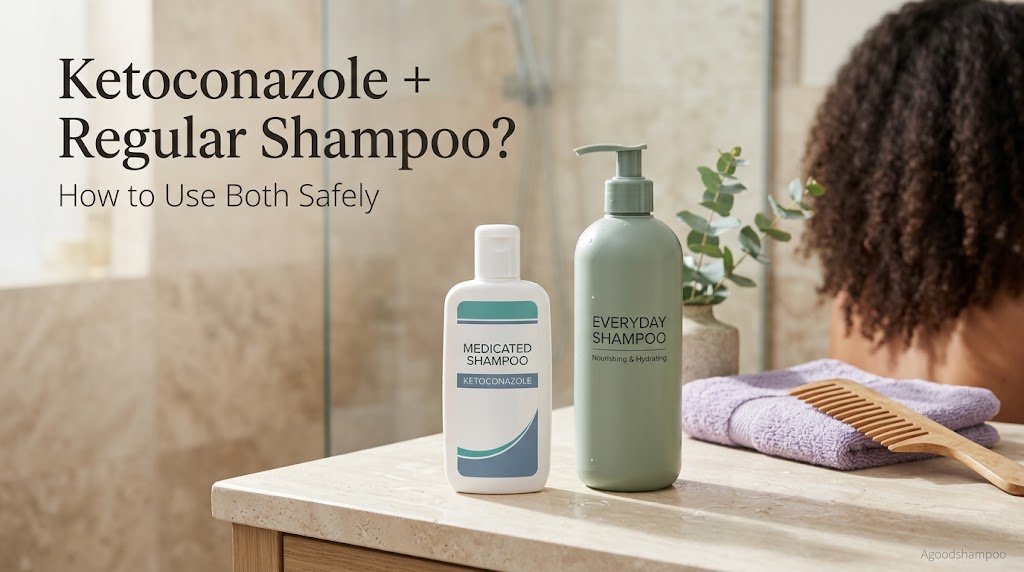
 Yes, you can use ketoconazole shampoo with regular shampoo, but you usually don’t need both during the same shower. A practical approach is to use ketoconazole on your scheduled treatment days and your ordinary shampoo on other days when your hair needs washing.
Ketoconazole is a medicated antifungal shampoo used to manage dandruff and certain yeast-related skin conditions. Regular shampoo primarily removes scalp oil, dirt, and product residue.
The important distinction is that ketoconazole products have specific treatment instructions. A 1% shampoo sold over the counter in the United States may have different directions from a 2% formulation supplied in another country.
Follow your medicated shampoo’s label first. Use regular shampoo to support your normal cleansing routine, not to replace or alter the prescribed treatment.
What Does Ketoconazole Shampoo Do Differently?
Ordinary shampoo contains cleansing agents called surfactants. These help water remove sebum, dirt, sweat-related residue, and hair-product buildup.
Ketoconazole shampoo also contains surfactants, but it includes the antifungal medicine ketoconazole.
This ingredient works against susceptible fungi, including Malassezia yeasts associated with dandruff and seborrhoeic dermatitis.
These conditions can cause scalp flaking, itching, and sometimes redness or greasy scales. Ketoconazole helps manage the yeast-related component of these symptoms.
Regular shampoo can remove visible flakes and oil, but it doesn’t necessarily provide the same antifungal treatment.
That doesn’t mean ketoconazole is appropriate for every itchy or flaky scalp. Irritant reactions, psoriasis, eczema, and other conditions can produce overlapping symptoms.
The two shampoos therefore have different purposes:
- Ketoconazole shampoo: Medicated treatment for appropriate scalp or skin conditions.
- Regular shampoo: Routine cleansing according to scalp oiliness, hair type, and product use.
Understanding this difference makes it easier to decide when each belongs in your routine.
Can You Use Both Shampoos in the Same Shower?
You can sometimes use regular shampoo and ketoconazole during the same washing session, but doing so is not routinely necessary.
According to Cleveland Clinic’s patient guidance, you don’t need to follow every ketoconazole application with regular shampoo.
Ketoconazole shampoo already contains cleansing ingredients. Using a second shampoo afterward may simply expose your hair to additional washing without improving treatment.
Should you use regular shampoo before ketoconazole?
Usually, you can apply ketoconazole directly to thoroughly wet hair and scalp as instructed.
However, some product instructions allow washing very thick or long hair with ordinary shampoo before using the medicated product.
This may help remove accumulated oil or styling residue and make scalp application easier.
It is a product-specific option, not a requirement for everyone.
If you have been prescribed ketoconazole, ask your pharmacist or clinician whether a preliminary wash is appropriate for your situation.
Should you use regular shampoo afterward?
Not automatically.
Once you’ve used ketoconazole according to its instructions and rinsed thoroughly, another shampoo application may be unnecessary.
Some people prefer to follow a medicated shampoo with conditioner to make the lengths easier to manage.
If your hair feels rough after treatment, adding conditioner may be more helpful than immediately shampooing again.
Can you mix the two shampoos together?
Avoid combining them in your palm or bottle.
Mixing can dilute the medicated shampoo or change how it spreads, foams, and contacts the scalp. There is no assurance that the mixture will perform as intended.
This is a precaution about following medication instructions, not evidence that the products necessarily undergo a dangerous chemical reaction.
If both shampoos are used in one shower, apply and rinse them as separate steps according to the relevant directions.
Should You Alternate Ketoconazole and Regular Shampoo?
For many people, alternating them on different wash days is the simplest approach.
The manufacturer of US Nizoral A-D states that users can continue using their regular shampoo and conditioner on days when they aren’t using its ketoconazole treatment.
For example, someone instructed to use medicated shampoo twice weekly might choose an ordinary shampoo for other needed washes.
There is no need to wash every day simply because you’re following a ketoconazole treatment schedule.
| Washing situation | Appropriate approach |
|---|---|
| Scheduled ketoconazole treatment day | Follow the medicated product’s directions |
| Hair needs washing between treatments | Use a suitable regular shampoo |
| Hair doesn’t need washing between treatments | No additional shampoo is necessary |
| Significant styling residue has accumulated | Consider whether separate preliminary cleansing is appropriate |
| Hair feels dry after treatment | Use suitable conditioner and reassess your cleansing routine |
| Scalp becomes irritated | Review the product warnings and seek medical advice when indicated |
This approach supports routine hair cleanliness without unnecessarily increasing exposure to medicated ingredients.
It also avoids a common mistake: assuming that every shower must include ketoconazole to control dandruff.
The appropriate frequency depends on the formulation, condition being treated, and professional instructions.
How to Use Ketoconazole Shampoo Correctly
The most important rule is to follow the instructions for the exact bottle you have.
Ketoconazole shampoos are available in different strengths, and their directions vary by country and medical indication.
Ketoconazole 1%: US Nizoral A-D
The US Nizoral A-D 1% Drug Facts label directs adults and children aged 12 years and older to:
- Wet the hair thoroughly.
- Apply the medicated shampoo and work it into a generous lather.
- Rinse thoroughly.
- Repeat the ketoconazole shampoo application.
- Use every three to four days for up to eight weeks, or as directed by a doctor. Afterward, use only as needed to control dandruff.
Notice that this label instructs users to repeat the medicated shampoo itself, not follow it with ordinary shampoo.
The label does not give the same three-to-five-minute contact instruction commonly associated with some 2% products.
Don’t substitute instructions from a different formulation.
Ketoconazole 2%: An example of UK treatment guidance
For dandruff or seborrhoeic dermatitis, NHS guidance describes using ketoconazole shampoo twice weekly for two to four weeks.
Some patients then use it once every one to two weeks to help prevent symptoms returning.
The NHS application instructions recommend massaging the shampoo onto the affected scalp, leaving it for three to five minutes, and rinsing thoroughly.
These directions also vary when ketoconazole is used for other skin conditions.
Do not combine the US 1% repeat instruction with the UK 2% contact-time schedule and assume the resulting routine is correct for your product.
If your label differs, follow that label or your prescriber’s instructions.
What If Ketoconazole Makes Your Hair Dry?
Some people notice that their hair feels rough, dry, or harder to detangle after using medicated shampoo.
There can be several reasons.
The cleansing ingredients may remove substantial surface oil. Hair that is already bleached, porous, curly, or chemically processed may be especially vulnerable to roughness during washing.
Additionally, a scalp that is already irritated may be less comfortable with unnecessary extra cleansing.
You can often make the routine more manageable by:
- Applying medicated shampoo to the scalp as directed rather than aggressively rubbing the lengths.
- Avoiding unnecessary additional shampoo applications.
- Using a suitable conditioner, especially on dry lengths and ends.
- Detangling gently and limiting excessive heat styling.
Conditioner generally serves a different purpose from ketoconazole and can be part of a hair-care routine when appropriate.
If your product instructions specify avoiding certain scalp products or your clinician has given particular directions, follow those instead.
Remember that dry hair lengths and scalp irritation are different problems.
Rough-feeling hair may benefit from improved conditioning. Burning, persistent redness, swelling, or a developing rash requires more caution.
Can You Combine Ketoconazole With Another Dandruff Shampoo?
Using ketoconazole alongside another medicated dandruff shampoo requires more consideration than alternating it with an ordinary cosmetic cleanser.
Other dandruff shampoos may contain ingredients such as selenium sulfide, zinc pyrithione where permitted, salicylic acid, or other treatment agents.
These ingredients have different functions and directions.
Using multiple active treatments without guidance can increase the complexity of your routine and may contribute to irritation or unnecessary cleansing.
There is no universal requirement to combine antifungal shampoos with exfoliating or other medicated scalp products.
If your dandruff isn’t improving, don’t automatically add another medicated shampoo or increase ketoconazole use.
A pharmacist or dermatologist can help determine whether you need a different treatment, an adjusted schedule, or evaluation for another scalp condition.
Ketoconazole should also not be presented as a guaranteed hair-regrowth treatment. Managing dandruff-related inflammation and treating hair loss are separate clinical questions.
When Should You Ask a Dermatologist?
Mild dandruff can often be managed with appropriate medicated shampoo, but not every scalp problem responds to the same treatment.
For the US OTC Nizoral A-D 1% product, the label advises stopping use and asking a doctor if a rash appears, the condition worsens, or there is no improvement within two to four weeks.
It also warns against using the product on a broken or inflamed scalp.
Consult a healthcare professional if you experience persistent or severe irritation, significant redness, painful sores, unusual hair loss, or symptoms that do not improve as expected.
Seek urgent medical attention for signs of a serious allergic reaction, such as breathing difficulty or swelling of the face or throat.
Age and pregnancy considerations also matter. The US 1% label directs users under 12 to ask a doctor and advises people who are pregnant or breastfeeding to consult a doctor before use.
These requirements can differ by product and location, so always read the relevant package information.
Choosing Your Next Wash
If today is a scheduled ketoconazole treatment day, follow the instructions for your particular medicated shampoo. There is usually no need to add ordinary shampoo unless your treatment directions or healthcare professional recommends it.
If today is an ordinary wash day between treatments, use a regular shampoo that suits your scalp and hair.
If your hair feels dry, consider conditioner and gentler handling rather than adding unnecessary cleansing steps.
And if your dandruff or scalp discomfort continues despite correct treatment, seek medical advice before changing the medication schedule yourself.
The most practical routine is to use ketoconazole as directed for its medicinal purpose and regular shampoo only as often as your everyday cleansing needs require.

Carolina Herrera writes about color-treated, damaged, and chemically processed hair. She focuses on understanding breakage, choosing suitable shampoos, and making sense of repair claims. Her goal is to help readers care for their hair with realistic expectations and informed product choices.