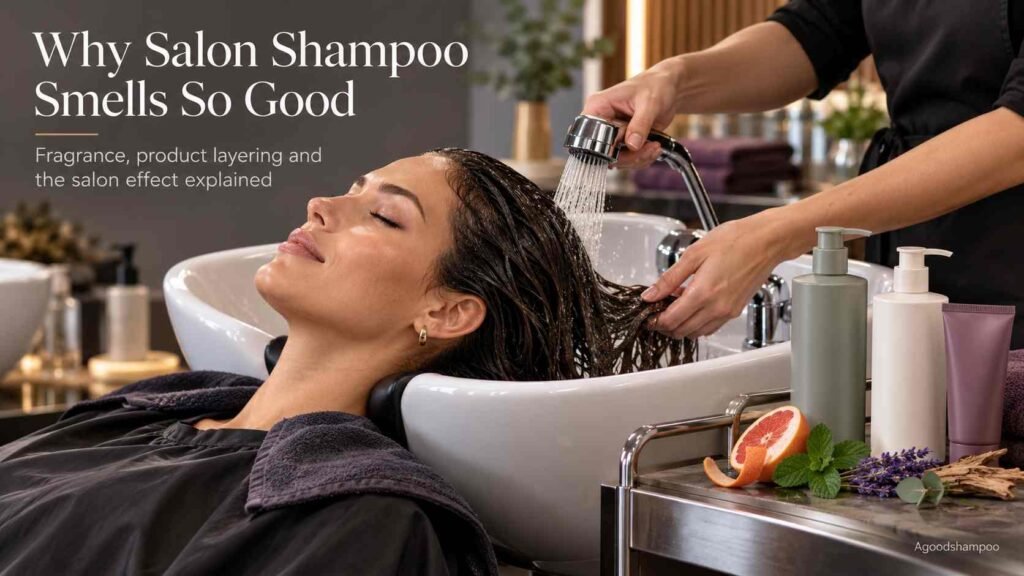
Why does hair salon shampoo smell so good? Usually, there isn’t one secret ingredient that professional salons have access to and everyone else doesn’t. 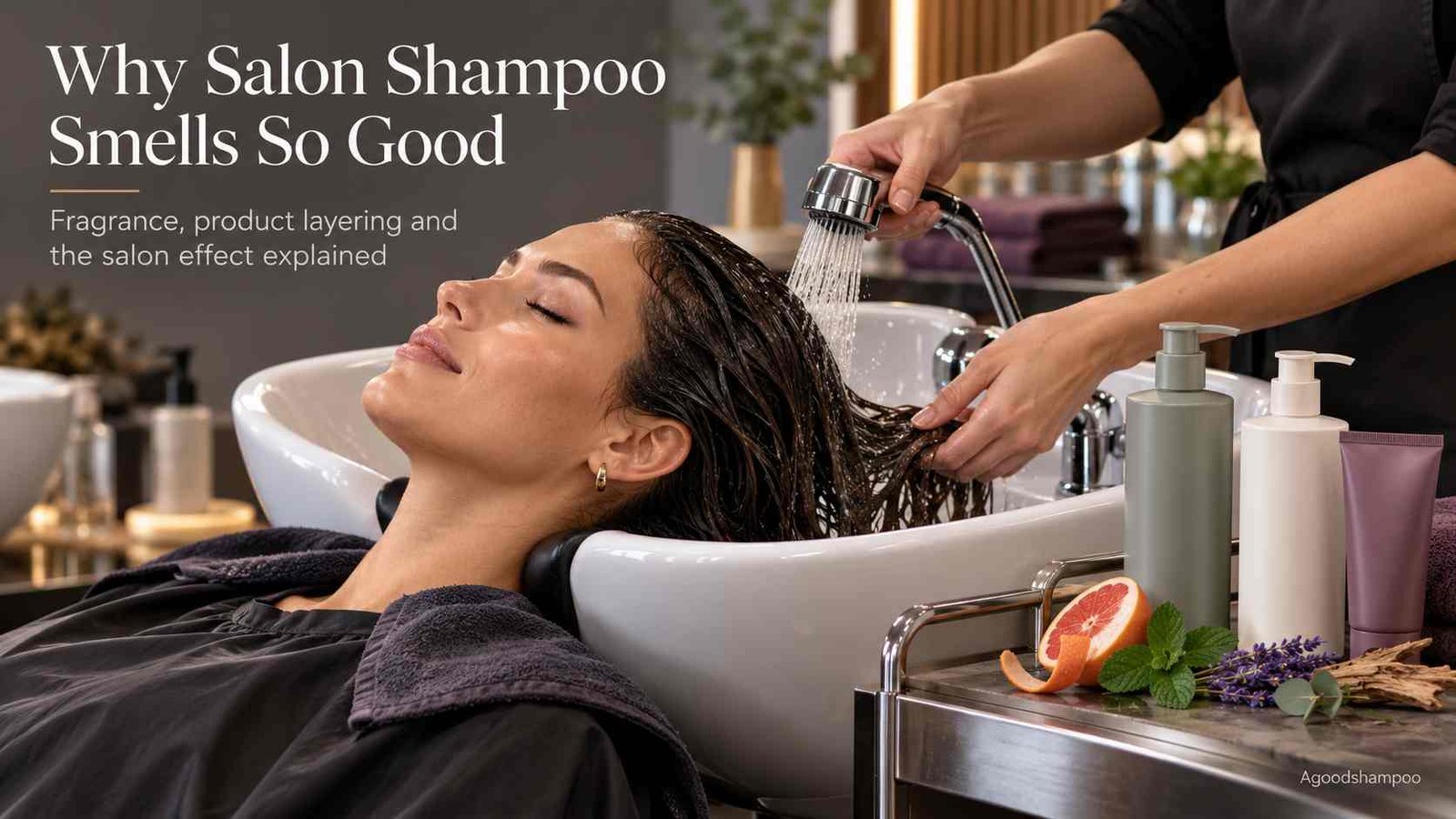
What you notice after a salon appointment is often the combined effect of a deliberately designed shampoo fragrance, conditioner, leave-in products, heat protection and finishing products. Freshly cleaned and styled hair can then carry that mixture of scents in a way that feels noticeably different from your normal wash at home.
Fragrance is also part of how manufacturers design the experience of using a shampoo. It can make a formula smell fresh, herbal, fruity, creamy or luxurious, but fragrance itself isn’t what makes shampoo clean your hair.
That distinction matters. A shampoo that smells expensive isn’t automatically better for your hair, and a lightly scented or fragrance-free shampoo isn’t automatically inferior.
Why Does Hair Salon Shampoo Smell So Good?
Professional hair products are often designed with the entire salon experience in mind. That includes how a shampoo spreads, lathers, rinses and smells while the stylist is using it.
The fragrance may contain several scent notes rather than one obvious perfume. Citrus can create a fresh opening, herbs can give a clean salon-like character, and warmer or softer notes can remain noticeable after rinsing.
OLAPLEX provides a good current example. The brand describes the fragrance of Nº.4 Bond Maintenance Strengthening Shampoo with grapefruit zest, sugared mint, ginger and crushed sage notes. Importantly, OLAPLEX separates those scent notes from what the cleansing formula is intended to do.
That is a useful way to think about any shampoo.
The fragrance shapes the sensory experience. Surfactants and other formulation ingredients are responsible for cleansing. Conditioning ingredients affect characteristics such as softness, slip and manageability.
Another reason salon shampoo may seem to smell better is simply that you’re paying more attention to it.
Having someone else wash your hair in a salon basin is very different from rushing through a shower at home. The scent is closer to your face, the shampoo is massaged through the scalp for longer, and you’re sitting in an environment already filled with hair-care products.
Your brain can start associating that particular fragrance with the feeling of freshly styled salon hair.
Your Shampoo Isn’t the Only Thing You’re Smelling After a Salon Visit
One of the biggest misconceptions is assuming the shampoo created the entire fragrance you notice when you leave the salon.
A typical appointment may involve several scented products:
- Shampoo
- Conditioner
- Hair mask
- Detangling spray
- Leave-in conditioner
- Heat protectant
- Styling cream
- Hair oil
- Mousse
- Hairspray or finishing spray
Each one can contribute something to the final scent.
Suppose the shampoo has a citrus-herbal fragrance, the conditioner has a similar fragrance profile, and your stylist then applies a scented leave-in treatment before blow-drying. The combined result can smell stronger and more complex than any one product by itself.
This is also why buying the shampoo used by your stylist doesn’t always recreate exactly the same salon smell at home.
You may have the right shampoo but not the matching conditioner, leave-in treatment or styling products.
Professional product lines sometimes deliberately use related fragrance profiles across several products, helping the scents blend rather than clash.
So if you’re trying to recreate your salon’s fragrance, ask your stylist which products were used from washing through finishing rather than asking only for the shampoo.
Why Shampoo Fragrance Can Remain Noticeable on Hair
Shampoo presents formulators with an interesting problem: it needs to remove oil, dirt and product residue, but consumers may still want some pleasant fragrance left behind after rinsing.
Research published in ACS Applied Materials & Interfaces looked specifically at improving the deposition of fragrance-delivery systems onto human hair from shampoo. The researchers described fragrance deposition from a rinse-off shampoo as challenging because shampoo’s main job is to remove hydrophobic material from hair.
That doesn’t mean every salon shampoo uses the technology studied in that paper. It does show that making fragrance remain associated with hair after shampooing is a genuine formulation consideration rather than simply adding perfume to a bottle.
Hair condition may also influence how you personally perceive lingering product scent.
Hair isn’t a smooth, sealed surface. The outer cuticle consists of overlapping layers, and chemical treatment, heat, weathering and everyday wear can change the hair surface. Different formulas may therefore feel and behave differently on different heads of hair.
What shouldn’t be assumed is that stronger fragrance retention means the shampoo repaired the hair or that porous hair is automatically holding a specific fragrance ingredient. Those claims would require product-specific evidence.
A simpler explanation is usually enough: some shampoo fragrance is noticeable after rinsing, and the products applied afterward can substantially increase how long the overall salon scent remains detectable.
Does Shampoo Actually Make Your Hair Smell Good?
Yes, shampoo can make hair smell good, but two things are happening at the same time.
First, shampoo removes substances that may contribute to unpleasant odor. That can include excess scalp oil, sweat-related residue, smoke, environmental odors and styling-product buildup.
Second, many shampoos contain added fragrance.
The U.S. Food and Drug Administration notes that fragrance ingredients are commonly used in shampoo and other cosmetics. Under U.S. labeling rules, many individual fragrance components can also be grouped on a label simply as “Fragrance” rather than every component being listed separately.
So shampoo can improve the way hair smells both by cleansing away odor-producing residue and by leaving behind a pleasant fragrance experience.
Those are not the same thing.
This distinction becomes particularly important with dry shampoo. Dry shampoo can help absorb oil and may add fragrance, but it doesn’t replace washing the scalp and hair with water and a rinse-off cleanser when actual cleansing is needed.
For a deeper explanation, see AGoodShampoo’s guide to whether dry shampoo makes hair smell good.
Does Better-Smelling Salon Shampoo Mean Better Shampoo?
No. A pleasant fragrance tells you very little about whether the shampoo is actually suitable for your hair.
A shampoo should primarily be judged by questions such as:
Does it clean your scalp adequately?
Does it leave your lengths excessively dry?
Is it suitable for how frequently you wash?
Does it work with your hair texture and level of damage?
Does your scalp tolerate it?
Does it complement your conditioner and styling routine?
Fragrance doesn’t answer any of those questions.
A beautifully scented shampoo can still be too cleansing for someone’s dry, fragile hair. A nearly fragrance-free shampoo may work extremely well for someone with a sensitive scalp.
Likewise, being sold through salons doesn’t automatically make every product appropriate for every person.
“Professional” describes positioning and distribution more reliably than it describes one universal formula standard. Salon brands can formulate sophisticated products, but mass-market brands also have access to effective surfactants, conditioning polymers, silicones, oils, humectants and other common cosmetic ingredients.
Judge the formula and your hair’s needs, not simply the place where the bottle is sold.
This also answers the broader question, are salon shampoos good for your hair?
They can be. Some professional shampoos are specifically designed for color-treated, bleached, damaged, fine or chemically processed hair. But “salon shampoo” alone isn’t enough information to decide whether a particular product is right for you.
Why Some Shampoo Brands Smell Especially Distinctive
Certain professional brands put considerable effort into making their products recognizable by scent.
That can make the fragrance seem more memorable than the scent of a basic everyday shampoo.
Does Olaplex Shampoo Smell Good?
Whether OLAPLEX smells good is a matter of personal preference, but its current Nº.4 Bond Maintenance Strengthening Shampoo does have a clearly defined fragrance profile.
OLAPLEX lists grapefruit zest as the top note, sugared mint and ginger in the middle, and crushed sage as the base.
That mix helps explain why someone might describe the scent as fresh, slightly herbal or polished rather than simply fruity.
What the fragrance doesn’t tell you is whether Nº.4 is the best shampoo for your hair. That should be decided from the complete formula, your hair texture, damage level and cleansing needs.
Does Redken Shampoo Smell Good?
Many people buy Redken products through salons, but there isn’t one universal Redken shampoo scent.
Redken has multiple shampoo ranges designed for different needs, including damaged hair, color-treated hair, blond hair, volume and scalp concerns.
The current Acidic Bonding Concentrate Shampoo, for example, is positioned primarily around damaged hair and its citric-acid-containing bonding-care system rather than fragrance as the central performance claim.
So asking whether Redken shampoo smells good is really a product-specific question. The scent you like in one Redken line may differ from another.
Does Kenra Shampoo Smell Good?
The same rule applies to Kenra Professional.
A brand can sell several shampoos with different formulas and sensory profiles. There isn’t a scientifically meaningful way to say every Kenra shampoo smells “good,” because fragrance preference is subjective.
If scent is important to you, check the exact product rather than relying on opinions about the brand as a whole.
Does Mint Shampoo Smell Good?
Mint shampoos tend to smell fresh and cooling because mint-related fragrance notes are strongly associated with cleanliness and freshness.
Some products also contain menthol or mint-related ingredients that create a cooling sensation, which can make the scent feel even more noticeable.
Paul Mitchell Tea Tree Special Shampoo is a useful example. The brand says the product contains tea tree, peppermint and lavender and describes the combination as part of the shampoo’s invigorating sensory experience.
That doesn’t mean mint shampoo cleans better because it smells minty.
The cooling sensation and fragrance are sensory characteristics. Cleansing still depends on the shampoo’s surfactant system and complete formulation.
Why Salon Hair Can Smell Better for Hours
The lingering salon smell often comes down to product layering.
A rinse-off shampoo may leave a light scent. Conditioner can add another layer. A leave-in treatment remains on the hair rather than being rinsed away, and styling products may stay in place until your next wash.
That means the products applied later in the appointment may influence lasting fragrance more than the shampoo itself.
Blow-drying can also change how you notice fragrance. Warm air helps disperse volatile scent molecules around your head while the stylist works, making the fragrance more noticeable during the appointment.
Once your hair is dry, movement releases scent close to your face. Every time your hair moves around your shoulders, you may notice the fragrance again.
This is one reason freshly styled salon hair can seem to smell unusually strong without the shampoo itself necessarily being heavily fragranced.
A Great Salon Smell Isn’t Great for Every Scalp
Fragrance is enjoyable for many people, but it can be a problem for others.
The FDA confirms that fragrance ingredients are widely used in cosmetics, including shampoo.
The American Academy of Dermatology also identifies fragrance as a common trigger of allergic contact dermatitis and notes that reactions can affect the scalp or other areas touched by personal-care products.
Watch for symptoms such as persistent itching, burning, redness, swelling or a rash after using a strongly fragranced shampoo.
If you already know fragrance triggers your skin, a fragrance-free shampoo may make more sense than chasing the salon scent.
There is also an important labeling distinction. “Unscented” doesn’t necessarily mean fragrance-free. The American Academy of Dermatology notes that an unscented product may still contain fragrance used to mask another odor, whereas fragrance-free is the more useful term for someone specifically trying to avoid fragrance.
Persistent or severe scalp irritation deserves professional assessment rather than continued trial and error with different scented shampoos.
How to Recreate the Salon-Hair Smell at Home
If your goal is simply to reproduce that fresh salon smell, start by finding out the exact products your stylist used.
Don’t stop at the shampoo.
Ask about the conditioner, mask, leave-in treatment, heat protectant and finishing product as well. Often, one of those leave-on products is responsible for more of the lingering scent than the rinse-off shampoo.
Then use products according to their directions rather than applying extra amounts just to increase fragrance. More product can lead to buildup, heaviness or wasted formula without giving you a better result.
Most importantly, choose products that work for your hair first.
If a lightly fragranced shampoo gives your scalp better comfort and leaves your hair softer and easier to manage, it is probably the more sensible choice than a strongly scented formula you dislike using.
The smell should be a bonus, not the main measure of shampoo quality.
The Real Secret Behind That Fresh Salon-Hair Smell
Hair salon shampoo often smells so good because fragrance is deliberately designed to make the wash experience pleasant, but shampoo is only part of what you’re smelling.
Conditioner, masks, leave-ins, heat protectants and styling products can layer together, while professionally cleaned and styled hair gives those scents an especially noticeable setting.
Products from OLAPLEX, Paul Mitchell, Redken, Kenra and other professional brands may have distinctive fragrance profiles, but scent preference remains personal. A pleasant fragrance also doesn’t prove that a shampoo cleans better, repairs damage more effectively or is healthier for your scalp.
If you want the exact smell you notice after an appointment, ask your stylist for the complete product routine.
If you want the best shampoo for your hair, pay more attention to how the formula cleans, conditions and agrees with your scalp than to how expensive it smells.

Marlena Stell makes everyday hair care easier to understand. From choosing a shampoo to managing common hair concerns, she breaks down confusing product claims and practical routines into straightforward advice that helps readers find what works for their needs.