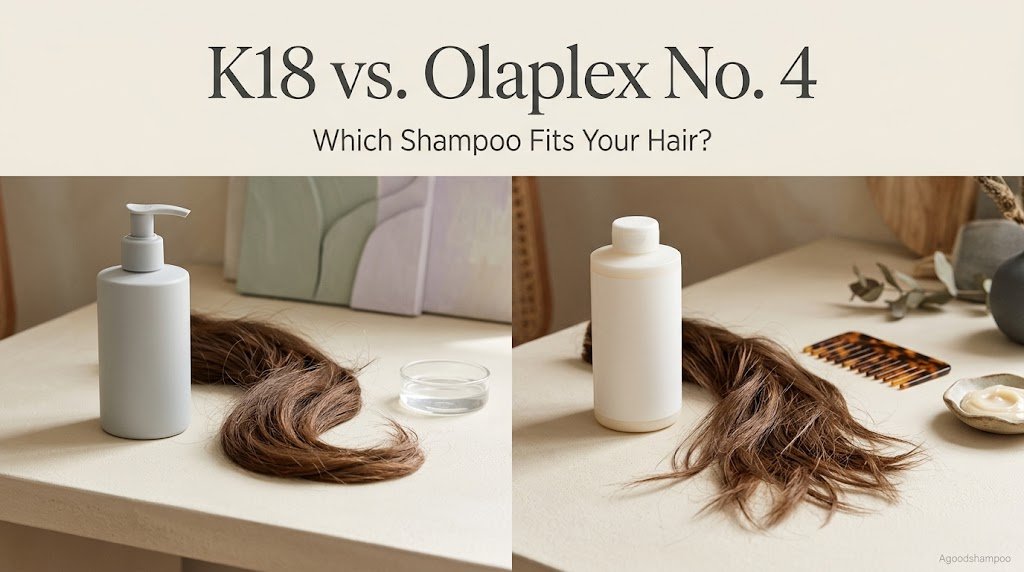
 K18 Peptide Prep and Olaplex No. 4 are premium shampoos associated with two of the best-known names in bond-repair hair care. Both target people concerned about damage, breakage, and chemically treated hair, but their ingredients and conditioning approaches differ.
K18 Peptide Prep pH Maintenance Shampoo, now called Damage Shield pH Protective Shampoo, is worth considering if you prefer a silicone-free, peptide-containing cleansing formula. Olaplex No. 4 may be a better fit if you want a shampoo with a broader conditioning system that includes silicones and conditioning polymers.
Neither shampoo has been independently established as the better choice for every hair type. The differences become clearer when you compare the actual formulas rather than treating the brands’ repair claims as directly comparable scientific results.
K18 Peptide Prep vs. Olaplex No. 4 at a Glance
| Feature | K18 Damage Shield | Olaplex No. 4 |
|---|---|---|
| Former or alternative name | Peptide Prep pH Maintenance Shampoo | Bond Maintenance Shampoo |
| Main positioning | pH-balanced protective cleansing | Bond maintenance and strengthening |
| Signature ingredient | sh-Oligopeptide-78 (K18PEPTIDE) | Bis-Aminopropyl Diglycol Dimaleate |
| Cleansing system | Includes olefin sulfonate and other surfactants | Mixed sulfate-free surfactants |
| Conditioning ingredients | Panthenol, glycerin, conditioning guar polymer | Amodimethicone, conditioning polymers, humectants |
| Silicones | None identified in the reviewed formula | Contains silicones |
| Fragrance | Yes | Yes |
| Regular washing | Designed for regular use | Designed for regular use |
| Common bottle size | 250 mL (8.5 fl oz) | 250 mL (8.5 fl oz) |
| Independently proven winner | Not established | Not established |
The biggest practical difference is not simply that K18 contains a peptide and Olaplex contains a bond-building molecule. Both products use several ingredients that contribute to the way hair feels after cleansing.
Olaplex No. 4 has a more extensive conditioning system on its published ingredient list. K18 Damage Shield uses a comparatively shorter, silicone-free formula. That distinction may influence product preference, but it does not establish which shampoo will feel lighter, clean better, or reduce breakage more effectively for an individual user.
Which K18 Shampoo Are We Comparing?
K18’s shampoo names have changed, which creates confusion when comparing products online.
The original K18 Peptide Prep pH Maintenance Shampoo is now sold as K18 Damage Shield pH Protective Shampoo.
According to K18, this was a naming change rather than a formula change.
That means older reviews of the Peptide Prep pH Maintenance Shampoo may still be relevant when they accurately describe the same formulation.
However, K18 also has a separate product called Peptide Prep Detox Shampoo.
These shampoos have different purposes.
Damage Shield is intended for regular cleansing and maintaining a comfortable hair and scalp routine. Peptide Prep Detox is positioned as a deeper-cleansing product for removing substantial residue, oil, and certain mineral deposits.
If your main concern is accumulated styling products or heavy buildup, the Detox Shampoo may be more relevant than the everyday Damage Shield formula.
Similarly, Olaplex No. 4C Bond Maintenance Clarifying Shampoo is a different product from standard Olaplex No. 4.
For a fair everyday comparison, the products discussed here are K18 Damage Shield and regular Olaplex No. 4.
What Makes Their Formulas Different?
The most meaningful distinctions involve the cleansing system, conditioning ingredients, and the brands’ proprietary technologies.
K18: A peptide-containing cleansing formula
K18 Damage Shield contains sh-Oligopeptide-78, identified by the manufacturer as K18PEPTIDE.
K18 describes this biomimetic peptide as helping reduce protein loss and support healthier-feeling hair.
Its shampoo formula also contains Sodium C14-16 Olefin Sulfonate, Cocamidopropyl Betaine, Sodium Methyl 2-Sulfolaurate, and Sodium Lauryl Sulfoacetate.
These ingredients help remove oil, dirt, and product residue.
An important detail is that Sodium C14-16 Olefin Sulfonate is not the same ingredient as Sodium Lauryl Sulfate, even though both are cleansing surfactants. Being sulfate-free does not automatically make a shampoo exceptionally mild.
A finished shampoo’s cleansing behavior depends on its complete surfactant combination, concentration, pH, and other formulation characteristics.
K18 also contains panthenol, glycerin, and Guar Hydroxypropyltrimonium Chloride. These ingredients contribute to moisture-related and conditioning properties.
The published formulation does not list conventional silicone conditioning ingredients such as dimethicone or amodimethicone.
That may appeal to people who prefer silicone-free products, although silicone-free does not necessarily mean better or more effective.
Olaplex No. 4: Bond technology and a broader conditioning system
Olaplex No. 4 contains Bis-Aminopropyl Diglycol Dimaleate, the ingredient associated with its patented Bond Building Technology.
Olaplex markets this ingredient as part of its approach to strengthening damaged hair.
The shampoo combines several cleansing surfactants, including Sodium Lauroyl Methyl Isethionate, Cocamidopropyl Hydroxysultaine, Potassium Cocoyl Glycinate, and Disodium Cocoyl Glutamate.
Its conditioning system includes amodimethicone, Polyquaternium-10, Polyquaternium-11, guar conditioning polymer, and humectant ingredients.
Amodimethicone is a silicone that can help improve hair lubrication, smoothness, and manageability. Conditioning polymers can reduce friction between strands, especially when damaged hair becomes rough or difficult to comb.
These ingredients offer a practical explanation for why Olaplex No. 4 may feel more conditioning than some simpler cleansing formulas.
However, the ingredient list alone cannot establish whether it will outperform K18 on your particular hair.
For additional detail about the formula, see our explanation of why Olaplex shampoo works for some types of damaged hair.
Is K18’s shorter ingredient list an advantage?
Not automatically.
A shorter list can make a product easier to evaluate, but ingredient count is not a scientific measure of effectiveness, gentleness, or safety.
Some ingredients are included for preservation, fragrance stability, viscosity, cleansing, or conditioning. Their number does not reveal whether a formula is well balanced.
Likewise, a longer formula is not necessarily more effective.
K18 and Olaplex make different formulation choices. The better match depends on how those choices affect cleansing, conditioning, and hair feel during actual use.
Do They Actually Repair Damaged Hair?
Both brands promote advanced damage-care technology, but the distinction between marketing claims and demonstrated shampoo performance matters.
Hair damage can involve changes to the cuticle, internal proteins, protective lipids, and structural bonds. Bleaching, chemical treatments, heat, and mechanical friction affect hair in different ways.
Olaplex emphasizes a proprietary ingredient associated with bond maintenance. K18 emphasizes a biomimetic peptide and its interaction with damaged hair.
These are not identical chemical technologies.
However, evidence supporting a proprietary ingredient or an intensive treatment does not automatically prove that a rinse-off shampoo permanently restores damaged hair.
Shampoo has a relatively short contact time. Its most immediate functions are cleansing and, depending on the formulation, improving hair feel and manageability.
K18 reports that 91% of participants in its product evaluation said their hair looked healthier, while 91% said it did not feel weighed down.
These are manufacturer-reported consumer-perception results for Damage Shield. They do not establish that the shampoo repairs 91% of hair damage or performs better than Olaplex.
Olaplex also makes strengthening and damage-care claims for its products and systems. Claims demonstrated using several products should not be attributed to No. 4 Shampoo alone.
The realistic goal with either shampoo is to clean hair comfortably while supporting a routine that limits further roughness, tangling, and breakage.
Which Shampoo Fits Your Hair Better?
Bleached or heavily processed hair
Bleached hair often has increased surface roughness, weaker areas, and greater susceptibility to breakage.
Olaplex No. 4 may appeal if you want a shampoo with multiple conditioning agents to help manage rough strands.
K18 Damage Shield may appeal if you prefer its silicone-free formula and peptide-focused positioning.
Neither product can replace the benefits of suitable conditioning, careful detangling, and reducing further chemical or heat damage.
If your hair is severely brittle, consider the whole routine rather than relying on the shampoo’s signature ingredient.
Our guide to choosing shampoo for dry, damaged hair explains additional factors to consider.
Fine hair that becomes flat easily
Fine hair can be particularly sensitive to the amount and type of conditioning material deposited during washing.
K18’s silicone-free formula may be worth trying if your current shampoo consistently leaves your hair overly coated.
But it would be inaccurate to guarantee a lighter result from K18 based on the absence of silicones alone.
Olaplex No. 4 contains more conditioning agents, which some fine-haired users may find too rich. Others may appreciate its smoothness and detangling effects.
Olaplex also sells a separate No. 4 Fine shampoo, designed specifically for finer hair. That is not the standard No. 4 formula compared here.
Dry, coarse, or curly hair
Dry or coarse hair often benefits from reduced friction and improved lubrication.
The conditioning polymers and silicones in Olaplex No. 4 may make it an appealing option if your lengths are rough or difficult to detangle.
K18 Damage Shield may still work well when followed by a conditioner that provides sufficient slip.
Curl pattern alone cannot establish which shampoo is superior.
Pay attention to how your hair feels after washing and conditioning. Persistent roughness may signal a need for better conditioning rather than a different bond-repair ingredient.
Color-treated hair
Both shampoos are marketed for use on color-treated hair.
K18 emphasizes its pH-balanced protective approach, while Olaplex combines its bond-maintenance technology with cleansing and conditioning ingredients.
Color retention depends on the particular dye, cleansing formulation, washing frequency, water exposure, and styling practices.
Neither brand has been established as universally better for preserving every type of hair color.
For broader guidance, see our shampoo recommendations for color-treated hair.
Price, Size and Everyday Value
Standard bottles of both K18 Damage Shield and Olaplex No. 4 are commonly available in approximately 250 mL sizes.
Comparing identical volumes makes the price calculation straightforward.
Price per 100 mL = Product price ÷ Bottle volume in mL × 100
A shampoo costing $35 for 250 mL, for example, costs $14 per 100 mL. This is an illustrative calculation, not a verified current price for either product.
Also consider how much shampoo you need per wash.
A product that cleans effectively with a small amount may offer better practical value than its bottle price suggests. However, claims that a product is concentrated do not establish an exact number of washes.
Shopping value also depends on availability, regional pricing, authenticity, and whether the formula suits your hair well enough to keep using.
Avoid paying more solely because a brand promises molecular repair.
What to Consider Before Switching
Before buying either shampoo, identify the reason your current product is not working.
If your hair feels dry immediately after washing, consider whether the shampoo cleans too aggressively or whether your conditioner provides enough lubrication.
If the roots feel coated, review styling products, washing frequency, and rinsing habits.
If you experience scalp itching, burning, or repeated irritation, both products contain fragrance and other ingredients that may cause individual sensitivities. Discontinue a product that triggers a reaction.
If your main issue is heavy product buildup, remember that K18 Damage Shield is not the same as K18 Peptide Prep Detox.
Also check the ingredient list on the specific bottle you purchase. Product formulations may change, and local-market packaging should take precedence over outdated online lists.
Making the Better Shampoo Choice
Choose K18 Damage Shield, formerly Peptide Prep pH Maintenance Shampoo, if you prefer a silicone-free formula, want regular cleansing with K18’s peptide technology, and are comfortable with its surfactant system.
Choose Olaplex No. 4 if you want a bond-maintenance shampoo with a more extensive conditioning system, particularly if roughness and tangling are major concerns.
Neither is a scientifically established overall winner. A shorter ingredient list does not prove K18 is gentler, and Olaplex’s additional conditioning ingredients do not prove it repairs more hair damage.
For most people, the best decision is to prioritize comfortable cleansing, manageable hair, and a conditioner suited to the lengths.
If your current routine already leaves your scalp comfortable and your hair easy to detangle, changing shampoos solely for a proprietary repair ingredient may offer little practical benefit.

Carolina Herrera writes about color-treated, damaged, and chemically processed hair. She focuses on understanding breakage, choosing suitable shampoos, and making sense of repair claims. Her goal is to help readers care for their hair with realistic expectations and informed product choices.