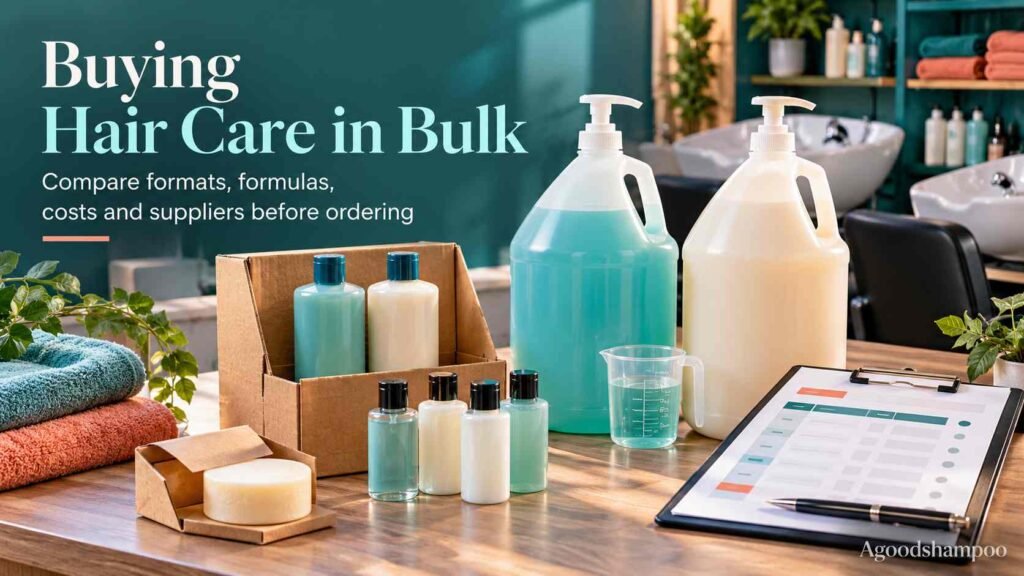
 Buying wholesale bulk shampoo and conditioner can make sense when you’re supplying a salon, hotel, spa, gym, retail store, care facility, nonprofit, vacation rental business, or simply a location that goes through hair-care products quickly.
But a large container or low case price isn’t automatically a good deal.
The useful question is: What are you getting for the total amount you spend, and does the product actually fit the people who will use it?
Bulk hair care comes in very different forms. A salon might need gallon-size back-bar shampoo. A hotel may prefer refillable dispensers or individual amenity bottles. A retailer needs consumer-ready packaging. A new beauty brand may be looking for private-label shampoo rather than somebody else’s finished product.
Those purchasing models shouldn’t be compared on price alone.
Formula, packaging, minimum order quantity, freight, storage, supplier reliability and intended hair type can matter just as much.
What Buying Shampoo and Conditioner in Bulk Actually Means
There isn’t one standard definition of bulk shampoo and conditioner.
A supplier may use the word bulk for a case containing several normal retail bottles. Another may sell one-gallon or five-liter professional containers. Hospitality suppliers may offer dozens or hundreds of small bottles. Private-label manufacturers may describe drums, bases or production runs as bulk orders.
Even solid products can qualify. Soap for Goodness Sake, for example, currently sells a bulk version of its Babassu Shampoo Bar in a ten-bar unlabeled pack. That illustrates why bulk hair care shouldn’t be assumed to mean only giant bottles of liquid shampoo.
Here are the main formats you’re likely to encounter:
| Bulk format | Typical use | Main advantage | Main issue to check |
|---|---|---|---|
| Gallon or large refill containers | Salons, spas, gyms | Lower packaging use and easy dispenser refills | Storage and dispensing |
| Cases of retail bottles | Stores, salons, online resale | Ready for individual sale | Cost per bottle and authenticity |
| Mini bottles or sachets | Hotels, rentals, travel | Convenient single-guest portions | More packaging per use |
| Refillable dispenser systems | Hotels, gyms, facilities | Fewer individual containers | Cleaning and refill procedure |
| Shampoo or conditioner bars | Hospitality, retail, low-liquid settings | Compact storage | User preference and water conditions |
| Private-label products | Beauty brands, salons, retailers | Your own branding | MOQ, labeling and regulatory responsibilities |
Before comparing suppliers, decide which of these purchasing models you actually need.
A gallon of salon shampoo, a case of twelve branded bottles and a private-label production run solve completely different problems.
Choose the Bulk Format Around How You’ll Use It
The most economical option is usually the one that fits your workflow without creating waste.
Buying too little means constant reordering. Buying too much creates its own problems: tied-up cash, storage requirements, damaged packaging, slow-moving inventory and products sitting longer than anticipated.
Salons and Spas: Back-Bar Size Versus Retail Stock
A salon normally has two distinct shampoo-and-conditioner needs.
The back bar needs working product. Large containers or refill formats can be practical because staff are using the product repeatedly rather than presenting each bottle to a retail customer.
The retail shelf is different. Products sold to clients need consumer-ready packaging, appropriate labeling and sizes customers actually want to take home.
Don’t assume the same bulk purchase is ideal for both.
A large professional container may be excellent behind the shampoo station but useless for retail. A case of attractive 250 ml bottles may be easy to sell but unnecessarily expensive for routine back-bar washing.
A salon also needs more than one formula if clients have substantially different needs. A single generic shampoo might cover straightforward cleansing, but color-treated, very dry, highly textured or frequently clarified hair can call for different product characteristics.
AGoodShampoo’s guide to choosing shampoo for color-treated hair is useful if colored hair makes up a significant part of your clientele.
Hotels, Gyms and Hospitality: Dispensers Versus Individual Amenities
Hospitality buyers face a different calculation.
Individual mini bottles look familiar and give each guest a fresh package, but they create more packaging and require frequent room-by-room replacement.
Refillable wall or countertop dispensers can reduce the number of individual containers being handled. Their success, however, depends on a reliable refill process, suitable fixtures and consistent housekeeping procedures.
A 2-in-1 formula may also deserve consideration where convenience matters more than giving every user a highly customized routine.
Technically, shampoo can contain conditioning ingredients. Research on 2-in-1 technology has described systems in which cleansing occurs while conditioning ingredients such as dimethicone are deposited on the hair during rinsing.
That doesn’t mean every 2-in-1 formula performs identically or that everyone prefers it to separate shampoo and conditioner.
For a gym shower, campsite, hostel or short hotel stay, fewer steps may be useful. For a salon serving dry, bleached or highly processed hair, separate conditioning products provide more flexibility.
A product labeled shampoo, conditioner and body wash in one should therefore be judged on its actual formulation and intended use rather than on the convenience claim alone.
Retailers: Cases, Sets and Resale-Ready Packaging
Retail buyers should think in sellable units rather than liters.
Ask how many individual products are in each case, what each sellable unit costs after freight, how the products are packaged, and whether the inventory is appropriate for your customers.
For branded products, supply-chain authenticity matters too. A very low wholesale price becomes irrelevant if products are old, damaged, diverted, incorrectly labeled or difficult to verify.
For independent brands, request enough information to understand exactly what you’re buying before scaling the order.
Compare Cost Per Usable Amount, Not Just the Wholesale Price
A supplier may advertise an attractive case price, but that number alone tells you very little.
Suppose Supplier A offers a cheaper case but requires a much larger minimum order. Supplier B charges more per bottle but lets you test a smaller quantity first. Supplier C has the lowest product price but expensive freight.
The cheapest headline price can become the most expensive commitment.
A useful calculation is:
Landed cost ÷ total usable quantity = practical cost per unit of product
For retail inventory, calculate landed cost per bottle.
For back-bar products, compare cost per ounce, fluid ounce, milliliter or liter.
For hotel amenities, compare cost per occupied room or expected guest use where you have reliable internal consumption data.
Your landed cost may include the product itself, freight, import charges where applicable, packaging, payment fees and other purchasing costs.
Minimum order quantity, usually called MOQ, also matters. MOQ tells you the smallest order the supplier or manufacturer will accept.
A low unit price attached to an MOQ far beyond what you can realistically use isn’t a saving.
Check the Formula Before Ordering a Large Quantity
Wholesale purchasing doesn’t change basic hair-care chemistry.
A product doesn’t become suitable for everyone simply because it arrives in a large container.
The main function of shampoo is cleansing the hair and scalp, while conditioner primarily improves properties such as smoothness, manageability and combing. Shampoo formulas commonly rely on surfactants for cleansing, whereas conditioners typically use combinations of conditioning agents, fatty materials, polymers, oils or silicones depending on the formulation.
For a bulk buyer, the practical lesson is simple: buy according to the users you actually serve.
If you’re choosing a general-use shampoo for a gym, you may prioritize straightforward cleansing, acceptable fragrance and ease of rinsing.
A salon working heavily with processed hair may place greater value on conditioning performance and formula choice.
A retailer needs to understand who each product is for because shelf space filled with nearly identical shampoos doesn’t give customers much reason to choose one over another.
Don’t reduce the evaluation to one ingredient either.
A sulfate doesn’t automatically tell you everything about cleansing strength. A sulfate-free label doesn’t automatically mean a shampoo will suit every dry or color-treated head. Silicones aren’t inherently evidence of a poor conditioner, and a long list of botanical extracts doesn’t prove superior performance.
What matters is the complete formula and what it is designed to do.
For buyers specifically sourcing products for colored hair, AGoodShampoo also has a guide to sulfate-free shampoo for colored hair.
When 2-in-1 Shampoo, Conditioner or Body Wash Makes Sense
A 2-in-1 can be a reasonable bulk option where speed, simplicity and reduced product handling matter.
Older but still relevant cosmetic-science literature explains how successful 2-in-1 shampoo systems can combine surfactant cleansing with deposition of conditioning ingredients during rinsing. Modern shampoo formulations can also incorporate conditioning polymers and other ingredients intended to improve combability and surface feel.
But 2-in-1 isn’t automatically the best wholesale choice.
Think about the users.
A person with short, untreated hair who wants a quick gym shower has different expectations from someone with long, bleached hair who relies on a richer conditioner for detangling.
The same applies to products marketed as shampoo and body wash in one. Convenience may be the key benefit, but you should still evaluate ingredients, fragrance, cleansing feel and intended application rather than assuming all-purpose automatically means universally suitable.
How to Check a Wholesale Shampoo and Conditioner Supplier
A good supplier should make it easier to understand what you’re buying, not harder.
Before placing a meaningful order, check the product identity, available sizes, exact case quantity, MOQ, current ingredient information where applicable, expected lead time, shipping terms, damaged-goods procedure and whether samples or small trial orders are available.
For branded resale inventory, verify the source and whether you’re permitted to sell it through your intended channels.
For private-label products, the questions become more detailed because your business name may appear on the finished package.
If you’re operating in the United States, cosmetic labeling isn’t merely a design exercise. FDA guidance states that cosmetics marketed in the U.S. must comply with applicable labeling requirements. Retail cosmetics generally require ingredient declarations, while the label also has requirements covering product identity, net quantity and the name and place of business of the firm marketing the product.
The FDA also makes clear that it does not pre-approve cosmetic product labeling. Responsibility for proper labeling rests with the manufacturer and/or distributor.
Rules differ by market, so businesses outside the U.S. should check requirements applicable to the countries where the products will actually be sold.
That becomes particularly important when a supplier says it can simply put your logo on an existing formula.
A logo is the easy part.
You still need to know who’s responsible for manufacturing, labeling, product documentation, safety compliance, claims and any market-specific requirements.
Branded Wholesale, Private Label or Bulk Base?
These three purchasing models are often grouped together even though they involve very different responsibilities.
| Option | What you’re buying | Best suited to | Main consideration |
|---|---|---|---|
| Branded wholesale | Finished products from an existing brand | Retailers and salons | Supplier legitimacy and resale economics |
| Private label | Finished formula sold under your branding | Salons, stores and new beauty brands | MOQ, labeling, claims and brand control |
| Bulk base or contract manufacturing | Product for further filling/custom production | Established operators | Manufacturing, filling, testing and compliance complexity |
Branded wholesale is the simplest concept. You’re purchasing finished inventory for use or resale.
Private label gives you more brand control. Depending on the supplier, you may choose from existing formulas, fragrances, bottle sizes and packaging options.
Custom or contract manufacturing can provide much greater flexibility, but that flexibility also creates more decisions around formulation, packaging, testing, production volume and regulatory compliance.
If you only need shampoo for salon sinks, there’s little reason to create a private-label project unless the branding itself serves a business purpose.
If your goal is to build a consumer hair-care brand, buying somebody else’s retail shampoo by the case doesn’t accomplish the same thing.
Define the business model first.
Product-Specific Searches Shouldn’t Be Confused With Wholesale Selection
Some shampoo searches sound related to bulk hair care because the products can be purchased in larger sizes, but they’re really questions about individual formulas.
Alaffia EveryDay Coconut Shampoo is one example. Alaffia currently positions its Purely Coconut shampoo for normal-to-dry hair and publishes a formula containing ingredients including potassium cocoate, lauryl glucoside, decyl glucoside and panthenol. The company also notes that its formulas may be updated and advises checking the ingredient list on the specific package.
That’s useful information if you’re evaluating that exact shampoo. It doesn’t establish whether Alaffia is the right wholesale supplier for a hotel, salon or retailer.
The same distinction applies to A Soap for Goodness Sake Babassu Shampoo and Body Bar.
The manufacturer’s current product information describes the bar as made with saponified babassu oil and intended for hair and body. The company itself says shampoo-bar suitability depends on multiple factors and suggests starting with a smaller size if you haven’t used a shampoo bar before.
Its bulk ten-bar option demonstrates an alternative purchasing format, but it doesn’t mean that bar shampoo is automatically preferable to liquid shampoo.
That distinction matters when you’re buying at scale: a product can be good at what it does without being the right product for your operation.
Buy a Test Quantity Before You Commit to a Large Order
The most useful wholesale decision often happens before the wholesale order.
Test the product.
That doesn’t necessarily mean conducting laboratory testing yourself. It means avoiding an unnecessarily large commercial commitment before you’ve confirmed the practical details.
Check how the shampoo dispenses. See whether the container works with your pumps. Confirm that the fragrance suits your environment. Examine packaging quality. Review the ingredient declaration. Make sure the conditioner has the slip and consistency you need. For retail products, inspect how the bottles actually look on the shelf.
If the supplier offers samples or a small introductory order, that can reveal problems a spreadsheet won’t.
This is especially sensible for alternative formats such as shampoo bars. Soap for Goodness Sake itself recommends trying smaller bars to determine which product works best before choosing among its shampoo-bar options.
A sample also gives you a chance to verify that the product you receive matches the information you used when making the buying decision.
When Wholesale Bulk Shampoo and Conditioner Is the Right Choice
Wholesale bulk shampoo and conditioner makes the most sense when you have predictable demand, suitable storage and a clear reason for buying at scale.
For a salon, that may mean lower-friction back-bar replenishment. For a hotel, it may mean a consistent guest-care system. For a retailer, it means buying finished units at a price that leaves enough room for operating costs and margin. For a private-label business, wholesale purchasing becomes part of a much larger manufacturing and compliance decision.
The strongest advantage of bulk purchasing is efficiency: fewer reorders and potentially lower packaging or per-unit purchasing costs.
Its biggest weakness is commitment. The larger the order, the more expensive a poor choice becomes.
So don’t choose a wholesale shampoo because it has the biggest container, the lowest advertised bottle price or the longest ingredient list.
Choose it because the formula fits the users, the format fits your operation, the supplier can support the order, and the real cost makes sense after everything is included.
That’s the difference between simply buying a lot of shampoo and making a smart wholesale purchase.

Marlena Stell makes everyday hair care easier to understand. From choosing a shampoo to managing common hair concerns, she breaks down confusing product claims and practical routines into straightforward advice that helps readers find what works for their needs.