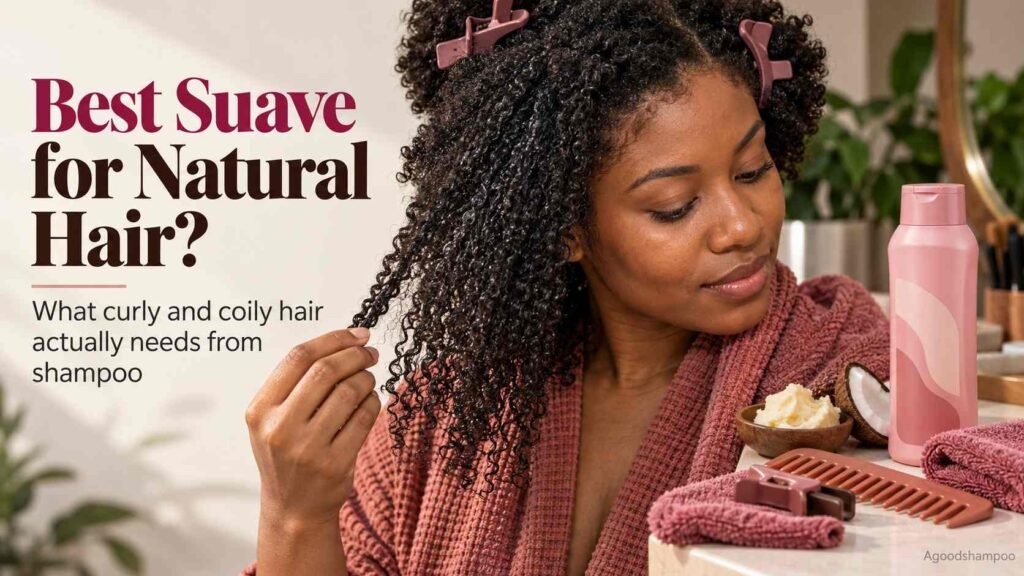
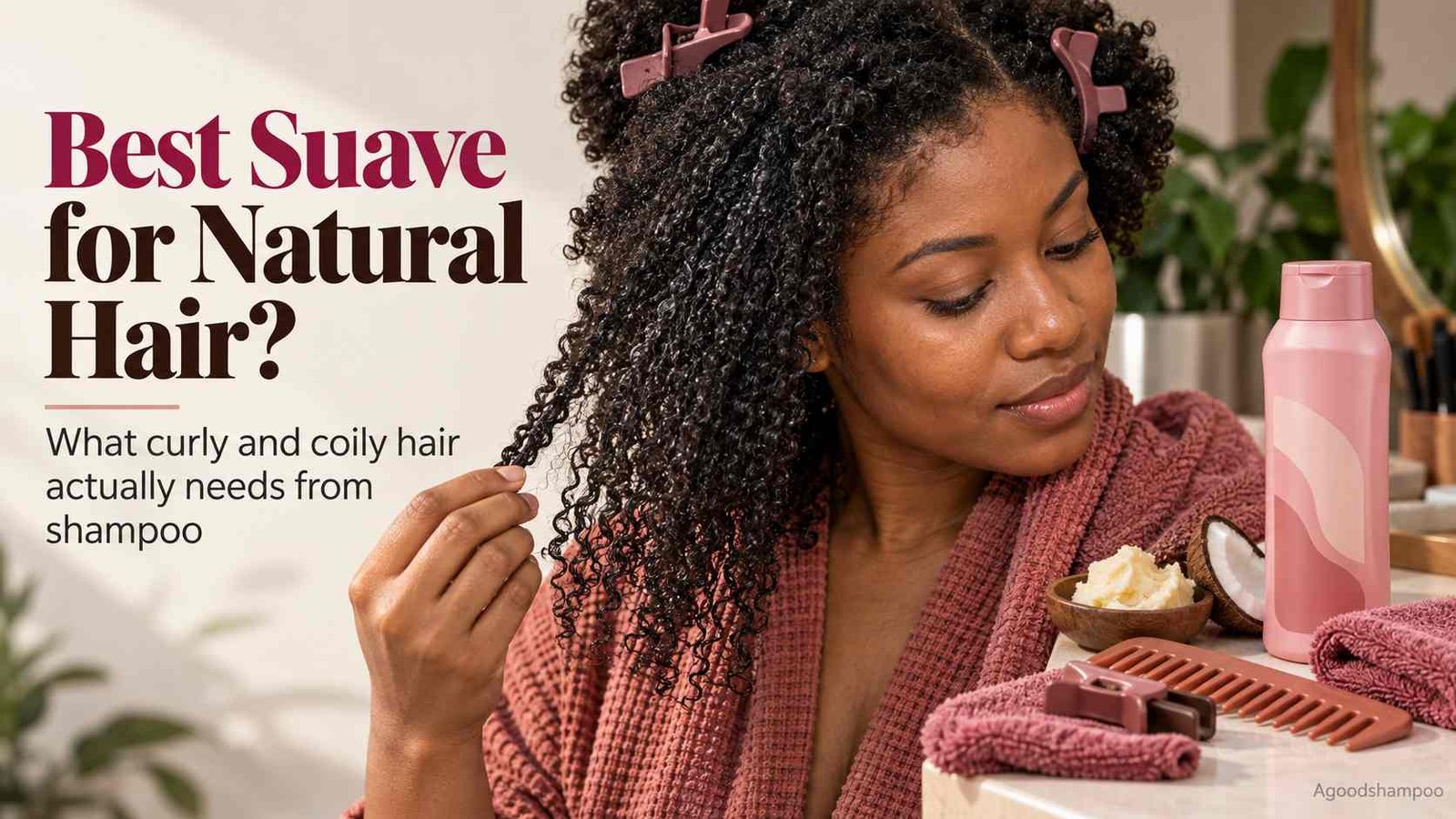
 If you’re choosing a Suave shampoo for African American hair, Suave Lush & Coily Sulfate-Free Cleansing Shampoo is the most directly targeted option in the current Suave range for natural curly and coily hair. Suave describes it as a sulfate-free cleanser made for curly-to-coily textures, with natural shea butter, coconut oil, and its Amino Complex.
That doesn’t mean it’s automatically the best Suave shampoo for every Black person.
African American hair isn’t one single hair type. Someone with tight natural coils, someone wearing a silk press, a man with short curls, and someone with chemically relaxed hair may need very different cleansing routines. Scalp oiliness, dryness, product buildup, chemical processing, styling habits, and wash frequency can matter more than ethnicity by itself.
For most people specifically looking for a Suave shampoo for natural curls and coils, though, Lush & Coily is the logical place to start.
The Best Suave Shampoo for Most Natural Black Hair
Suave currently lists Lush & Coily Sulfate-Free Cleansing Shampoo among its products for curl definition, moisture, frizz control, and damaged hair. According to the company, it:
- contains no sulfates, parabens, or dyes
- is intended to cleanse while maintaining moisture
- contains shea butter and coconut oil
- includes Suave’s Amino Complex
- is intended primarily for curly-to-coily hair
Suave also says the product can be used on dry and damaged hair and that its shampoo products are suitable for color-treated curls.
That combination makes more sense for many natural-hair routines than simply choosing whichever Suave bottle says “moisturizing.”
The important distinction is the cleansing system.
A curl-focused shampoo can still remove sweat, scalp oils, styling residue, and dirt, but people with dry curls and coils often prefer not to use a strong cleanser every time they wash. A sulfate-free formula can be useful in that situation, although “sulfate-free” shouldn’t be confused with “automatically gentle” or “better for everyone.”
The entire formula matters.
There is also one current information gap worth knowing. Suave’s official U.S. page currently lists the ingredients for Lush & Coily as “Coming Soon.” That means the brand verifies the sulfate-free claim and the presence of highlighted ingredients such as shea butter and coconut oil, but a complete current manufacturer-published INCI list isn’t available on that page at the time of review.
That limitation is important because a shampoo can’t be fully judged from its front-label claims alone.
Why Lush & Coily Makes More Sense for Curls and Coils
Curly and coily hair often needs a different balance between cleansing and conditioning than straighter hair.
Sebum produced by the scalp can travel down straight hair relatively easily. With pronounced bends, spirals, and coils, natural scalp oils may not coat the lengths as evenly. Add detangling, protective styles, gels, creams, edge products, oils, heat styling, coloring, or chemical treatments, and the ends can feel dry even when the scalp itself needs cleansing.
That is why choosing shampoo according to both the scalp and the hair shaft matters.
Suave positions Lush & Coily specifically around that balance. The company says the line was influenced by a community of more than 5,000 women with natural hair and developed for wavy, curly, and coily textures. That number describes Suave’s product-development process; it isn’t clinical evidence that the shampoo will work for 5,000 people or that it prevents breakage in everyone.
Shea butter and coconut oil are also prominent parts of the product’s marketing.
Those ingredients make sense in a moisture-focused hair-care line, but they shouldn’t be credited with effects the finished shampoo hasn’t independently demonstrated. A rinse-off shampoo spends only a limited time on the hair, and ingredient research doesn’t automatically establish the performance of the entire finished product.
What matters more for the buying decision is this: Suave designed this particular cleanser around curly and coily hair rather than asking textured-hair users to adapt a general-purpose shampoo to their routine.
If you want a broader look at whether the brand suits textured hair, see our guide on whether Suave shampoo is good for Black hair.
Which Suave Shampoo Fits Your Actual Hair Needs?
The best Suave shampoo changes once the problem changes.
| Hair or scalp need | Suave option to consider | Main consideration |
|---|---|---|
| Natural curls or coils that tend to feel dry | Lush & Coily Sulfate-Free Cleansing Shampoo | Most directly targeted Suave option for curly-to-coily hair |
| Dry or damaged hair that tolerates conventional cleansing | Almond & Shea Butter Moisturizing Shampoo | Contains sodium laureth sulfate and moisturizing ingredients |
| Heavy styling-product buildup | A dedicated clarifying shampoo may make more sense | Use according to buildup and scalp needs rather than as an automatic daily cleanser |
| Oily roots between full washes | Dry shampoo can temporarily refresh roots | Doesn’t replace washing with water and shampoo |
Natural, Dry, Curly or Coily Hair
For this group, Lush & Coily is the strongest Suave match.
It belongs to Suave’s current curl-definition and moisture collections and is specifically described as suitable for curly-to-coily hair.
That makes it particularly relevant if your main concerns are maintaining curl feel, avoiding unnecessarily aggressive cleansing, and keeping dry lengths manageable.
Still, don’t assume a moisturizing cleanser will remove every type of buildup indefinitely. Heavy use of gels, edge controls, oils, butters, waxes, silicones, or protective-style products can eventually change what your scalp and hair need.
Dry or Damaged Hair That Tolerates Stronger Cleansing
Another Suave option is Almond & Shea Butter Moisturizing Shampoo.
Suave markets it for dry or damaged hair and publishes a current ingredient list that begins with water, sodium laureth sulfate, cocamidopropyl betaine, sodium chloride, and glycerin. It also contains sweet almond oil, shea butter, jojoba oil, aloe extract, dimethiconol, fragrance, and several botanical extracts.
That makes it meaningfully different from Lush & Coily.
Sodium laureth sulfate is a conventional cleansing surfactant. Its presence doesn’t automatically make a shampoo harsh or unsuitable for Black hair, just as the absence of sulfates doesn’t automatically make another shampoo superior.
But if your natural hair already feels dry after washing, the Lush & Coily formula is the more obvious first product to investigate because Suave explicitly designed it around curly-to-coily textures.
Almond & Shea Butter may appeal more to someone who wants a richer conventional shampoo and whose scalp and hair respond well to it.
Natural, Relaxed, Braided and Men’s Hair Don’t Need the Same Routine
One of the biggest problems with searching for “a good shampoo for African American hair” is that the phrase makes very different routines sound interchangeable.
They aren’t.
Someone wearing loose natural curls may wash and condition differently from someone maintaining braids for several weeks. Relaxed hair has undergone chemical processing. Locs create different concerns around residue and rinsing. A short haircut exposes much less hair shaft than waist-length coils.
Even gender isn’t a useful way to choose shampoo by itself.
A good shampoo for an African American man doesn’t need to say “men” on the bottle. A man with dry, coily hair may be better served by a moisturizing curl cleanser than by a strongly fragranced multipurpose men’s product.
Suave currently sells a men’s Aloe Vera & Vitamin 3-in-1 shampoo, conditioner, and body wash, but being marketed to men doesn’t make it more appropriate for coily hair.
Choose according to the problem you’re trying to solve:
Dry coils: prioritize manageable cleansing and conditioning.
Oily scalp: you may need more effective scalp cleansing even if the lengths are dry.
Relaxed or color-treated hair: pay more attention to chemical damage, breakage, and conditioning.
Braids or protective styles: scalp accessibility, sweat, residue, and rinsing become especially important.
Heavy styling-product use: occasional deeper cleansing may be useful.
The label “African American hair” is therefore a starting point for understanding texture and styling patterns, not a complete shampoo prescription.
Dry Shampoo and Baby Shampoo Solve Different Problems
Two related searches regularly appear around Black hair care: whether dry shampoo is useful and whether baby shampoo is gentle enough.
They solve different problems.
Dry shampoo doesn’t actually replace a conventional shampoo wash. It generally uses powders or starch-like absorbent ingredients to reduce the appearance and feel of excess oil between washes.
That can be convenient with silk presses, braids, protective styles, or situations where frequent wet washing isn’t practical. AARP’s textured-hair guidance, quoting hairstylist Tamara Johnson, describes dry shampoo as a temporary refresh rather than a substitute for regular shampooing.
Suave currently sells several dry shampoos, including Fresh Citrus & Vanilla, Bamboo & Hibiscus Volumizing, and Sweet Coconut Refreshing Dry Shampoo.
If that’s what you need, our guide to dry shampoo for African American hair goes deeper into that decision.
Baby shampoo is different. A product being labeled for babies doesn’t mean it’s automatically the ideal shampoo for natural Black hair. Baby shampoos are formulated around infant-use considerations, while adults wearing gels, oils, protective styles, or heavy conditioners may need different cleansing performance.
If dryness is your concern, choosing a shampoo specifically developed for curly or dry adult hair usually makes more sense than choosing baby shampoo simply because you assume it must be mild.
When Black Hair Needs a Clarifying Shampoo Instead
A moisturizing shampoo can be a poor solution when the actual problem is buildup.
Natural-hair routines commonly involve leave-ins, curl creams, oils, gels, edge-control products, mousses, butters, and styling sprays. None of those products are automatically harmful, but residue can accumulate.
Signs that deeper cleansing may be worth considering include hair that still feels coated after washing, unusually dull curls, residue around the scalp, or styling products that no longer seem to behave normally.
That doesn’t mean every case of itching, flaking, or scalp discomfort is “buildup.” Persistent itching, inflammation, sores, unusual shedding, or severe flaking can have other causes and deserve proper assessment rather than repeated aggressive cleansing.
Clarifying shampoo is best thought of as a different tool, not as proof that your normal moisturizing shampoo has failed.
Someone washing lightly styled natural coils may need it far less often than someone layering multiple oils, gels, edge products, and silicone-rich styling products.
If buildup is your main concern, see our detailed guide to choosing a clarifying shampoo for Black hair.
What About Dove Shampoo for African American Hair?
Dove is another frequently compared drugstore brand, but there isn’t a useful rule that says Dove is “better for Black hair” or Suave is “better for Black hair.”
The exact formula matters more than the logo.
A moisturizing Dove shampoo may suit one person’s dry, chemically treated hair better, while Suave Lush & Coily may be the more logical choice for another person specifically seeking a sulfate-free cleanser aimed at natural curls and coils.
The same principle applies when comparing almost any mainstream shampoo brands: evaluate the specific shampoo, scalp condition, hair texture, styling routine, and cleansing needs, not just the company name.
Our broader guide on whether Dove shampoo is good for hair explains how to evaluate Dove formulas in the same way.
Who Should Choose Suave Lush & Coily, and Who Should Look Elsewhere?
Suave Lush & Coily Sulfate-Free Cleansing Shampoo is the Suave shampoo I’d consider first for natural African American hair that is curly, coily, dry, or prone to feeling stripped after cleansing.
That recommendation comes mainly from product positioning and formulation characteristics Suave currently verifies: the shampoo is sulfate-free, made for curly-to-coily hair, and part of the company’s moisture and curl-care range.
It makes less sense to choose it automatically if your biggest problem is stubborn buildup, a very oily scalp, or residue from heavy styling products. In those situations, a more cleansing or clarifying shampoo may sometimes be the better tool.
Likewise, someone with chemically relaxed, bleached, or badly damaged hair should look beyond ethnicity and assess damage level, breakage, conditioning needs, and treatment compatibility.
The strongest point in Lush & Coily’s favor is that it is one of Suave’s few shampoos explicitly designed around curly and coily hair rather than merely being marketed as universally moisturizing.
Its biggest limitation is that Suave’s current official product page does not publish the complete ingredient list, so a full current manufacturer-verified formulation analysis isn’t possible.
For most readers with natural coils or curls asking specifically which Suave Professional shampoo is good for African American hair, Lush & Coily is therefore the clearest first choice. The next step is to judge how your scalp and hair respond, then adjust the routine if dryness or buildup tells you that your cleansing needs have changed.

Marlena Stell makes everyday hair care easier to understand. From choosing a shampoo to managing common hair concerns, she breaks down confusing product claims and practical routines into straightforward advice that helps readers find what works for their needs.