 If you want a shampoo that is good for removing dandruff, start by looking at the active ingredient, not the brand name on the front of the bottle.
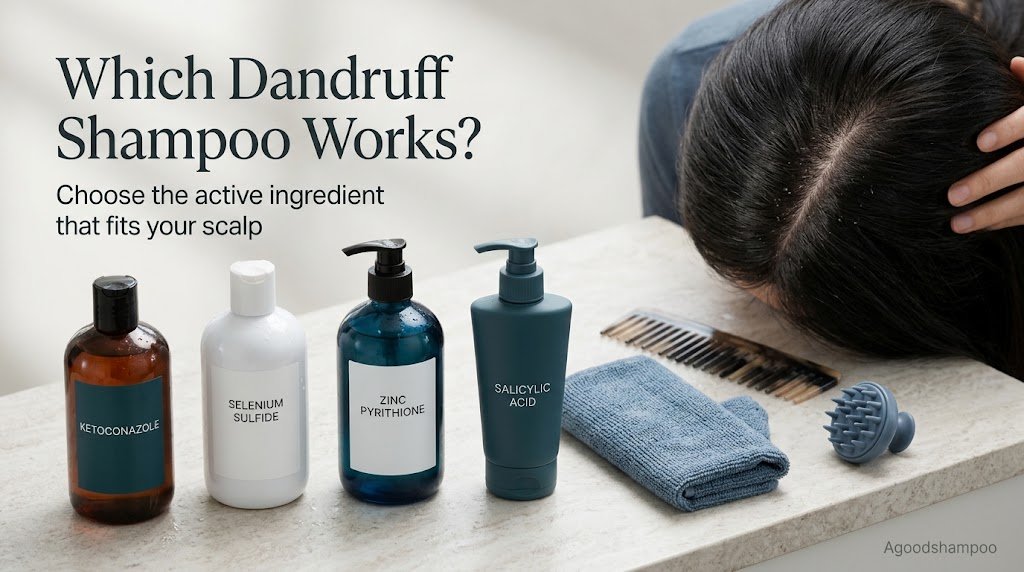
The American Academy of Dermatology lists ketoconazole, selenium sulfide, zinc pyrithione, salicylic acid, sulfur and coal tar among ingredients used in dandruff shampoos. They don’t all work in exactly the same way, and one shampoo may work better for your scalp than another.
For recurring itchy or oily dandruff, an antifungal active such as ketoconazole or selenium sulfide is often a logical option to consider. Salicylic acid is more useful when thick scale and stuck-on flakes are part of the problem. Your hair texture matters too because some medicated shampoos can leave curly, coily or dry hair feeling rough if they’re used too frequently.
The important point is that dandruff usually needs control rather than a once-and-for-all cure. Mayo Clinic states that dandruff symptoms can return after treatment, although most people can manage them successfully.
Which Shampoo Is Good to Remove Dandruff?
A good dandruff shampoo contains an active ingredient suited to the type of flaking you’re dealing with and is used according to its directions.
Here’s a practical starting point:
| Active ingredient | Main role in dandruff care | May make sense when |
|---|---|---|
| Ketoconazole | Antifungal action | Dandruff repeatedly returns or is associated with seborrheic dermatitis |
| Selenium sulfide | Helps control dandruff-associated yeast and scaling | Scalp is oily, itchy and persistently flaky |
| Zinc pyrithione | Anti-dandruff antimicrobial active | General dandruff control where products containing it are available |
| Salicylic acid | Loosens and removes scale | Flakes are thick or stuck to the scalp |
| Sulfur | Used in some anti-dandruff formulas | Flaking and scaling need additional control |
| Coal tar | Slows excessive skin-cell turnover | Persistent scaling in appropriate users |
These ingredients shouldn’t be treated as interchangeable miracle cures. Product strengths, directions, availability and formulas can vary by country.
The AAD also recommends trying a shampoo with a different active ingredient if the first dandruff shampoo doesn’t work.
That is more useful than repeatedly buying different brands that all rely on essentially the same treatment approach.
Ketoconazole for recurring dandruff
Ketoconazole is an antifungal ingredient used in medicated shampoos for dandruff and seborrheic dermatitis.
Mayo Clinic includes ketoconazole among dandruff shampoo ingredients that help reduce or slow fungi involved in dandruff.
It can be a sensible option when dandruff:
- keeps returning after ordinary shampooing
- comes with itching
- is associated with oily or scaly areas
- has not responded well to ordinary cosmetic shampoos
That doesn’t mean every person with flakes should immediately choose ketoconazole.
A flaky scalp can also result from dryness, product irritation, psoriasis, eczema or other scalp conditions. Mayo Clinic notes that several different conditions can produce dandruff-like symptoms.
If you keep treating what you assume is dandruff and nothing improves, the diagnosis may be the more important question.
Selenium sulfide and Selsun Blue
Selenium sulfide is another established anti-dandruff active.
If you’re specifically wondering which Selsun Blue shampoo is good for dandruff, check the active ingredient and strength on the exact bottle rather than choosing by bottle color or product name alone.
Selsun Blue is strongly associated with selenium sulfide anti-dandruff formulas, but products can differ between markets and product lines.
Our dedicated guide on whether Selsun Blue is good for dandruff explains that distinction in more detail. Selsun Blue dandruff shampoo guide
Selenium sulfide may make particular sense when flakes come with an oily, itchy scalp or recurring seborrheic dermatitis-type symptoms. Mayo Clinic lists selenium sulfide among nonprescription dandruff shampoo actives.
One detail is easy to miss: don’t assume instructions for one selenium sulfide shampoo apply to another.
Different strengths and formulas may have different contact times and usage schedules. Follow the label on the product actually in your hand.
Salicylic acid when flakes are stuck to the scalp
Salicylic acid works differently from an antifungal shampoo.
Its main advantage is scale removal. It helps loosen dead skin so thick flakes are easier to wash away.
That makes it useful when you can feel buildup or scale attached to the scalp rather than simply seeing a few loose flakes on your shoulders.
But loosening flakes isn’t necessarily the same as addressing every factor behind recurring dandruff.
Some people may therefore use salicylic acid as part of a routine rather than assuming it is automatically the best treatment for all dandruff.
It can also feel drying on some hair types, which matters if your scalp needs treatment while your lengths are already dry.
Zinc pyrithione, sulfur and coal tar
Zinc pyrithione has a long history in anti-dandruff shampoos and remains listed by the AAD among common dandruff-shampoo ingredients. Availability can vary by market, so check the current label rather than relying on an old online ingredient list.
Sulfur also appears in dandruff treatments, although it is less prominent in many modern shampoo aisles.
Coal tar can help control scaling by affecting skin-cell turnover, but it has some practical disadvantages. The AAD warns that coal-tar shampoos may increase scalp sensitivity to sunlight. Mayo Clinic also notes that some coal-tar shampoos can stain or darken lighter-colored hair.
So “stronger” isn’t automatically “better.” The right shampoo has to work for your scalp without creating a new problem for your hair.
How to Use Dandruff Shampoo So It Actually Reaches Your Scalp
Buying a medicated shampoo and washing it out like an ordinary cosmetic shampoo may not give the active ingredient enough time to work as intended.
Dandruff shampoo is primarily scalp treatment, not a hair-length treatment.
Apply it to the scalp, work it into the areas where you actually experience flakes or itching, and follow the bottle’s instructions before rinsing.
The AAD notes that some dandruff shampoos may need to remain on the scalp for up to 5 to 10 minutes, depending on the product.
That does not mean every dandruff shampoo should sit for 10 minutes.
Use this routine instead:
- Wet the scalp and hair thoroughly.
- Apply the medicated shampoo mainly to the scalp.
- Massage gently rather than scratching with your nails.
- Leave it on for the time stated on the bottle.
- Rinse thoroughly.
- Condition the lengths if they need moisture.
- Repeat only as often as the product directions and your hair type allow.
If the shampoo causes significant burning, stinging or worsening irritation, stop using it. Mayo Clinic advises discontinuing dandruff shampoo that causes itching, burning or stinging and seeking medical help for signs of an allergic reaction.
Frequency matters too.
People with oily scalps or naturally straight, fine hair may shampoo more often than people with coarse, curly or coily hair. That difference changes how medicated shampoo should fit into the routine.
The Best Dandruff Shampoo for Curly Hair Needs a Different Routine
The best dandruff shampoo for curly hair isn’t necessarily a completely different medicine. What often changes is how frequently you use it and where you apply it.
The AAD specifically advises people with curly or coily hair to concentrate dandruff shampoo on the scalp because dandruff-treatment ingredients may dry the hair. It suggests using dandruff shampoo about once weekly when tolerated, compared with more frequent washing that may suit oily, straight or fine hair.
That creates a useful scalp-versus-hair distinction.
Your scalp may need an effective dandruff active.
Your curly lengths may need moisture and conditioning.
Those are not conflicting goals.
You can apply the medicated shampoo primarily to the scalp, rinse it through the hair rather than aggressively scrubbing the lengths, and follow with conditioner where needed.
Mayo Clinic also notes that ketoconazole can increase dryness and breakage risk in tightly coiled or chemically treated hair, which is another reason not to treat frequency as one-size-fits-all.
If you also have oily roots and dry lengths, our guide to choosing shampoo for an oily scalp and dry hair covers that combination in more detail. choosing shampoo for an oily scalp and dry hair
Can You Remove Dandruff Forever?
Probably not in the permanent sense that many searches imply.
The phrase how to remove dandruff forever sounds reasonable because flakes feel like something that should disappear once the right product is found.
Dandruff doesn’t usually behave that way.
Mayo Clinic states clearly that there is no cure for dandruff and that symptoms may return even after treatment. Most people, however, can manage it.
This changes the goal.
Instead of asking, “What shampoo will cure this forever?” a more useful question is:
What shampoo controls my dandruff, and what maintenance routine keeps it from coming back as quickly?
Once symptoms improve, some people can reduce how often they use medicated shampoo rather than stopping completely.
Mayo Clinic notes that after dandruff improves, maintenance use may help prevent relapse.
If one active stops controlling your dandruff well, alternating or switching to another active may also make more sense than simply increasing the amount you use.
And if regular dandruff shampoo doesn’t improve the problem after several weeks, professional assessment becomes important.
Persistent “dandruff” may sometimes be seborrheic dermatitis, psoriasis, eczema, contact dermatitis or another scalp disorder requiring a different approach.
Dry Shampoo Does Not Replace Dandruff Shampoo
A dry shampoo for dandruff sounds convenient, especially if your roots become oily between wash days.
But conventional dry shampoo and dandruff shampoo do different jobs.
Dry shampoo mainly absorbs oil and helps hair look or feel fresher without water. It doesn’t automatically contain a recognized dandruff-treatment active, and it doesn’t replace washing and treating the scalp.
This distinction matters because buildup is not the same thing as dandruff.
If your scalp is flaky, itchy and oily, repeatedly adding powder or starch-based dry shampoo can temporarily improve the appearance of greasy roots without treating the underlying scalp problem.
Use dry shampoo as a styling or oil-management product if it suits you.
Use actual dandruff treatment for dandruff.
People interested in gentler or botanical approaches can also read our guide to natural shampoo options for dandruff, but “natural” should not be confused with stronger clinical evidence. natural shampoo options for dandruff
What If You Have Hair Loss and Dandruff at the Same Time?
This is where shampoo claims need especially careful wording.
A shampoo that’s good for dandruff is not automatically a shampoo for hair growth, and treating dandruff does not prove that new hair will grow.
Dandruff concerns the scalp.
Hair growth happens at the follicle level.
Those are related parts of the same area, but they aren’t the same biological problem.
If dandruff makes your scalp itchy, controlling it may reduce discomfort and scratching. Better scalp management can also make your hair-care routine easier.
That is different from treating androgenetic alopecia, alopecia areata, telogen effluvium, hormonal hair loss, nutritional deficiency, thyroid-related shedding or other causes of hair loss.
Seborrheic dermatitis itself does not cause permanent hair loss, according to Mayo Clinic.
So if you’re searching for which shampoo is good for hair loss and dandruff, separate the questions.
For dandruff, choose a shampoo based on an appropriate anti-dandruff active.
For significant hair loss, find out why the hair is being lost.
The same applies to which shampoo is good for hair growth and dandruff. A dandruff shampoo may improve scalp symptoms, but that should not be translated into a claim that it stimulates meaningful new hair growth.
Pay closer attention when shedding comes with:
- obvious bald or thinning patches
- sudden heavy shedding
- painful scalp inflammation
- open sores
- thick crusting
- pus or possible infection
- symptoms that continue despite dandruff treatment
Those signs deserve medical assessment rather than another cosmetic shampoo experiment.
Which Dandruff Shampoo Should You Start With?
The best starting point depends on what your scalp is actually doing.
If your scalp is oily, itchy and repeatedly flaky, consider a recognized antifungal-type dandruff active such as ketoconazole or selenium sulfide and follow the product directions.
If the main problem is thick scale stuck to your scalp, a salicylic-acid shampoo may help loosen buildup.
If your dandruff is mild, regular cleansing plus a conventional anti-dandruff active may be enough.
If you have curly, coily, bleached or very dry hair, focus the medicated shampoo on the scalp and be more conservative with frequency. Protect the lengths with appropriate conditioning.
If one shampoo doesn’t work, don’t assume dandruff shampoo as a whole has failed. Check the active ingredient. Trying another appropriate active may be more useful than switching to another bottle containing the same one. The AAD specifically recommends considering dandruff shampoos with different active ingredients when one isn’t effective.
And if nothing improves after several weeks, don’t keep escalating your routine blindly.
Mayo Clinic recommends seeing a healthcare professional when dandruff doesn’t improve with regular use of dandruff shampoo.
The most useful answer to which shampoo is good to remove dandruff is therefore not one brand name.
Choose a shampoo with a proven dandruff active that matches your scalp needs, apply it to the scalp correctly, give it the label-specified contact time, adjust frequency for your hair texture, and switch treatment strategy if it isn’t working.
For many people, that turns dandruff from a recurring guessing game into a manageable scalp-care routine.

Marlena Stell makes everyday hair care easier to understand. From choosing a shampoo to managing common hair concerns, she breaks down confusing product claims and practical routines into straightforward advice that helps readers find what works for their needs.