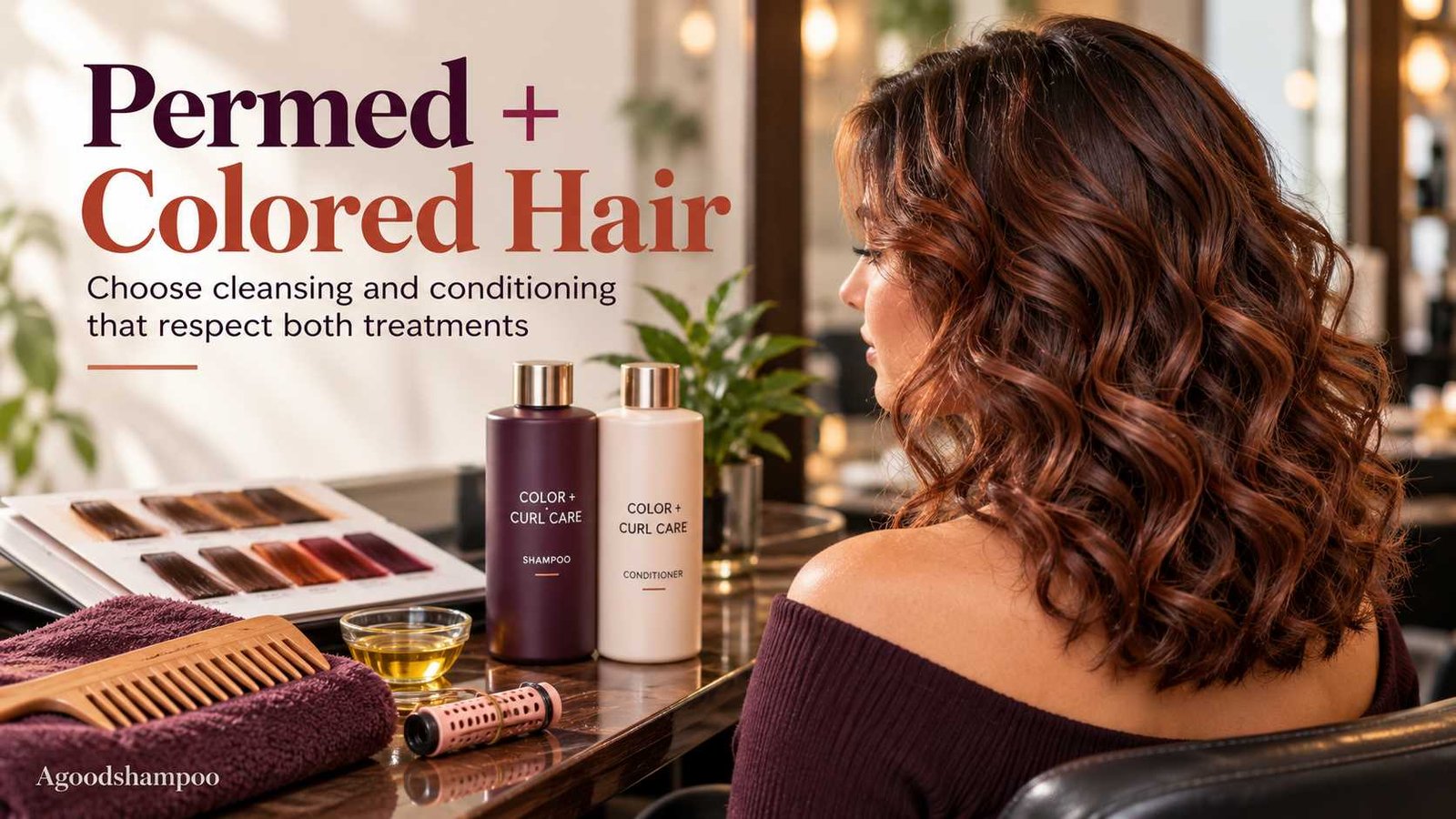
 Hair that has been both permed and colored needs more thoughtful care than hair that has gone through only one chemical treatment. In one laboratory study of repeatedly digitally permed hair, the most heavily treated samples showed up to a 58% decrease in measured protein content after three treatments. That figure does not describe what happens after one normal perm, but it does illustrate why repeated chemical processing can leave the hair fiber more vulnerable to dryness, roughness, and breakage.
A good shampoo for permed and colored hair should therefore clean the scalp without making the lengths feel increasingly stripped. The best choice is usually a formula with an appropriate cleansing system, useful conditioning ingredients, and enough gentleness for your wash frequency. Sulfate-free can be helpful, but it is not automatically better. Argan oil can add conditioning value, but it does not make an otherwise unsuitable shampoo ideal.
The whole formula matters.
What Makes a Shampoo Good for Hair That Is Both Permed and Colored?
Perming and coloring affect hair in different ways, but both can increase the amount of care your hair needs afterward.
Permanent waving changes the chemical structure of the hair so it can hold a new shape. Traditional perm chemistry works by reducing some of the disulfide bonds within keratin and then reforming bonds during the neutralizing step. Hair coloring can also alter the cuticle and internal hair structure, particularly when permanent color or lightening is involved.
That does not mean every head of permed and colored hair is severely damaged. Hair thickness, previous treatments, technique, frequency, aftercare, and the condition of the hair before treatment all matter.
The American Academy of Dermatology advises that chemical treatments such as coloring and perming can contribute to dry, brittle hair. That makes the shampoo decision less about finding one miracle ingredient and more about avoiding unnecessary stress during routine cleansing.
For most people, a suitable shampoo should do three things well:
- Remove scalp oil, sweat, and styling residue without leaving the lengths excessively rough.
- Work alongside a conditioner that improves slip and reduces tangling.
- Fit the person’s actual scalp and hair needs rather than relying only on labels such as natural, sulfate-free, repair, or nourishing.
Someone with an oily scalp may still need stronger cleansing than someone with dry roots and very porous ends. The goal is not the weakest shampoo possible. It is the right cleansing strength for your hair and scalp.
Look at the Cleansing System Before the Marketing Claims
Sulfates get much of the attention in discussions about chemically treated hair, but judging a shampoo by one ingredient category can be misleading.
Sulfate surfactants such as sodium lauryl sulfate or sodium laureth sulfate are effective cleansers. Depending on concentration and the rest of the formulation, they can produce stronger cleansing than some milder alternatives. But the presence of a sulfate does not automatically prove that a shampoo is harsh.
The reverse is also true. A shampoo can be sulfate-free and still feel too cleansing for dry, highly processed hair.
What matters is the complete surfactant system, the amount of conditioning built into the formula, your washing frequency, and how your hair responds after several washes.
Is Sulfate-Free Shampoo Good for Permed Hair?
A sulfate-free shampoo can be a sensible option for permed hair, especially when the hair also feels dry, coarse, porous, or color-treated. Milder cleansing can help some people avoid the squeaky, rough feeling that follows over-cleansing.
That said, sulfate-free should be treated as a starting point, not a guarantee.
If a sulfate-free shampoo leaves your roots greasy, causes buildup, or requires repeated washing to get the scalp clean, it may not be the best choice for you. Conversely, a well-formulated shampoo containing a sulfate may still work well when used less often and followed by an effective conditioner.
For readers comparing options, our guide to sulfate-free shampoo for permed hair is a useful next step, while those primarily worried about fading can also look at sulfate-free shampoo for colored hair.
Moisture, Conditioner, Oils and Protein Matter After Chemical Processing
Shampoo gets the attention because it cleans the hair, but conditioner may make an even bigger difference to how permed and colored lengths feel after washing.
Chemically processed hair often benefits from formulas designed to improve lubrication and reduce friction between strands. That can make detangling easier and reduce the mechanical stress caused by brushing or combing wet hair.
Here is what common formula features can contribute:
| Formula feature | Why it may matter |
|---|---|
| Conditioning agents | Improve slip, softness and manageability |
| Humectants | Help support moisture retention in the hair fiber |
| Oils and emollients | Improve lubrication and reduce a dry feel |
| Hydrolyzed proteins | May temporarily improve the feel of some damaged hair |
| Silicones | Can smooth the surface, improve shine and reduce friction |
| Strong clarifying cleansers | Useful occasionally for buildup but may feel too drying for frequent use |
None of these ingredients repairs hair in the sense of restoring chemically altered fibers to their original untouched condition. Most shampoo and conditioner benefits are cosmetic: smoother texture, better slip, reduced friction, easier detangling, and improved appearance.
That distinction matters because repair claims can sound stronger than the evidence behind them.
A well-chosen shampoo and conditioner for permed hair is usually more useful than focusing on shampoo alone.
Is Argan Oil Shampoo Good for Permed Hair?
Argan oil can be useful in products designed for dry or chemically processed hair because oils can improve lubrication and help hair feel softer.
But the phrase argan oil shampoo tells you very little about the strength of the cleanser.
A shampoo could contain argan oil and still use a cleansing system that feels too strong for your hair. It could also contain only a small amount of oil compared with the surfactants and conditioning ingredients around it.
So rather than choosing an argan oil shampoo purely because argan oil appears on the front label, check what the complete formula is designed to do.
An argan-oil-containing shampoo makes the most sense when it combines appropriate cleansing with conditioning support and your hair actually feels manageable after repeated use.
Is Aussie Shampoo Good for Permed and Colored Hair?
Aussie cannot be judged as one single shampoo formula.
Different Aussie shampoos use different cleansing systems, which means one may suit dry, processed hair better than another. Current formulations in the US have included products such as Miracle Moist and Miracle Curls that use sodium lauryl sulfate, while other products such as Miracle Coils have used different sulfate-free cleansing systems.
That does not make one automatically good and another automatically bad.
If your permed and colored hair is already dry, coarse, or easily tangled, a more conditioning formula may be the better starting point. If your scalp becomes oily quickly or you use heavy styling products, stronger cleansing may occasionally be useful.
The better question is therefore not simply Is Aussie shampoo good for permed hair? It is Which Aussie formula matches the condition of my scalp, curl pattern, color treatment, and lengths?
Readers considering the brand specifically can compare that decision with our guides to Aussie as a shampoo brand and Aussie Miracle Moist for colored hair.
A Simple Wash Routine for Keeping Processed Hair Manageable
The way you use shampoo matters almost as much as the product you choose.
- Concentrate shampoo on the scalp.
Massage it through the roots, where oil and buildup accumulate. You usually do not need to scrub shampoo aggressively through fragile ends. - Let the rinse clean the lengths.
As the shampoo rinses out, the diluted cleanser passes through the rest of the hair. - Use conditioner every wash if your hair needs it.
Apply it mainly to the mid-lengths and ends, where chemically processed hair is often driest. - Detangle carefully.
A wide-tooth comb or gentle detangling method can reduce pulling on wet hair. - Adjust washing frequency rather than forcing a schedule.
An oily scalp may need more frequent cleansing. Dry, tightly curled, or highly processed hair may feel better with fewer washes. - Limit unnecessary heat.
Repeated high-temperature styling can add another source of stress to hair that has already been chemically treated.
If your perm is new, also follow the specific timing and aftercare instructions given by the stylist or product manufacturer before the first wash.
What Should You Actually Buy for Permed and Colored Hair?
Choose a shampoo based on cleansing strength and overall conditioning support, not one fashionable ingredient.
For dry or coarse permed and colored hair, a moisturizing shampoo with a relatively mild cleansing system is usually the most sensible place to start. Pair it with a conditioner that gives good slip and makes the hair easier to detangle.
A sulfate-free shampoo may suit you well if frequent washing or stronger cleansers leave the hair rough. An argan oil formula may be useful when additional softness is needed. Protein-containing products can also help some damaged hair feel stronger or fuller, but more protein is not automatically better for every person.
If your scalp is oily, do not be afraid of effective cleansing. You may simply need to balance a cleaner scalp with richer conditioning on the lengths.
Most importantly, look at how your hair behaves after several washes. A good shampoo for permed and colored hair should leave the scalp clean while the curls remain manageable, the lengths do not become progressively rougher, and your conditioner can do its job effectively.
That practical result tells you more than sulfate-free, argan oil, repair, or color-safe written on the front of the bottle.

Carolina Herrera writes about color-treated, damaged, and chemically processed hair. She focuses on understanding breakage, choosing suitable shampoos, and making sense of repair claims. Her goal is to help readers care for their hair with realistic expectations and informed product choices.