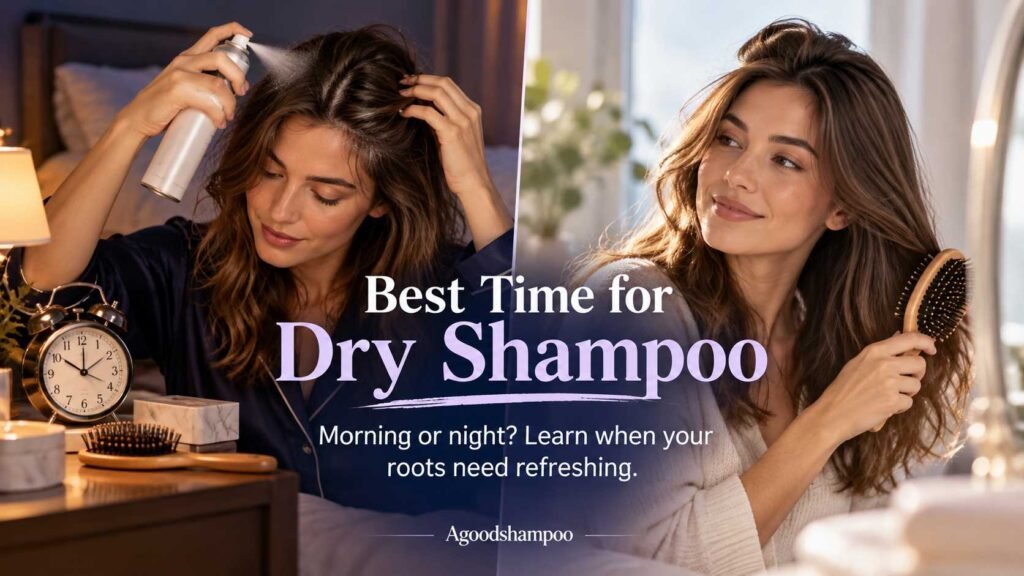
 Dry shampoo can save a hairstyle when your roots turn greasy before you’re ready to wash your hair. But timing makes a difference. Apply it too late, after your scalp has accumulated substantial oil and sweat, and you may end up using more product than you need.
The best time to use dry shampoo is when your roots begin to look or feel oily, usually between regular washes. You can apply it in the morning for an immediate refresh or before bed to absorb some oil overnight. Neither timing is automatically better for everyone. Your scalp condition, hair texture, and styling routine matter more than the clock.
According to the American Academy of Dermatology (AAD), dry shampoo absorbs oil but does not actually clean your hair or scalp. The organization advises washing with regular shampoo and water after one or two dry-shampoo applications. That’s an important distinction if you’re using the product to stretch the time between washes.
When Is a Good Time to Use Dry Shampoo?
A good time to use dry shampoo is when your hair still feels reasonably clean overall, but the roots are beginning to lose their fresh appearance. The product is particularly useful for absorbing excess sebum, the natural oil produced by your scalp, without wetting or restyling your entire head of hair.
Think of dry shampoo as a temporary styling refresh rather than an alternative cleaning method.
Different situations call for slightly different approaches.
| Situation | Is dry shampoo useful? | Best approach |
|---|---|---|
| Roots look slightly greasy in the morning | Yes | Apply lightly before styling |
| Hair tends to become oily overnight | Yes | Try a small amount before bedtime |
| Hair needs refreshing between washes | Yes | Target oily roots only |
| Hair is sweaty after exercise | Sometimes | Let hair and scalp dry first |
| Scalp feels itchy or has significant buildup | Usually not | Wash appropriately and assess the cause |
| Hair is clean but lengths feel dry | Usually unnecessary | Use suitable conditioning care instead |
The key is to use enough product to improve the appearance of oily roots without unnecessarily coating the scalp.
If the hair still looks fresh, there’s usually no reason to add dry shampoo simply because it’s part of your daily routine.
Should You Use Dry Shampoo Before Bed or in the Morning?
Both approaches can work. The better choice depends on whether you’re trying to prevent a greasy-looking hairstyle the next morning or refresh hair that’s already oily.
Using dry shampoo before bed
Nighttime application is worth considering when you frequently wake up with flat, oily roots.
Applying a small amount to dry hair before sleeping gives the powder or starch-based ingredients time to interact with scalp oil. You can then brush or style your hair in the morning.
Some people prefer this approach because it reduces the amount of styling they need before work or school.
However, there isn’t strong independent evidence establishing that overnight application consistently produces better results than morning application.
Using dry shampoo in the morning
Morning application makes sense when your roots look greasy after waking or when you want to refresh your hairstyle before leaving home.
It also gives you more immediate control over the amount of product you use. You can target visible oiliness and check whether any powdery residue remains before styling.
For a simple routine, start with a light application rather than spraying heavily across your entire scalp.
Which is better? Choose nighttime application if your hair routinely gets greasy while you sleep. Choose morning application when you need to see exactly which sections require refreshing. Both methods are legitimate cosmetic uses.
How to Apply Dry Shampoo Without Leaving Residue
Even a well-formulated dry shampoo can leave visible powder or make hair feel stiff when too much is applied.
Proper application matters as much as choosing the right time.
Start with completely dry hair. Dry shampoo works best on dry roots. Applying powder to damp or sweaty hair can produce uneven residue or clumping.
Separate your hair into manageable sections. Focus on the hairline, crown and other places where oil is most noticeable.
Hold the bottle at the recommended distance. For example, Batiste’s aerosol instructions specify approximately 8–12 inches from the roots. Follow your own product’s label because directions vary.
Apply a small amount. Spray briefly rather than saturating the scalp or hair.
Allow the product to settle. Follow the label’s waiting instructions before touching, brushing or styling.
Massage or brush to distribute the product. This helps reduce visible residue and spread the product through oily sections.
If your hair still looks greasy, another very small application may help. But if you need repeated heavy applications, it’s probably time for a regular wash.
Can you use dry shampoo after exercise?
Yes, but only in suitable circumstances.
If your hair is slightly oily after a workout and the sweat has dried, dry shampoo may improve its appearance. For very sweaty hair, let the scalp and roots dry before applying it.
Dry shampoo does not remove sweat, dirt or microorganisms the way cleansing with shampoo and water does. If your scalp feels sticky, uncomfortable or noticeably dirty after exercise, washing is the more appropriate choice.
The distinction matters for people who exercise frequently: refreshing the appearance of hair is not equivalent to cleaning the scalp.
How Often Can You Use Dry Shampoo Before Washing?
Dry shampoo is most useful as an occasional solution between regular washes, not something to keep layering onto the scalp indefinitely.
The American Academy of Dermatology recommends washing your hair with water and regular shampoo after one or two dry-shampoo applications. Dermatologists also explain that there’s no universal number of uses that suits every individual. The practical concern is preventing an accumulation of oil, dead skin cells and cosmetic residue.
Using too much dry shampoo can leave hair feeling gritty, stiff or coated. According to Cleveland Clinic, prolonged buildup can also contribute to scalp irritation.
Your regular washing schedule should still depend on how quickly your scalp becomes oily, your hair texture, physical activity and scalp health.
If your roots remain oily even after applying dry shampoo, adding more powder may be less useful than washing your hair.
Is Dry Shampoo Suitable for Dry Hair or an Itchy Scalp?
Dry shampoo can be suitable for someone with dry hair if their roots occasionally become oily. But it isn’t designed to moisturize dry hair, soothe irritated skin or treat scalp conditions.
Dry hair with oily roots
Having dry hair lengths doesn’t necessarily mean your scalp produces little oil. It’s possible to have oily roots while the mid-lengths and ends remain dry.
In that situation, apply dry shampoo only where excess oil appears. Avoid spraying it throughout the lengths, particularly if the hair is already brittle or prone to tangling.
Our guide to dry shampoo for dry hair explores that distinction further.
For readers dealing with oily roots and rough ends, choosing an appropriate regular shampoo and conditioner can be more useful than relying on frequent powder applications. You can also explore shampoo choices for oily scalp and dry hair.
An itchy or sensitive scalp
An itchy scalp deserves more attention than another application of dry shampoo.
Itching can result from several causes, including dryness, product irritation, dandruff and skin conditions. Dry shampoo doesn’t identify or treat those causes.
Cleveland Clinic notes that hair-care products may contribute to dryness or contact dermatitis. If a product causes irritation, stopping that product and addressing the underlying cause is more sensible than continuing to apply it.
For persistent irritation, consider guidance on choosing shampoo for an itchy scalp. Seek medical advice if itching persists, worsens or occurs with painful areas, sores or significant hair shedding.
What Makes a Good Affordable Dry Shampoo?
An expensive dry shampoo isn’t automatically more effective for your hair. For an everyday refresh, what matters most is how the formula manages visible oil, how it feels after application and whether your scalp tolerates it.
When comparing cheap or drugstore dry shampoos, focus on these characteristics:
Oil-absorbing ingredients: Starches such as rice starch can help absorb oil at the roots.
Minimal visible residue: Particularly important for darker hair, where pale powder may be noticeable.
Comfortable finish: Hair shouldn’t become unnecessarily stiff, gritty or difficult to brush.
Fragrance preference: A fragrance-free option may be worth considering if scented styling products bother you, although fragrance-free doesn’t guarantee freedom from irritation.
Clear instructions: A product with straightforward application guidance is easier to use without overapplying.
For example, Batiste’s current US Fragrance Free Light Dry Shampoo lists rice starch among its ingredients. The brand markets it as lightweight, with an invisible finish. Those are manufacturer descriptions, not proof that it will perform equally well for everyone.
Batiste Original is another recognizable drugstore option, but its scent and finish may not suit everyone.
Rather than choosing solely by price, consider whether the formula suits your hair color, scalp sensitivity and usual frequency of application.
If you’re uncertain about the broader tradeoffs, our guide to the benefits and drawbacks of dry shampoo explains the difference between short-term cosmetic results and ongoing hair care.
When Dry Shampoo Makes Sense and When to Wash Instead
Dry shampoo makes the most sense when your roots need a temporary refresh but your scalp doesn’t yet need a full wash.
Try it before bed if overnight oiliness is your main problem. Use it in the morning when you need a quick styling improvement. After exercise, reserve it for hair that has dried and needs only a light cosmetic refresh.
But don’t use it to cover up persistent itching, heavy buildup or a scalp that needs cleaning.
The strongest benefit of dry shampoo is convenience. Its biggest limitation is that absorbing oil doesn’t replace cleansing with shampoo and water.
The simplest rule is to apply dry shampoo when your roots need it, use only a little, and maintain regular washing according to your scalp’s needs. That gives you the styling benefit without expecting dry shampoo to do a job it wasn’t designed to perform.

Marlena Stell makes everyday hair care easier to understand. From choosing a shampoo to managing common hair concerns, she breaks down confusing product claims and practical routines into straightforward advice that helps readers find what works for their needs.