 Hair that feels coated, stiff, or unusually heavy may be holding onto mineral deposits from hard water, cosmetic residue from styling products, or a combination of both. Although the sensations can be similar, the materials responsible are different. Hard water introduces dissolved minerals, primarily calcium and magnesium, while product buildup comes from substances left by shampoos, conditioners, oils, and styling products.
The US Geological Survey classifies water containing more than 180 milligrams per liter of hardness, expressed as calcium carbonate, as very hard. That gives you a measurable starting point rather than relying entirely on how your hair feels.
The challenge is that neither dullness nor a waxy texture can confirm which type of residue is present. To narrow down the likely cause, you need to consider your water supply, product history, and how your hair responds to changes in your routine.
Hard Water and Product Buildup Come From Different Sources
Hard water contains dissolved calcium and magnesium
Water hardness describes the concentration of dissolved minerals, particularly calcium and magnesium. These minerals occur naturally as water passes through rocks and soil.
When mineral-rich water comes into contact with hair, some mineral ions can interact with the hair surface. The amount of deposition depends on factors such as water composition, hair characteristics, and washing conditions.
A laboratory study involving hair samples from 20 healthy volunteers examined the effects of three weeks of exposure to hard and soft water. Researchers found significantly greater magnesium deposition in the hard-water group, but they did not observe a statistically significant difference in hair-surface damage between the groups.
That distinction matters. Mineral deposition is possible, but it does not mean every person using hard water will develop brittle or permanently damaged hair.
Traditional soap also reacts with calcium and magnesium to produce insoluble deposits commonly described as soap scum. Modern shampoos typically use synthetic surfactants, so their behavior with hard water varies by formulation.
A change in water supply may explain why hair suddenly feels different, but water hardness alone is not proof of the cause.
Product buildup comes from cosmetics and styling routines
Product buildup is different because the material originates primarily from products applied to the hair.
Conditioning polymers, certain silicones, oils, waxes, and styling ingredients can remain on hair after use. Some deposition is intentional because it helps improve smoothness, reduce friction, and make hair easier to manage.
Problems may arise when the resulting coating becomes heavier than the hair needs or when regular washing does not adequately remove accumulated products.
Fine hair may lose volume when heavily conditioned, while dry or damaged hair may benefit from ingredients that form protective or lubricating films.
This is why a silicone-containing shampoo is not automatically responsible for undesirable buildup. A finished formula’s performance depends on its ingredients, their concentrations, and how they interact.
If your hair became heavy after introducing a new leave-in cream or styling oil, that change may be more informative than the mineral content of your water.
How to Tell Hard Water Buildup From Product Buildup
Hard-water minerals and cosmetic residue can create overlapping complaints, including dullness, reduced movement, roughness, or a coated sensation.
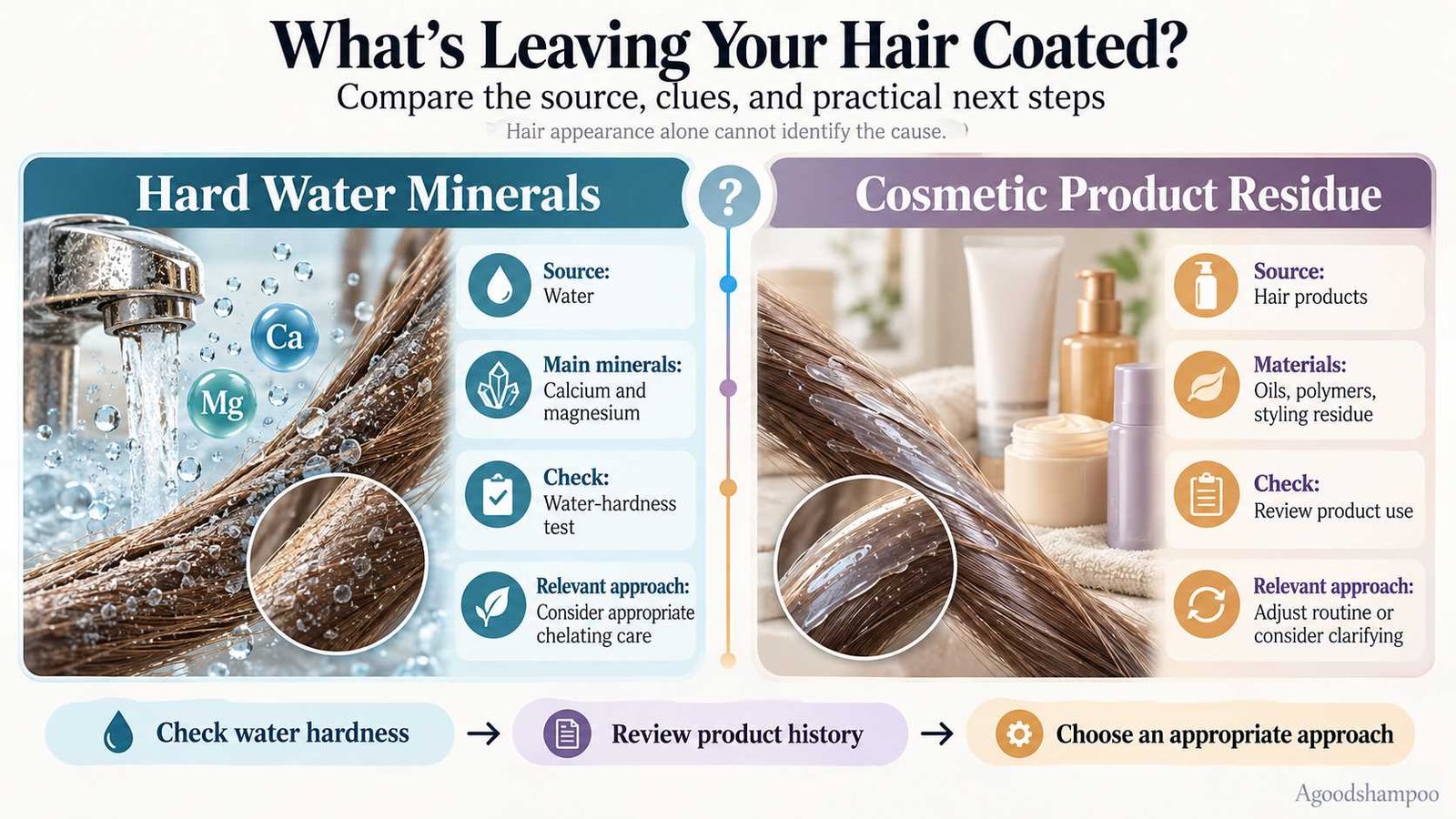
The most useful differences concern where the materials come from and what you can reasonably investigate.
| What to compare | Hard-water minerals | Cosmetic-product residue |
|---|---|---|
| Main source | Water containing calcium and magnesium | Conditioner, styling products, oils, and deposited ingredients |
| Common clues | Hair feels different after a water-supply change | Hair feels different after changing products or using more styling products |
| Other observations | Mineral scaling may appear on fixtures | Product accumulation may increase between washes |
| More informative check | Water-hardness test or supplier report | Review product history and simplify the routine |
| Relevant cleansing approach | A suitable chelating formula may help | Ordinary or clarifying cleansing may help |
| What appearance proves | Nothing conclusive | Nothing conclusive |
A white deposit on your showerhead may suggest mineral-rich water, but it does not establish that the same minerals are responsible for your hair’s texture.
Likewise, hair that feels waxy after using conditioner does not necessarily contain excessive product residue. It may simply be responding to a formula that provides more conditioning than you prefer.
Consider when the change began. If your hair felt normal until you moved to a different home, water quality is worth checking. If your water supply has stayed the same but your hair began feeling coated after introducing several styling products, investigate those products first.
Both factors can also exist together. Someone living in a hard-water area may use styling products that leave additional deposits, making it difficult to identify a single cause without changing one variable at a time.
For more detail on removing cosmetic residue, see our guide to how clarifying shampoo works.
How to Check Whether Your Water Is Hard
Water hardness is more useful when measured than guessed.
Start by checking whether your local water supplier publishes a water-quality report. Many utilities report hardness as milligrams per liter of calcium carbonate, abbreviated mg/L as CaCO₃.
The US Geological Survey uses the following general classifications:
| Water hardness | Classification |
|---|---|
| 0–60 mg/L | Soft |
| 61–120 mg/L | Moderately hard |
| 121–180 mg/L | Hard |
| Above 180 mg/L | Very hard |
If a local report isn’t available, a water-hardness test kit can provide an estimate. Follow the kit instructions carefully, including the units used.
Hardness may also be expressed in grains per gallon. One US grain per gallon is approximately 17.1 mg/L as CaCO₃.
Be careful not to confuse hardness with total dissolved solids, or TDS. A TDS meter estimates the concentration of dissolved substances based on electrical conductivity, but it cannot separately determine calcium-and-magnesium hardness.
Water may contain dissolved substances other than hardness minerals. Therefore, a high TDS reading does not automatically prove that the water is very hard.
If your household has a water-softening system, the actual hardness of water reaching your shower may also differ from the untreated supply.
Knowing the measured hardness helps you make a more informed decision, although it still cannot establish how much mineral material is present on your hair.
Clarifying vs. Chelating Shampoo: Which Addresses the Problem?
Clarifying and chelating describe different functions that can overlap within the same shampoo.
Clarifying shampoos target accumulated oils and cosmetic residue
A clarifying shampoo is generally formulated to provide more thorough cleansing of materials such as scalp oil, styling-product residue, and accumulated conditioning products.
Its performance depends on the cleansing system and supporting ingredients, not simply the word clarifying on the bottle.
Clarifying may be appropriate when hair feels heavy after repeated use of dry shampoo, styling creams, or other leave-in products.
However, more aggressive cleansing isn’t always better. Repeatedly removing too much lubrication can leave dry, bleached, or chemically treated hair feeling rough or difficult to detangle.
Our Neutrogena clarifying shampoo review provides a product-focused example of the considerations involved when choosing a clarifying cleanser.
Chelating ingredients interact with certain metal ions
Chelating agents bind metal ions through chemical interactions.
In hair-care formulas, ingredients such as disodium EDTA or tetrasodium EDTA can help manage metal ions and support formulation performance.
But finding EDTA on an ingredient label does not prove that a finished shampoo will remove a particular amount of mineral buildup from hair.
Concentration, pH, exposure time, other ingredients, and the overall formulation can influence performance. Some chelating agents are included primarily to improve product stability rather than to serve as a dedicated hair-mineral-removal treatment.
For this reason, a product marketed specifically for mineral deposits may be more relevant to hard-water concerns than an ordinary clarifying shampoo that has no verified chelating performance.
The distinction is about function, not a guarantee that one bottle will resolve every problem.
Choose cleansing strength according to your hair
If your hair is fine and weighed down by styling products, a suitable clarifying cleanser may be helpful occasionally.
If you’re dealing with verified hard water and suspect mineral deposition, investigate products formulated for that purpose rather than relying on a generic deep-cleansing claim.
People with colored, bleached, curly, or fragile hair should consider the product instructions and the possibility of additional dryness.
There is no universal weekly schedule for clarifying or chelating. Frequency depends on the particular formula, your hair condition, product use, and how your hair responds.
Why Water Filters and Home Remedies Are Not Always the Answer
Not every shower filter is a water softener.
Some shower filters are designed primarily to reduce chlorine or certain other substances. Reducing chlorine does not necessarily remove enough calcium and magnesium to significantly lower hardness.
Water softeners that use ion exchange operate differently, replacing hardness ions with other ions. If a shower device claims to soften water, look for credible performance information rather than relying on marketing language alone.
Home remedies also require caution.
Baking soda can be highly alkaline, and repeated use may increase roughness or irritation. Acidic rinses such as vinegar are sometimes promoted for mineral residue, but their effects depend on concentration, application, and the material involved.
Neither should be treated as a universally safe or proven solution for hair buildup.
Understanding the likely source of the residue is a better starting point than experimenting with increasingly aggressive treatments.
What Should You Change First: Your Water or Hair Products?
If hair began feeling stiff or difficult to manage after changing homes, check the water-hardness reading before replacing every product in your routine.
If the problem appeared after introducing conditioner, dry shampoo, styling cream, or hair oil, simplify those products first. Improve ordinary shampooing and observe whether your hair feels different over subsequent washes.
Where cosmetic residue is likely, occasional clarifying may help. Where verified hard water is a significant concern, a suitably formulated chelating product may be worth considering.
Persistent scalp itching, inflammation, sores, or unusual shedding should not be assumed to result from either kind of buildup. Those symptoms may need professional assessment.
The useful distinction is this: hard-water minerals originate in the water, while cosmetic buildup originates largely in the products used on your hair. Identifying the most plausible source helps you choose a sensible response without unnecessary treatments or product purchases.

Michael Chen focuses on the science behind shampoos and hair-care ingredients. He explains how cleansing agents, silicones, proteins, and other formula components work, separating useful evidence from marketing claims to help readers better understand the products they use.