 A good moisturizing shampoo should remove oil, sweat, dead skin, and styling residue without leaving your hair noticeably rough, tangled, or stripped after rinsing. That sounds simple, but the word moisturizing on a bottle doesn’t tell you how the entire formula will behave on your hair.
Shampoo formulas are built around surfactants, the cleansing ingredients that allow oil and debris to mix with water and rinse away. A review published in the International Journal of Cosmetic Science describes surfactants as the core of shampoo formulation and notes that their performance depends on the surfactant system as a whole, including cleansing, mildness, foaming, and deposition of conditioning agents.
That is why the best moisturizing shampoo isn’t automatically the richest formula, the most expensive bottle, or the one with the longest list of oils. The better choice is the formula that cleans enough for your scalp while leaving your particular hair manageable.
What Makes a Shampoo Genuinely Moisturizing?
Shampoo and conditioner have different jobs. Shampoo mainly cleans the scalp and hair. Conditioner coats and lubricates the hair fibers, helping with softness, detangling, and manageability.
The American Academy of Dermatology recommends concentrating shampoo on the scalp rather than rubbing it through the full length of the hair. This removes accumulated oil and products while reducing unnecessary drying of the lengths. Dermatologists also recommend conditioner after shampooing because it moisturizes, detangles, and makes hair easier to manage.
A moisturizing shampoo therefore doesn’t need to behave like a conditioner. What you want is an appropriate balance between cleansing and conditioning.
Depending on the formula, that balance may involve ingredients such as glycerin and other humectants, fatty alcohols, conditioning polymers, silicones, oils, or related ingredients that can improve how the hair feels during or after washing.
But ingredient spotting has limits. Finding argan oil, glycerin, aloe, or a silicone near the ingredient list doesn’t prove that the shampoo will suit you. The cleansing system, concentrations, ingredient interactions, and your own hair characteristics all matter.
For a closely related explanation, see our guide to hydrating shampoo for dry hair.
Look at the Cleanser Before the Moisturizing Claims
People often assume sulfate-free automatically means moisturizing. It doesn’t.
Sulfates are a family of surfactants, and different sulfate-containing shampoos can behave very differently. The same applies to sulfate-free formulas. Modern shampoos may combine several surfactants to adjust cleansing strength, foam, sensory feel, and mildness.
Instead of rejecting a shampoo because one ingredient name looks harsh, pay attention to what happens after several washes.
A suitable moisturizing shampoo should generally:
- Clean your roots without requiring repeated aggressive scrubbing.
- Leave the lengths reasonably easy to detangle after conditioning.
- Avoid making already-dry hair progressively rougher.
- Avoid leaving so much residue that fine hair becomes flat or greasy.
- Fit how frequently you actually wash your hair.
Wash frequency matters because scalp oil production varies. The American Academy of Dermatology advises washing according to how quickly hair becomes oily or dirty. Straight hair with an oily scalp may need much more frequent washing than dry, thick, curly, or textured hair.
This is also why a good gentle men’s shampoo isn’t really a separate formulation category. Hair and scalp needs matter more than whether the bottle is marketed to men or women. Someone with oily roots and fine hair may need more cleansing than someone with coarse, dry curls regardless of gender.
Match the Formula to How Your Hair Actually Behaves
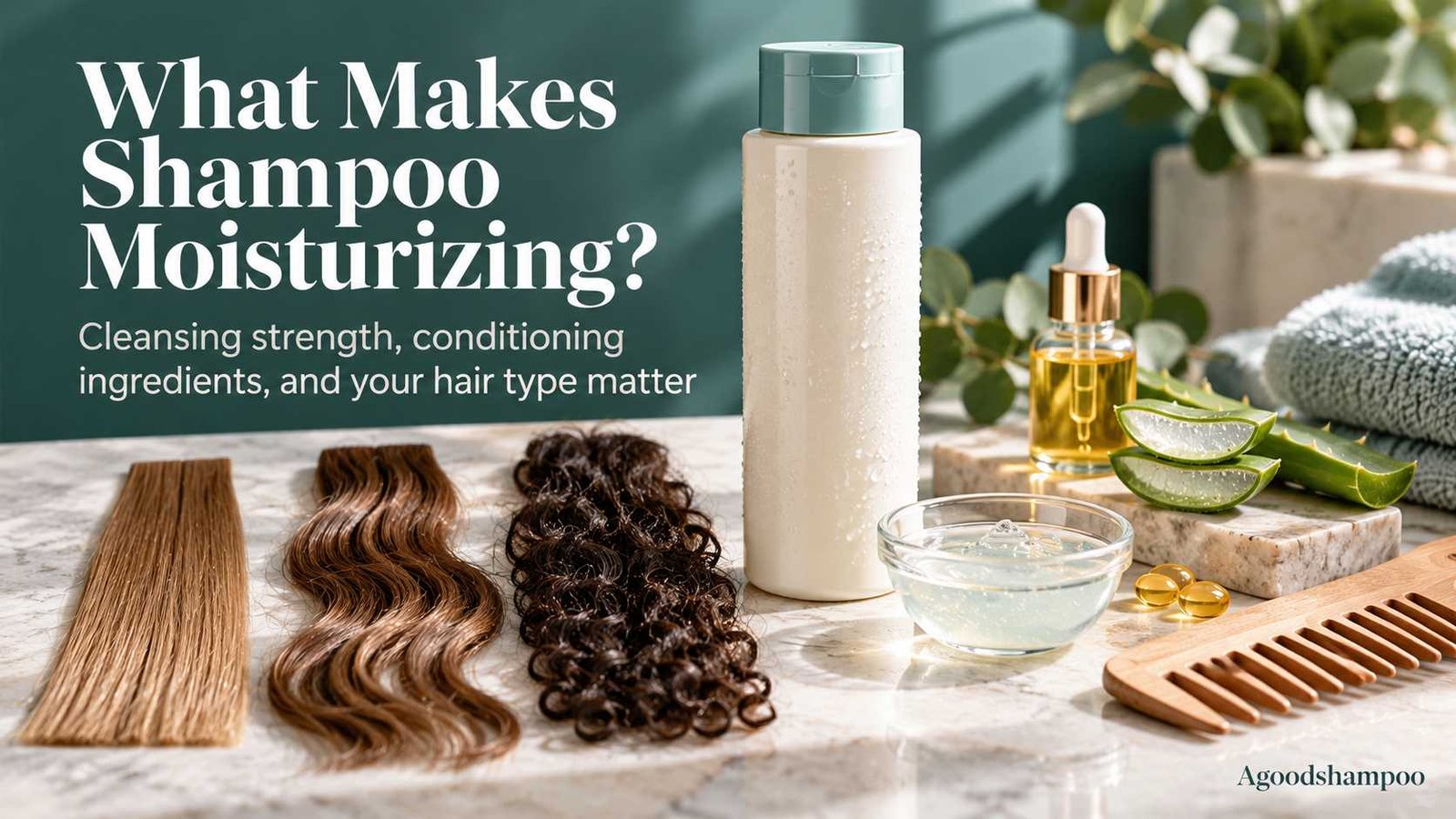
There is no single best shampoo for hair because hair types don’t need the same balance of cleansing and conditioning.
| Hair situation | What to look for | What may cause trouble |
|---|---|---|
| Fine, dry hair | Gentle cleansing with lightweight conditioning | Very rich residue that removes volume |
| Thick or coarse hair | Mild cleansing and stronger conditioning support | Frequent aggressive cleansing |
| Curly or coily hair | Moisture-focused routine and adequate conditioning | Overwashing or insufficient conditioning |
| Color-treated or damaged hair | Gentle cleansing and good after-wash conditioning | Repeated stripping and high heat |
| Oily scalp, dry ends | Effective scalp cleansing with targeted conditioning on lengths | Heavy shampoo applied repeatedly through the ends |
Curly hair deserves particular attention because dryness can be more noticeable. The American Academy of Dermatology advises keeping curly hair moisturized and notes that conditioning ingredients such as glycerin, argan oil, cetyl alcohol, and stearyl alcohol can be useful in conditioning products.
Fine hair presents the opposite problem. A very rich formula can technically contain plenty of conditioning ingredients yet leave the hair limp. The goal is not maximum conditioning. It is enough conditioning for your hair without sacrificing cleanliness and movement.
If your roots become greasy much sooner than your ends, see our guide to choosing shampoo for an oily scalp with dry hair.
Sometimes Dry-Feeling Hair Needs Clarifying, Not More Moisture
Hair that feels dull, coated, heavy, or strangely rough isn’t always simply lacking moisture.
Styling creams, oils, silicones, dry shampoo, conditioners, and other products can accumulate. In that situation, repeatedly switching to richer moisturizing shampoos may make the problem worse rather than better.
Dry shampoo is one example. The American Academy of Dermatology explains that dry shampoo absorbs oil but doesn’t actually clean the hair. Regular shampoo and water are still needed to remove oil, dead skin, microorganisms, and accumulated dry-shampoo particles. The AAD recommends washing with regular shampoo after one or two dry-shampoo uses rather than relying on it indefinitely.
If product residue is the issue, an occasional clarifying wash may make more sense. Our guide to what clarifying shampoos are good for explains when stronger cleansing can be useful.
Hard water creates another situation altogether. Minerals in water can deposit on hair, but ordinary clarifying and chelating shampoos shouldn’t automatically be treated as interchangeable. Chelating formulas are specifically designed around binding or helping remove mineral deposits.
Research comparing hair exposed to hard and deionized water has investigated measurable changes in hair strength, although this kind of study does not prove that every person using hard water needs a chelating shampoo.
If mineral buildup is your concern, our chelating shampoo guide for hard-water buildup is the more relevant next step.
How to Tell Whether Your Moisturizing Shampoo Is Working
Ignore the front label for a moment and judge the result across several washes.
Your shampoo is probably doing its job if your scalp feels clean, your hair doesn’t become progressively rough, and your normal conditioner can detangle the lengths without excessive effort.
Pay attention to these signals:
- Hair feels squeaky, rigid, or very tangled after every wash: cleansing may be stronger than your hair needs, or your conditioning routine may be insufficient.
- Roots become flat or coated quickly: the formula may be too conditioning for your scalp and hair density.
- Ends stay rough while roots feel fine: shampoo may not be the main problem. Your lengths may need better conditioner, leave-in care, less heat, or reduced mechanical damage.
- Hair remains dull despite richer products: buildup or hard water may need attention.
- Scalp burns, itches, develops sores, or stays inflamed: stop treating this as an ordinary dryness problem and consider professional assessment.
The AAD specifically recommends conditioner after washing and notes that dry or curly hair may benefit from conditioning the entire length rather than only the ends.
A moisturizing shampoo works as one part of that routine. It shouldn’t be expected to replace conditioner, repair severe structural damage, treat scalp disease, or change what happens at the hair follicle.
Who Should Choose a Moisturizing Shampoo?
A good moisturizing shampoo makes the most sense if ordinary cleansing repeatedly leaves your hair dry, rough, tangled, frizzy, or difficult to manage, especially if your hair is curly, coarse, color-treated, heat-styled, or naturally prone to dryness.
Choose a lighter formula if your scalp becomes oily quickly or rich shampoos leave your hair flat. Choose a clarifying shampoo when the main problem is accumulated styling residue. Consider a chelating product when hard-water minerals are the more likely issue.
And don’t judge a shampoo simply by sulfate-free claims, botanical ingredients, or words like hydrating and nourishing on the front of the bottle. The better question is whether its complete cleansing system matches your scalp while leaving your hair in a condition that your normal conditioning routine can manage.
That is what makes a moisturizing shampoo genuinely good for your hair.

Marlena Stell makes everyday hair care easier to understand. From choosing a shampoo to managing common hair concerns, she breaks down confusing product claims and practical routines into straightforward advice that helps readers find what works for their needs.