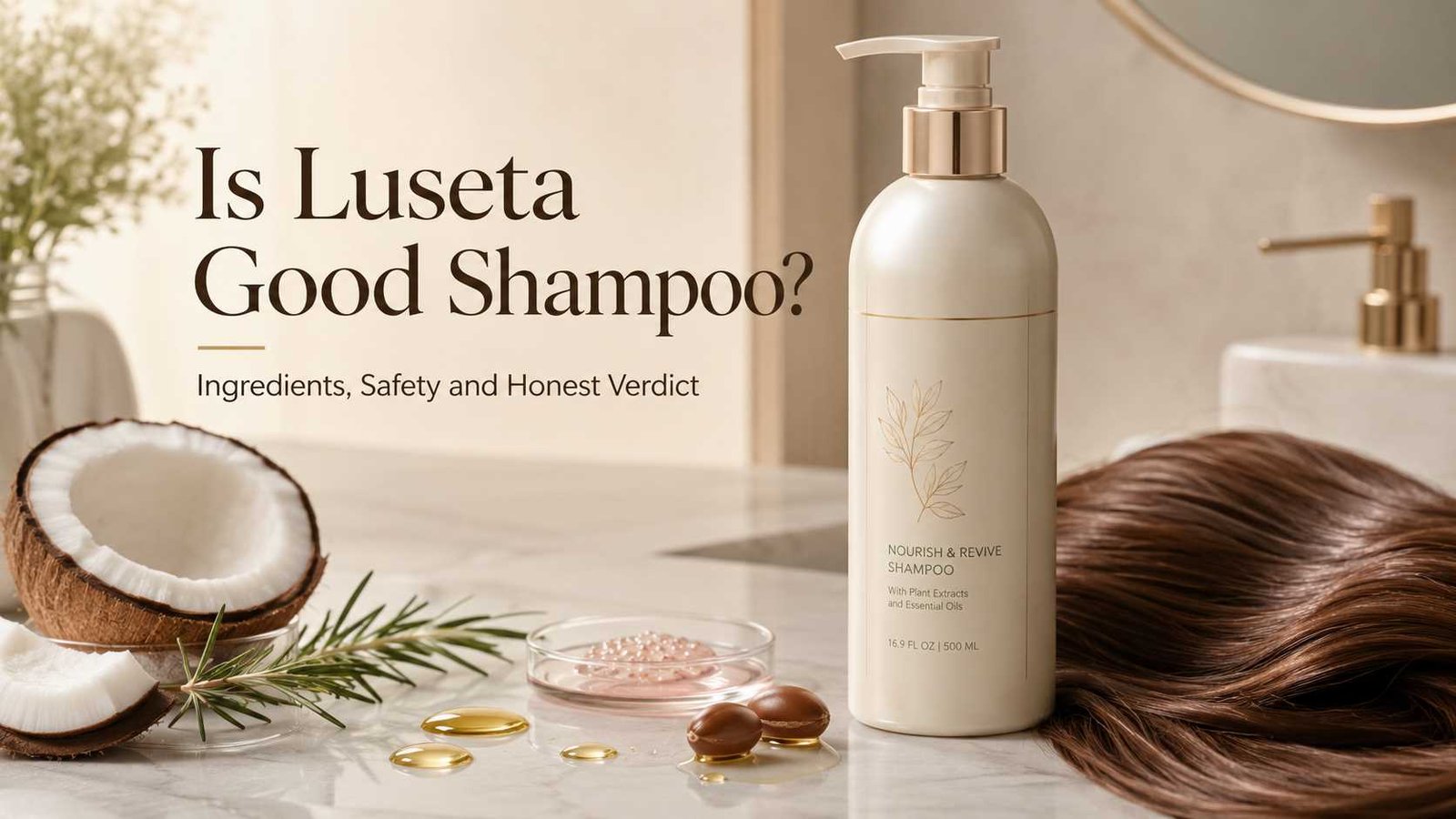
Is Luseta Good Shampoo? Ingredients, Safety and Honest Verdict
 You see Luseta on a shelf and it looks expensive.
Big bottles. Clean labels. Keratin. Biotin. Collagen. Argan oil. Rosemary. Manuka honey. Pretty much every ingredient people search for when their hair feels dry, flat, damaged, or just plain tired.
Then you see the price and think, wait… is Luseta actually good shampoo, or is this another nice bottle full of clever marketing?
I had the same question when I started looking at the formulas.
My short answer is yes. Luseta makes some genuinely good shampoos, especially for people who want salon-style hair care without paying luxury salon prices. But I wouldn’t call every Luseta shampoo gentle, and I definitely wouldn’t believe every hair-growth claim word for word.
The interesting part is hidden on the back of the bottle.
Some Luseta formulas use mild cleansing systems that I really like. Others use stronger cleansers that may work beautifully on an oily scalp but leave very dry, curly, bleached, or sensitive hair asking for mercy.
So the brand itself is good.
The trick is choosing the right Luseta shampoo.
So, is Luseta a good hair shampoo?
For most people, yes.
Luseta sits somewhere between regular drugstore shampoo and expensive salon hair care. The company says it was founded in 2011, is based in Los Angeles, and formulates and manufactures its products in the United States. Luseta also describes its formulas as salon-grade, sulfate-free, paraben-free, cruelty-free, and safe for color-treated hair.
Those are nice claims. I care more about what is inside the bottle.
And that’s where Luseta gets interesting.
Take its Biotin & Collagen Shampoo. The current formula starts with water, cocamidopropyl betaine, sodium cocoyl isethionate, glycerin, disodium laureth sulfosuccinate, and coco-glucoside. It also contains dimethicone, Polyquaternium-10, coconut oil, argan oil, hydrolyzed collagen, and biotin.
That’s not a cheap, bare-bones cleanser.
You have several cleansing agents working together rather than relying on one aggressive detergent. You also get glycerin for moisture, conditioning polymers for smoother feel, silicone for slip and shine, and small amounts of oils and proteins.
From a formulation point of view, that makes sense.
A scientific review of modern shampoo technology explains that shampoos normally combine surfactants with conditioning and care ingredients. Another dermatology review notes that a well-formulated shampoo can clean regularly without automatically damaging healthy hair.
That’s pretty much where I land with Luseta.
The formulas aren’t magical.
But several of them are well thought out.
What I like most about Luseta shampoo
The first thing I noticed was that Luseta doesn’t use the exact same shampoo base and slap a different ingredient on every bottle.
That happens more than people realize.
Luseta’s Biotin & Collagen Shampoo, for example, relies heavily on cocamidopropyl betaine, sodium cocoyl isethionate, disodium laureth sulfosuccinate, and coco-glucoside. Its Keratin Shampoo uses a very similar mild-looking cleansing system.
But the Rosemary Mint Complex Shampoo is different.
Its second ingredient is sodium C14-16 olefin sulfonate, followed by cocamidopropyl betaine. The same strong cleanser appears near the top of the Manuka Honey Shampoo and several other Luseta formulas.
That tells me Luseta actually builds shampoos for different cleaning needs.
Now, don’t let the word sulfate-free confuse you.
Sodium C14-16 olefin sulfonate isn’t a sulfate. So yes, a shampoo containing it can truthfully be called sulfate-free.
But that doesn’t automatically make the shampoo mild.
Research on hair-care chemistry shows that strong anionic surfactants can remove surface oils and contribute to a rougher, drier hair feel when cleansing becomes too aggressive.
This is one of those little shampoo-label tricks that matters in real life.
Your hair doesn’t care whether the front label says sulfate-free.
It cares how strong the whole cleansing system feels after three washes.
Quick ingredient breakdown
| Ingredient | Why Luseta uses it | My take |
|---|---|---|
| Cocamidopropyl betaine | Cleansing and foam | Usually useful in blended cleansing systems |
| Sodium cocoyl isethionate | Cleansing | Often gives a softer-feeling wash than traditional strong sulfate systems |
| Sodium C14-16 olefin sulfonate | Deep cleansing | Good for oil and buildup, potentially drying for fragile hair |
| Glycerin | Moisture support | A useful humectant |
| Dimethicone | Smoothness and shine | Helpful for frizz and damaged lengths, though some people dislike silicone buildup |
| Polyquaternium-10 | Conditioning and slip | Helps reduce rough feel after washing |
| Argan oil | Conditioning and protection | Has some interesting research behind its protective effects |
| Hydrolyzed collagen or keratin | Surface conditioning | Can help hair feel fuller or stronger, but doesn’t permanently rebuild damaged hair |
| Biotin | Marketing and hair-care support | Don’t expect shampoo biotin to cure hair loss |
| Fragrance | Scent | Fine for many people, but worth avoiding if your scalp reacts easily |
And this is why I wouldn’t give every bottle the same score.
Formula matters more than brand name.
The Biotin & Collagen Shampoo may be Luseta’s safest starting point
If someone asked me which Luseta shampoo I’d try first without knowing much about their hair, I’d probably look at Biotin & Collagen.
Not because biotin is some miracle ingredient.
Actually, quite the opposite.
I like the shampoo because of its base formula.
Cocamidopropyl betaine, sodium cocoyl isethionate, disodium laureth sulfosuccinate, and coco-glucoside form the main cleansing system. Glycerin appears high on the list. You also get dimethicone and Polyquaternium-10 for conditioning, followed later by coconut oil, argan oil, hydrolyzed collagen, biotin, and a peptide called Tripeptide-1.
That’s a nice combination for hair that feels dull, thin, dry, frizzy, or slightly damaged.
What I would not do is buy it expecting dormant follicles to suddenly start producing thick new hair.
Luseta says the shampoo helps hair look stronger, fuller, thicker, and healthier. That wording is much more believable than treating it like a medical hair-loss treatment.
Biotin gets wildly overhyped in the hair world.
A published review of biotin and hair loss found only 18 reported cases meeting its review criteria, and all of those people had an underlying condition linked with poor hair or nail growth. The authors found insufficient evidence to support biotin supplementation for hair growth in otherwise healthy people.
And that’s oral biotin research.
A rinse-off shampoo has even less reason to be treated like a hair-loss medicine.
So if Luseta Biotin & Collagen makes your hair look thicker, I would credit much of that effect to cleansing, conditioning, reduced roughness, coating of the fiber, and improved body rather than assuming new follicles suddenly appeared.
Still useful.
Just less glamorous than the marketing.
What about argan oil?
This ingredient deserves a little more respect.
Luseta uses argan oil in several products, including Biotin & Collagen Shampoo, Biotin B-Complex Thickening Shampoo, Manuka Honey Shampoo, and other formulas.
A 2022 study tested argan oil as a pretreatment before exposing human hair samples to oxidative damage. Hair treated with argan oil showed significantly lower protein loss, and researchers concluded that the oil helped protect the fibers from oxidative damage.
That’s useful evidence.
But there’s a catch.
The research treated hair with argan oil before damaging it. That’s not the same thing as putting a small amount of argan oil into shampoo and rinsing it off after a minute.
So yes, I like seeing argan oil.
No, I wouldn’t buy Luseta only because the label says argan oil.
The complete formula still matters more.
Luseta Keratin Shampoo is better suited to damaged hair
Bleach. Highlights. Flat ironing. Chemical straightening. Constant blow-drying.
Hair eventually starts keeping score.
If your ends feel rough and grabby when they’re wet, Luseta Keratin Shampoo makes more sense to me than something like the stronger Rosemary Mint formula.
The current Keratin Shampoo ingredient list begins with water, cocamidopropyl betaine, sodium cocoyl isethionate, glycerin, disodium laureth sulfosuccinate, and coco-glucoside. It also contains dimethicone, Polyquaternium-10, coconut oil and, farther down the formula, hydrolyzed keratin-related conditioning ingredients.
That cleansing base looks more appropriate for hair that already has damage.
The shampoo will not permanently glue broken hair back together.
Nothing in a normal rinse-off shampoo can turn severely bleached hair into untouched virgin hair again.
What it can do is make damaged strands behave better.
Smoother cuticles mean less tangling. Conditioning agents can lower friction. Silicones can improve slip and shine. Proteins and film-forming ingredients may temporarily improve the feel of porous areas.
And sometimes that’s exactly what you need.
Your hair doesn’t have to become biologically younger.
It just needs to stop feeling like straw.
One extra detail matters for vegan shoppers. Luseta says most of its products are vegan, but its Keratin Shampoo and several other keratin products contain hydrolyzed keratin derived from sheep’s wool.
So cruelty-free and vegan aren’t the same thing here.
The Rosemary Mint Shampoo is where I’d be more careful
Rosemary hair products are everywhere now.
I get the appeal. They smell fresh. They make the scalp tingle. And people associate rosemary with hair growth.
But look beyond the rosemary.
Luseta Rosemary Mint Complex Shampoo starts with water and sodium C14-16 olefin sulfonate, followed by cocamidopropyl betaine. It also contains dimethicone, fragrance, glycerin, coconut oil, panthenol, mint oil, and other conditioning ingredients.
That doesn’t make it bad.
Actually, if your scalp gets greasy quickly, you use lots of styling products, or lighter shampoos leave you feeling dirty, you may love it.
But I wouldn’t automatically choose it for bleached curls, very dry coils, or an easily irritated scalp.
Here’s my little rule.
If your hair feels clean, light, and soft after shampooing, great.
If it squeaks, knots immediately, or feels rough while you’re still in the shower, your cleanser may simply be stronger than your hair needs.
No ingredient trend can fix that mismatch.
Is Luseta a safe brand?
Based on the formulas and company information I reviewed, I don’t see a reason to label Luseta an unsafe shampoo brand.
The company says its products are dermatologist-tested, cruelty-free, color-safe, free from harsh sulfates, and designed with ingredient-led formulas. Luseta also says it does not test its products on animals.
Still, I want to keep the word safe in perspective.
Cosmetics sold in the United States do not generally receive FDA premarket approval, apart from certain color additives. Manufacturers have the legal responsibility to make sure their cosmetic products are safe when used as directed.
So don’t read dermatologist-tested as FDA-approved.
Those are completely different ideas.
Also, a perfectly legal shampoo can still irritate one person’s scalp.
Luseta formulas commonly contain fragrance. Several also contain cocamidopropyl betaine. Most people use that ingredient without trouble, but allergic contact reactions have been documented. One published report described 20 cases linked with cosmetic exposure, mainly shampoos and shower gels.
That doesn’t mean cocamidopropyl betaine is dangerous.
It means skin is weird.
Mine may love something yours hates.
If your scalp burns, becomes very itchy, develops a rash, or suddenly flakes badly after switching shampoo, stop using the product instead of trying to convince yourself that your scalp is detoxing.
Shampoo doesn’t need to hurt to work.
What about parabens, sulfates, and all those scary words?
Luseta makes a big point of being sulfate-free and paraben-free.
That’s useful if you’re specifically trying to avoid those ingredients.
But I wouldn’t use those two claims as my entire definition of a good shampoo.
Parabens are preservatives. Preservatives matter because water-based cosmetics can support microbial growth if they aren’t properly protected. The FDA explains that preservatives are used in cosmetics to help prevent harmful bacteria and mold from growing.
Removing parabens simply means another preservation system has to do the job.
Luseta commonly uses ingredients such as phenoxyethanol, sodium benzoate, and related preservation helpers instead. You can see these throughout its current ingredient lists.
Same story with sulfates.
Sulfate-free may be helpful for some hair types, but it doesn’t tell you how mild the shampoo is.
The whole formula tells you that.
Is Luseta shampoo salon grade?
Luseta says yes.
The brand states that its products are formulated to salon-grade standards and describes itself among professional hair-care brands. Product pages also use terms such as salon-quality formulas and salon-inspired hair care.
Would I personally call it salon quality?
Yes, with a small asterisk.
I’d call Luseta salon-style or premium mass-market hair care.
Here’s why.
The formulas contain the types of blended cleansing systems, conditioning polymers, silicones, humectants, proteins, oils, and targeted additives you’d expect to see in many premium formulas.
The price is much friendlier, though. At the time I checked the brand’s site, several 16.9-ounce Luseta shampoos were listed around $16, while 33.8-ounce sizes were around $27.
That’s one reason the brand is interesting.
You’re getting a big bottle without immediately wandering into $30-to-$50 shampoo territory.
But here’s the important part.
Salon grade isn’t some magic chemical category.
A shampoo doesn’t suddenly become better because a stylist can use it.
I care about surfactants, conditioning ingredients, hair compatibility, performance, scalp comfort, and how often you need to use it.
Your shower doesn’t know whether you bought the bottle at a salon.
Neither does your hair.
Is Luseta a professional hair brand?
I would describe Luseta as a professional-inspired hair-care brand that also sells directly to everyday consumers.
The brand itself uses professional and salon-quality language, and its range is much broader than a simple shampoo-and-conditioner company. Luseta currently markets shampoos, conditioners, hair masks, oils, serums, styling products, heat protectants, scalp products, and different lines for moisture, volume, curls, frizz, color, and scalp cleansing.
It is also sold through mainstream retail channels. Walmart, for example, currently lists multiple Luseta shampoos and places some within its premium shampoo section.
So I wouldn’t think of Luseta as an exclusive salon-only brand.
It’s more accessible than that.
And frankly, that’s not a weakness.
What do people actually seem to like about it?
Real-world feedback matters because ingredient lists can’t tell you everything.
They can’t tell you whether a shampoo smells amazing.
They can’t tell you whether a pump drives you mad.
They can’t fully predict whether your fine hair will feel bouncy or flattened by Friday afternoon.
Luseta has built a decent consumer following. Walmart’s current listing for the Keratin Shampoo shows a rating around 4.6 out of 5 from hundreds of reviews, while its Rosemary Mint Shampoo has also collected hundreds of reviews with a rating in the high four-star range. Those numbers can change, of course, and retailer reviews aren’t controlled clinical trials.
Allure also reviewed Luseta’s Manuka Honey shampoo and conditioner favorably, with the reviewer describing clean, soft, shiny results as part of a regular weekly wash routine.
I don’t treat those experiences as proof that you’ll get identical results.
But they do tell us something useful.
Luseta isn’t just a pretty bottle nobody actually enjoys using.
Who will probably like Luseta most?
This is where I’d make the decision.
If your hair is dry or damaged, I’d lean toward the Keratin or Biotin & Collagen formulas because their cleansing systems look more balanced for stressed hair.
Fine hair that feels limp may also enjoy Biotin & Collagen, though go easy on conditioner if your roots flatten easily.
If you have an oily scalp, heavy product buildup, or wash infrequently, Rosemary Mint, Manuka Honey, Coconut Milk, and other formulas built around sodium C14-16 olefin sulfonate may give you the stronger clean you’re after.
Very dry curls and coils are trickier.
Some Luseta products may work beautifully, especially when paired with a rich conditioner or mask. But I’d inspect the cleanser first instead of blindly buying whatever bottle says coconut, honey, or rosemary.
The hero ingredient on the front isn’t always the ingredient doing most of the work.
That sentence will save you a surprising amount of money.
Who might want to skip it?
I’d think twice about Luseta if fragrance usually bothers your scalp.
Fragrance appears in many of the formulas I reviewed. The FDA notes that fragrance ingredients can be declared collectively as fragrance rather than listing every component separately, which can make things harder for people trying to track a specific fragrance sensitivity.
I’d also be cautious if you have known sensitivity to cocamidopropyl betaine because it appears in many Luseta shampoos.
And if you’re dealing with actual hair loss rather than breakage or flat-looking hair, don’t depend on a biotin, collagen, rice water, or rosemary shampoo to diagnose or treat the cause.
The FDA specifically distinguishes ordinary cleansing shampoos from products making drug-style claims such as restoring hair growth.
Hair shedding can come from many things.
A shampoo bottle can’t tell you why it’s happening.
Is the price worth it?
I think this is one of Luseta’s stronger points.
A current 16.9-ounce Biotin & Collagen bottle is listed at $16 on Luseta’s website, and several other core shampoos sit around the same price. Large 33.8-ounce sizes are also available in many ranges.
That’s not dirt cheap.
But it’s not painful either.
For a shampoo with a more polished formula and premium feel, I think the value is fair.
I’d rather spend around that amount on a formula matched to my hair than pay twice as much simply because something comes from an exclusive salon.
Hair care gets expensive fast.
More expensive doesn’t automatically mean more compatible.
My Luseta shampoo rating
I’d give the brand about 8 out of 10 overall.
The strongest point is choice. You can find gentler-looking cleansing systems, stronger clarifying-style formulas, repair-focused products, volume products, color care, scalp care, and rich conditioning ranges.
I also like that several formulas include ingredients that genuinely improve how hair feels rather than relying completely on trendy extracts.
Where Luseta loses points is marketing.
Words like biotin, collagen, rosemary, keratin, honey, and rice water can make a bottle sound almost medicinal.
Most of the real cosmetic benefit still comes from familiar shampoo chemistry.
Good cleansing.
Good conditioning.
Less friction.
Better softness.
Better shine.
Maybe less breakage.
That’s not boring.
That’s what a shampoo is supposed to do.
https://www.youtube.com/watch?v=WcpjFj8j02E
Is Luseta Good Shampoo? My final verdict
Yes, Luseta is good shampoo overall, and I’d comfortably put several of its formulas above basic drugstore shampoo.
But don’t buy by brand name alone.
The Biotin & Collagen and Keratin shampoos are the Luseta products I’d look at first for dry, damaged, frizzy, or processed hair because their cleansing bases look more balanced to me.
For oily hair or heavy buildup, some of the sodium C14-16 olefin sulfonate formulas may make more sense.
And if you’re hoping Luseta will regrow thinning hair simply because the bottle contains biotin or rosemary, lower that expectation.
A good shampoo can make hair look fuller, smoother, shinier, and healthier.
It can help reduce roughness and breakage.
It can make wash day way less annoying.
That’s already a win.
It doesn’t need to pretend to be medicine.
So yes, I’d call Luseta a legitimate salon-inspired hair-care brand with several well-designed shampoos and pretty reasonable pricing. Just turn the bottle around before you fall in love with whatever trendy ingredient is printed on the front.
Your hair type gets the final vote.

Michael Chen combines scientific expertise with hair care industry insights to offer well-researched product evaluations and tips for optimal hair health.